The Triangle of Bureaucratic Policy Analysis and the Professional Types of High-Level Civil Servants: Empirical Evidence from Southern Europe

Public policy and public administration research has focused on conceptualizing bureaucrats as pivotal actors in the policymaking process. This has allowed scholars to investigate the capacities and skills of bureaucrats as policymakers and how advice and knowledge inform their behavior. Nevertheless, the literature has proceeded in a fragmented way and without a sophisticated analytical framework that would allow for comparative research. Our recent study aims to address this by proposing a new framework for understanding how high-level civil servants—those at the top of national public administrations—engage in policymaking through the lens of policy analysis.

This study asks a central question: How can we better conceptualize the professional role of senior civil servants in the policy process? To answer this, we developed the “triangle of bureaucratic policy analysis,” which connects three core dimensions of bureaucratic work:

  • Policy Work: What bureaucrats do on a daily basis (e.g., advising, managing, steering).
  • Policy Analytical Capacity: What analytical skills and techniques they use (e.g., economic, legal, statistical).
  • Sources of Information: Where they get their information (e.g., laws, government reports, statistical data).

Figure 1. Triangle of bureaucratic policy analysis.

We applied this framework to a unique dataset: a large survey of 1,014 senior civil servants in the central governments of Greece, Italy, Portugal, and Spain. These countries share a “Napoleonic” administrative tradition and do not typically employ specialized policy analysts, making them ideal cases for examining how policy analysis functions without formal structures.

We used factor analysis to identify patterns in how civil servants combine work, skills, and information. Then, we used principal component analysis (PCA) to cluster these patterns into three main professional “types” of high-level bureaucrats:

  1. Political Generalist: A flexible coordinator and boundary-spanner. These bureaucrats steer ministry activities, interact with politicians and stakeholders, and rely on a broad mix of information sources. They possess “eclectic” analytical capacities—skills gained through both training and professional experience—and play a central role in aligning government priorities across sectors.
  2. Legal Advisor: True to Southern Europe’s legalistic traditions, these civil servants focus on advising political leaders using legal and regulatory tools. Their policy work revolves around assessing legal feasibility, and they rely heavily on juridical sources of information. Their analytical expertise is narrowly focused on legal techniques.
  3. Manager: A newer type, these officials emphasize implementation and results. They are more empirically oriented, favoring evidence-based data and economic analysis. Their policy work includes program management and performance monitoring, reflecting the influence of New Public Management reforms.

Each of these types reflects a different way that bureaucrats contribute to policymaking—one political and strategic, one legalistic, and one managerial.

Image Description

Figure 2. (a) Empirical types of high-level civil servants in Southern Europe: Type 1 (political generalist). (b) Empirical types of high-level civil servants in Southern Europe: Type 2 (legal advisor). (c) Empirical types of high-level civil servants in Southern Europe: Type 3 (manager).

This study contributes to a growing recognition that senior civil servants are more than passive implementers—they are policy actors with distinct analytical profiles. Our “triangle” approach offers a new way to classify and understand how bureaucracies influence policymaking, moving beyond simplistic divides like “generalist vs. specialist” or “bureaucrat vs. politician.” Moreover, these insights are relevant for reform efforts, helping policymakers assess whether administrative roles and skills are well-matched—and whether bureaucrats are being utilized effectively across different policy challenges.

You can read the original article in Policy Studies Journal at

Capano, Giliberto, Alice Cavalieri and Andrea Pritoni. 2025. “The Triangle of Bureaucratic Policy Analysis and the Professional Types of High-level Civil Servants: Empirical Evidence From Southern Europe.” Policy Studies Journal 53(1): 69–90. https://doi.org/10.1111/psj.12577.

About the Article’s Authors

Giliberto Capano is a professor of Public Policy at the University of Bologna, Italy. He specializes in public administration, public policy analysis, and comparative higher education. His research focuses on governance dynamics and performance in higher education and education, policy design and policy change, policy instruments’ impact, the social role of political science, the policy impact of COVID-19, and leadership as an embedded function of policy making. His recent books are A modern Guide to Public Policy (coedited with M. Howlett, Edward Elgar, 2020); Convergence and Diversity in the Governance of Higher Education (coedited with D. Jarvis, Cambridge University Press, 2020); Trajectories of Governance How States Shaped Policy Sectors in the Neoliberal Age (coauthored with A. Zito, J. Rayner, and F. Toth, Palgrave, 2022); The Fate of Political Scientists in Europe (with Luca Verzichellli, Palgrave, 2023). 

Alice Cavalieri is a post-doctoral researcher at the University of Trieste (Italy), where she works on a project about the response of parliaments and governments to different crises. Her main research interests are public budgeting and women’s representation. Her first book, Italian Budgeting Policy (Palgrave Macmillan; 2023), has been awarded the “Pietro Grilli di Cortona” Biannual Prize for the best book published by a member of the Italian Political Science Association. She is a member of the Italian team of the Comparative Agendas Project and former country lead for Italy of the OxCGRT led by the Blavatnik School of Government (University of Oxford).

Andrea Pritoni is an associate professor of Political Science in the Department of Arts at the University of Bologna, where he teaches Electoral Campaigns in Italy and Institutional Relations and Advocacy. His main research interests relate to Italian politics, lobbying and interest group politics, as well as comparative public policy. He has recently published articles on South European Society & Politics (2024), International Review of Administrative Sciences (2024) and European Political Science (2024).

Institutional Fit and Policy Design in Water Governance: Nebraska’s Natural Resources Districts 

by Tomás Olivier & Sechindra Vallury

Water governance is a critical challenge that demands locally tailored solutions to address diverse social and ecological conditions. Our new paper explores this through Nebraska’s Natural Resources Districts (NRDs)—a basin-level governance arrangement created to manage groundwater resources. We investigated how well NRDs design policies to fit their local social-ecological contexts and the influence of broader institutional mandates on those policies.

The overarching goal of our research was to bridge the gap between institutional fit and policy design literature. To do this, we aim to better understand the drivers behind institutional fit—how well governing arrangements address local resource challenges—and the mechanisms shaping policy design in decentralized governance systems like Nebraska’s NRDs. Our research question was: how do actors in governing arrangements design policy outputs to fit to their social, ecological, and institutional environment?

Image Description

Figure 1. Nebraska’s Natural Resource Districts and the status of their Integrated Management Plans. The map was generated using data provided by the Nebraska Department of Natural Resources.

Nebraska’s NRDs are an ideal case for examining institutional fit. Established in 1972, these districts are defined by river basins and tasked with managing shared resources like water, soil, and land. Each NRD develops its own management plans and groundwater rules, which vary widely due to differing local conditions such as precipitation, population, and agricultural needs. This setting allows for a comparative study of how context influences policy design across NRDs.

Using topic modeling, k-means clustering, and fuzzy-set Qualitative Comparative Analysis (fsQCA), we analyzed Integrated Management Plans (IMPs) and Groundwater Management Rules and Regulations (GMRRs) produced by 23 NRDs. We found evidence that the design of NRD outputs (plans and rules) aligned with local biophysical conditions. NRDs in areas with higher precipitation or greater groundwater demand tended to emphasize water management priorities tailored to those conditions. For instance, NRDs in drier western Nebraska prioritized policies addressing groundwater scarcity, as illustrated by their IMPs’ focus on water quantity controls (see Figure 2).

Image Description

Figure 2. Topic model of stemmed text from Integrated Management Plans of 23 Natural Resource Districts.

Our results also suggested that NRDs with a state mandate to develop Integrated Management Plans (IMPs) produced more distinct, context-sensitive policy outputs than those without mandates. NRDs with state-mandated IMPs showed lower textual similarity across their policy outputs, indicating more tailored responses to local conditions. Voluntary IMPs, on the other hand, often relied on boilerplate language, reflecting less contextual customization.

The fsQCA analysis identified multiple pathways for achieving institutional fit, involving combinations of factors like population size, precipitation, and state mandates. For example, NRDs with large populations and high precipitation but no state mandate tended to produce outputs with less focus on enforcement mechanisms, highlighting how context shapes policy emphasis (see Table 2).

Image Description

This study underscores the importance of institutional fit in natural resource governance. It shows that decentralized systems like Nebraska’s NRDs can successfully tailor policies to local contexts, particularly when supported by state-level guidance. However, the reliance on voluntary planning can lead to inconsistent levels of customization, raising questions about equity and effectiveness across districts.

You can read the original article in Policy Studies Journal at

Olivier, Tomás and Sechindra Vallury. 2024. “ Institutional Fit and Policy Design in Water Governance: Nebraska’s Natural Resources Districts.” Policy Studies Journal 52 (4): 809–832. https://doi.org/10.1111/psj.12550.

About the Authors

Tomás Olivier is an Assistant Professor of Public Administration and the Assistant Director of the Center for Policy Design and Governance at the Maxwell School of Citizenship & Public Affairs at Syracuse University.

Follow him on Bluesky: @tomasolivier.bsky.social

Sechindra Vallury is an Assistant Professor of Environmental Policy at the Odum School of Ecology and the Director for Policy at the River Basin Center, University of Georgia. 

Follow him on Bluesky: @sechindra.bsky.social


Rethinking Policy Piloting: Managing Uncertainty in the Policy Process

by Sreeja Nair

As governments grapple with uncertainties associated with complex policy issues such as climate change, digital transformation, pandemics and Artificial Intelligence, the role of policy piloting and experimentation will be key in shaping policy choices. Designing policies as pilots and experiments “in theory” permits governments a safe space to test new and alternative policy designs and learn from them. There are, however, challenges in realizing the potential of pilots to do so in practice. In my book Rethinking Policy Piloting, I study design features of selected policy pilots that were launched to manage risk and uncertainty in the agriculture sector in India. Despite their technical merit, pilots—just as regular policies—are prone to political influences, which can alter their expected performance on implementation. This is then an interesting departure from a common sentiment, “When in doubt, just pilot.”

Drawing from literature on policy experimentation, scaling-up, and policy change, I develop a theoretical model with four conditions hypothesized to influence a pilot’s outcomes in terms of its policy translation. These conditions are 1) the pilot’s vision to scale-up, 2) stakeholders governing the pilot, 3) semblance of the pilot’s objectives and 4) semblance of the pilot’s instruments (to reach set objectives) to a policy it was designed to improve or replace. Thirteen policy pilots launched by the central Ministry of Agriculture and Farmers Welfare, Government of India to address risks and uncertainties in agriculture production were selected for a comparative case analysis. These pilots spread across 25 years starting from 1990—the decade that saw liberalization and decentralization reforms in India to 2015.

The pilots aimed at increasing crop productivity and reducing risks to agricultural production following a period of demonstration and evaluation and involved testing of different policy elements for guiding national agriculture policy. While some were intended to be incremental measures to support current policy programmes, others proposed new models and innovations to reform and replace the same. Semi-structured interviews were conducted with those involved in design and implementation or evaluation of the pilots. Thick case narratives along with a Qualitative Comparative Analysis helped understand how variations in the four conditions influenced the outcomes of each pilot.

The analysis reveals three key insights. First, pilots can survive in different forms without scaling-up fully and still contribute meaningfully to improved policy design. Second, successful design, implementation, and scaling up of pilots is not automatic and involves a tussle between its technical merit and political appeal. Pilots come with the risk of failure and associated reputational consequences to the policymaker and thus might often be conservative, proposing only marginal changes to current policies. Third, a departure from conservative pilots is seen when non-governmental actors are involved, which could be attributed to risk-sharing in case of failure.

Rethinking Policy Piloting makes an appeal to policymakers to experiment more considering these as opportunities to improve policy design, and to researchers to regulate their enthusiasm around expected outcomes from pilots considering the politics that surrounds them- just as routine policies.

About the Author

Sreeja Nair is an Assistant Professor at the Lee Kuan Yew School of Public Policy, National University of Singapore. She studies how governments manage risk and uncertainty in the policy process, focusing on the interplay of science and politics. Her research examines varied policy tools, in particular pilots and experimentation, for addressing high uncertainty in planning for climate change, sustainability transitions and digital transformation. Follow her on X/Twitter: @Sreeja_Nair01

Policy Design Receptivity and Target Populations: A Social Construction Framework Approach to Climate Change Policy

by Chris Koski & Paul Manson

Climate change is by any definition a wicked problem with myriad potential policy tools and even more potential targets. Policymakers face difficult political choices when designing policies to combat climate change. Among these choices are who should bear the costs and benefits of various policy tool options. Policy tools can be carrots and sticks, and policymakers assign these differently based on who will receive either option. Previous attempts to address climate change at the federal level have largely relied on subsidies and guidance rather than rules and punishment. Winners in these choices have been those with power to influence outcomes.

Previous research on federal climate policy has sought to explain failure both in legislation and executive action. Why have efforts to establish a carbon market in the US failed?  What was the source of demise for the Obama administration’s Clean Power Plan (and can Biden breathe life into it)?  Public opinion research has focused on understanding support for climate policies, including very specific proposals (e.g. cap and trade). Missing from this work is the general answer to the question: How do policy design features influence public support for policy?

Our article “Policy Design Receptivity and Target Populations: A Social Construction Framework Approach to Climate Change Policy,” recently published in Policy Studies Journal, addresses this question. Our work is situated in the literature on policy deservingness and the resurgence of interest in the social construction of target populations framework.

Using a national survey experiment, we assessed support for seven policy tools across the four archetypal target populations built on Schneider and Ingram’s Policy Design for Democracy.  We find that climate policies are popular across all target populations. Contemporary federal climate policy focuses on carrots: de-emphasizing regulations, leveraging subsidies, and creating carve-outs for firms. In contrast, we find the public prefers sticks: policies that impose burdens – in our case, policies that mandate behaviors – for nearly all target populations, even the positively constructed groups who have power.  The public still supports subsidizing most populations, but not those viewed as undeserving.  Perhaps the most striking contrast between our findings and the federal policy discourse on climate change is that we find Americans are broadly hostile to giving groups exceptions to climate rules, a carrot they will not share with others.

Future work could consider a more complex, and realistic, view of policymaking, namely, that policies target bundles of populations with multiple tools. For example, the Biden administration has taken two distinct approaches to electric vehicle policies in the US, creating subsidies to purchase or lease EVs as well as proposing fuel economy standards that require automakers to increase fleet efficiency. Our current research and research we plan for the future hope to improve the relationship between design and public support for policy.

Editor’s Note: This article won the 2024 Theodore J. Lowi Policy Studies Journal Best Article Award. Congratulations to the authors!

You can read the original article in Policy Studies Journal at

Koski, Chris and Paul Manson. 2024. “Policy Design Receptivity and Target Populations: A Social Construction Framework Approach to Climate Change Policy.” Policy Studies Journal, 52(2): 211–233. https://doi.org/10.1111/psj.12520.

About the Authors

Chris Koski is the Daniel B. Greenberg Professor of Political Science and Environmental Studies at Reed College in Portland, Oregon. He is co-author of Means, Motives, and Opportunities: How Executives and Interest Groups Set Public Policy with Christian Breunig published by Cambridge University Press (2024).

Paul Manson is Assistant Research Professor with the Center for Public Service at Portland State University in Portland, Oregon.

Operationalizing social equity in public policy design: A comparative analysis of solar equity policies in the United States

by Shan Zhou, Xue Gao, Adam M. Wellstead, & Dong Min Kim

Concerns over climate change and the decreasing costs of clean energy in the United States have resulted in large public investment in alternative energy sources, such as solar power. While government officials have recently made widespread efforts to usher in this transition, public concern has emerged over social equity in government policies promoting solar energy. Evidence exists that low-income and minority communities are less likely to adopt rooftop solar photovoltaic (PV) systems caused by cost barriers, information gaps, principal-agent issues, and income-targeted marketing by PV installers. Consequently, many recent policies promoting clean energy neglect distributional justice concerns or even increase inequities.

In response, different levels of government in the United States are taking action to address inequities through policy intervention. Despite these interventions being perceived as improvements over traditional alternative energy policies, a gap in the research exists surrounding how solar policies have been formulated and designed to incorporate equity concerns. This research addresses this gap by answering the following research question: How have social concerns about solar equity been incorporated in public policy design?

To answer this question, we constructed a nationwide dataset of solar equity policies, defined as policies and programs in the United States that promote equity in distributed solar deployment. The data set includes over 50 policies adopted across 24 states and Washington D.C. We then examined how justice and equity considerations manifested at three levels of policy design in practice, including macro-level policy goals, meso-level policy tools, and micro-level policy settings (i.e., target populations and eligibility criteria) and calibrations.

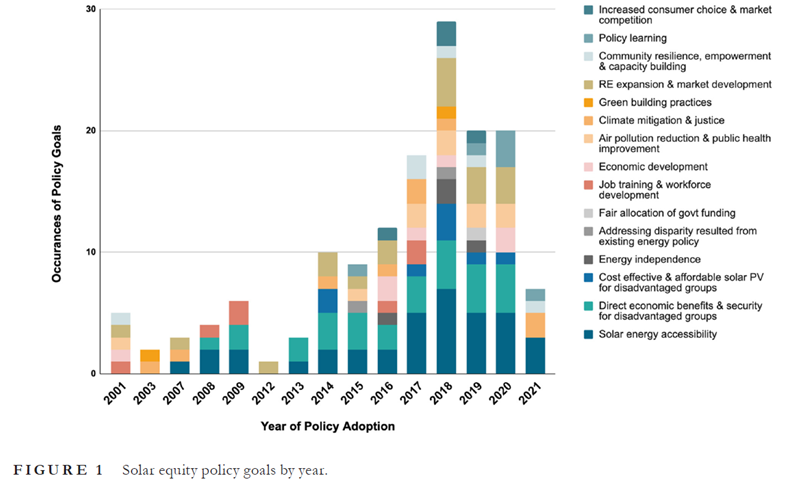
As illustrated in Figure 1, results suggest that policy actors attempt to address unequal distribution of benefits and costs regarding solar PV deployment, as issues of accessibility and affordability for diverse and disadvantaged groups are among the most common solar equity policy goals. Financial incentives that directly benefit disadvantaged groups and organizations serving underrepresented groups are the most common policy instrument utilized, and economic vulnerability (defined by income benchmarks) is often used to define target populations, but the benchmarks used varied over time and geographic area.

This research offers a valuable contribution by joining energy justice and public policy literature to provide a more detailed understanding of meaningful ways to analyze energy justice. It also confirms the argument of Curley et al. (2020) that policymakers use different types of tools to target different takers and advance different policy goals. Finally, it contributes to the policy design literature by applying Schneider and Ingram (1990) and Howlett and Cashore’s (2009) policy design elements to a comparative analysis of solar equity policies. Moreover, research findings in this paper can be particularly useful to policy actors interested in creating policies and programs that reduce solar inequities.

You can read the original article in Policy Studies Journal at

Zhou, Shan, Xue Gao, Adam M. Wellstead and Dong Min Kim. 2023. “Operationalizing social equity in public policy design: A comparative analysis of solar equity policies in the United States.” Policy Studies Journal 51 (4): 741–772. https://doi.org/10.1111/psj.12505.

About the Authors

Shan Zhou is an assistant professor in the Department of Political Science at Purdue University. Her research interests focus on the intersection of public policy, social equity, and sustainability. She has extensive experience in analyzing the justice implications of clean energy policies and infrastructure development in both developed and developing countries (e.g., U.S. and China), using quantitative and qualitative research methods. She has also worked on policy design research promoting effective and equitable clean energy adoption.

Xue Gao is an Assistant Professor at the Askew School of Public Administration and Policy at Florida State University. Her research focuses on the interplay between policy, politics, technology, and society in the energy transition process. Her research encompasses various aspects of the energy transition, including the policy-making process, evaluation of energy programs, innovation and entrepreneurship in renewable energy, and energy justice. 

Adam M. Wellstead is a Professor of Public Policy with the Department of Social Sciences at Michigan Technological University. His research interests include policy innovation labs, policy capacity, policy design, and public value. 


Dane Kim is a PhD Candidate in Environmental and Energy Policy at Michigan Technological University. He holds a Bachelor of Science degree in Environmental Engineering and a Master of Science degree in Environmental Engineering, both from the University of Southern California. His research interests include energy transition, energy policy, air pollution, governance, and data analytic research methods.