Nascent policy subsystems in polycentric governance networks: The case of sea-level rise governance in the San Francisco Bay Area

by Tara Pozzi, Elise Zufall, Kyra Gmoser-Daskalakis, & Francesca Vantaggiato

The biggest environmental policy challenges of our time cut across policy sectors and levels of governance. The wide scope of these issues requires collaboration across sectoral, geographical, and administrative boundaries. Recent literature utilizing the Advocacy Coalition Framework (ACF) has explored the behavior of nascent subsystems, which emerge in response to novel policy challenges and feature developing coalitions. 

However, we still lack an empirical approach to identify and analyze the structural characteristics of these nascent (i.e., emergent) subsystems and assess their implications for theoretical and subsystem development. How do we recognize a nascent policy subsystem when we see one, and what are the drivers of its coalitional structure?

This study builds and expands upon Ingold et al.’s (2017) study of nascent fracking policy subsystems in the United Kingdom and Switzerland, which found that network structure was better explained by actors’ secondary policy beliefs and former collaborative relationships than by actors’ deep core beliefs. We examine the case of the governance of sea-level rise (SLR) adaptation in the San Francisco Bay Area (SF Bay Area), utilizing a 2018 online survey to identify whether its governance system is nascent, whether actors’ policy core beliefs (specific to the subsystem) form discernible advocacy coalitions, and whether those beliefs inform network partner selection.

Image Description

Employing community detection methods and a Bayesian model for statistical analysis of networks (the Bayesian Exponential Random Graph Model, or BERGM) to test for core policy belief homophily between actors, we found that the network does not divide into fully fledged coalitions (illustrated in Figure 1), and that belief homophily is a driver of network structure (Figure 2), suggesting that coalitions are emerging. Moreover, we determined that emerging coalitions dovetail existing policy divides in the SF Bay Area around environmental protection and environmental justice goals.

Image Description

Taken together, these results suggest that coalition formation in the nascent subsystem of SLR in the SF Bay Area is associated with actors’ beliefs imported from pre-existing, related subsystems. At present, communities do not display the adversarial coalitional structure consistent with mature subsystems; instead, overlapping membership by actors in communities creates a core-periphery structure consistent with a collaborative policy subsystem.

Our analysis has important implications for theory, methods, and practice. It shows that nascent subsystems addressing new collective action problems such as SLR derive at least part of their emerging structure from existing coalitions. However, most policy actors in our network display heterogeneous policy core beliefs which do not clearly refer to either pre-existing environmental protection or environmental justice coalitions. This underscores the role that learning plays in coalition formation, particularly when actors face new issues and need to gather information to form their positions. Thus, while pre-existing coalitions shape collaborative ties in the current network structure, they need not prevent the development of entirely new coalitions in the future. Additionally, our empirical approach for recognizing a nascent policy subsystem, parsing out its structural characteristics, and understanding the drivers of its structure can be replicated in other emerging policy subsystem studies.

The implications of this analysis for practice are twofold: for one, understanding the structure of nascent policy subsystems can alert policymakers to the likely trade-offs to be faced in decision-making; and secondly, tracking subsystem development can ensure policymakers include affected interests in the governance process.

You can read the original article in Policy Studies Journal at

Pozzi, Tara, Elise Zufall, Kyra Gmoser-Daskalakis and Francesca Vantaggiato. 2024. “ Nascent Policy Subsystems in Polycentric Governance Networks: The Case of Sea-level Rise Governance in the San Francisco Bay Area.” Policy Studies Journal 52 (3): 561–581. https://doi.org/10.1111/psj.12549.

About the Authors

Tara Pozzi is a PhD candidate in the Graduate Group in Ecology at the University of California, Davis and a Delta Science Fellow. Her research focuses on how governance networks influence effective climate adaptation policy and planning decision-making. Prior to UC Davis, she completed her M.S. in Human-Environment Systems from Boise State University and her B.S. in Civil Engineering from Santa Clara University.  

Website: https://tarapozzi.github.io/ 
LinkedIn: https://www.linkedin.com/in/tara-pozzi-74587856/ 

Elise Zufall is a PhD candidate in the Geography Graduate Group at the University of California, Davis. Zufall studies the role of actor relationships, beliefs, and knowledge in environmental resource management and decision-making. Zufall received her M.S. and B.S. in Earth Systems from Stanford University.  

Kyra Gmoser-Daskalakis is a PhD candidate in the Graduate Group in Ecology at the University of California, Davis. She studies collaborative environmental governance, with a particular focus on the implementation of multi-benefit green infrastructure. She holds a B.S. in Environmental Economics and Policy from UC Berkeley and a Master of Urban and Regional Planning from UCLA.

LinkedIn: https://www.linkedin.com/in/kyra-gmoser-daskalakis-939375b3
X (Twitter): @kyraskyegd

Francesca Pia Vantaggiato is Senior Lecturer in Public Policy at the Department of Political Economy at King’s College London (UK). Her research focuses on how policy-makers and stakeholders use collaborative relationships to tackle change and uncertainty. Her work has been published in journals such as the Journal of Public Administration Research and Theory, Policy Studies Journal and Global Environmental Change. Prior to King’s College London, Vantaggiato was a postdoctoral researcher in the Department of Environmental Science & Policy at the University of California, Davis.

Website: https://francescavantaggiato.github.io/ 
Bsky: https://bsky.app/profile/fpvantaggiato.bsky.social 

The Politics of Problems versus Solutions: Policymaking and Grandstanding in Congressional Hearings

by Jonathan Lewallen, Ju Yeon Park, & Sean M. Theriault

Many journalists, legislators, academics, and other commentators have lamented the recent state of U.S. policymaking and a seemingly increased emphasis on “message politics” and grandstanding at the expense of “serious” legislating.

Taking positions is an important part of political representation and grandstanding often gets traced to electoral motivations and incentives. Our new article, “The Politics of Problems versus Solutions: Policymaking and Grandstanding in Congressional Hearings,” finds another source: a focus on the problem space.

Many aspects of decision-making depend on whether we are focused on the problem space or the solution space. Simplifying problems involves using heuristics to narrow our attention on different potential focusing events and indicators. Navigating the solution space involves both consulting experts and making analogies to similar-enough alternatives adopted for other issues or in other governing jurisdictions.

We find evidence that the different focus on problems and solutions doesn’t just influence the kinds of information we pay attention to; it also influences how policymakers engage in deliberation and creates different political dynamics.

We compared Professor Park’s “Grandstanding Score,” which measures individual legislators’ intensity of sending political messages, across three types of U.S. congressional committee hearings: those focused only on the problem space, those focused on implementation of existing policies, and those focused on proposed alternatives.

Our analysis shows that hearings focused on the problem space have average grandstanding scores about 0.65 points higher than solution-focused hearings, and 1.41 points higher than implementation-focused hearings. 

We also find variation in grandstanding by policy topic using the Policy Agendas Project major topic codes. Specifically, hearings on issues like social welfare, law and crime, education, civil rights, macroeconomics, international affairs, and the environment tend to have significantly higher grandstanding scores. Hearings on technology and agriculture, on the other hand, tend to have significantly lower grandstanding scores.

Our research adds valuable insights to the ongoing discussion of legislative dysfunction in the United States, highlighting how the focus on problem politics at the expense of solution-driven deliberation has affected congressional behavior over time.

While our results are potentially good news for policymakers focused on implementing existing policy, they also present a few challenges to advocates looking to reduce messaging politics in Congress and encourage substantive policymaking. Grandstanding derives at least in part from both a focus on policy problems and the specific problems receiving attention; to some extent, grandstanding is baked into both the policy agenda and Congress’s responsibilities as a representative institution. Rather than trying to reduce grandstanding behavior, then, perhaps we need recommendations for encouraging the kinds of activities that counterbalance grandstanding.

You can read the original article in Policy Studies Journal at

Lewallen, Jonathan, Ju Yeon Park and Sean M. Theriault 2024. “ The Politics of Problems Versus Solutions: Policymaking and Grandstanding in Congressional Hearings.” Policy Studies Journal 52 (3): 515–531. https://doi.org/10.1111/psj.12526.

About the Authors

Jonathan Lewallen is an associate professor of political science at the University of Tampa. His research focuses on agenda setting and the policy process and how issues and institutions evolve together over time. Dr. Lewallen’s book Committees and the Decline of Lawmaking in Congress was published in 2020 by the University of Michigan Press.

Ju Yeon (Julia) Park is an Assistant Professor at the Department of Political Science, The Ohio State University and a faculty affiliate of the Center for Effective Lawmaking. Her research focuses on the public speeches and legislative behavior of members of U.S. Congress, and their impact on legislative processes and elections.

Sean M. Theriault is a University Distinguished Teaching Professor in the Government Department at the University of Texas at Austin.


The Dynamics of Issue Attention in Policy Process Scholarship

by E. J. Fagan, Alexander Furnas, Chris Koski, Herschel Thomas, Samuel Workman, & Corinne Connor

The Policy Studies Journal (PSJ) is the premier destination for scholars who apply and advance theories of the public policy process. As such, the work published in the journal reflects important trends and priorities in the policy community. In our article, we examine the agenda of PSJ over the last three decades in an effort to understand the evolving focus of the discipline and contribute to the emerging “Science of Science” literature. To do this, we analyze over 1,300 abstracts from PSJ articles, using the Comparative Agendas Project (CAP) codebook to systematically categorize the policy topics covered.

One of the key insights from our analysis is the broad range of policy topics covered in PSJ. With the exception of a major focus on environmental policy, attention is roughly divided among a variety of different topics. While the substantive range of the scholarship in PSJ is encouraging, we do identify a recent decline in topic diversity and a lack of attention on areas like foreign policy.

Figure 1. Subfigure (a) shows the distribution of paper across policy topics from our coding of abstract text. Subfigure (b) shows the normalized Shannon’s H of the topic codings for papers published in PSJ over time. We exclude the “No Substantive Topic” category from the calculation of Shannon’s H so the measure reflects the diversity of PSJ papers across substantive policy topics. The years 1986–1990 are excluded from this plot because there are no coded papers due to the lack of available abstracts in OpenAlex.

We also examine the theoretical frameworks that have shaped policy process research within the PSJ. Notably, Punctuated Equilibrium Theory (PET) emerged as a dominant framework, appearing more frequently in the journal than other influential theories like the Advocacy Coalition Framework (ACF) and the Institutional Analysis and Development (IAD) Framework. We attribute PET’s extensive presence in the journal to the theory’s broad applicability across various policy domains. Additionally, we find that theories of the policy process tend to specialize in specific areas, such as ACF’s focus on environmental and energy policy.

In terms of the policy stages addressed in PSJ articles, our findings indicate a strong emphasis on the implementation and evaluation stages of the policy cycle. This is particularly interesting given that one might expect PET’s focus on agenda-setting and lawmaking to lead to greater attention to these stages. Instead, the journal’s content has increasingly shifted from stage-based analysis to a more theory-driven approach.

Figure 2. Subfigure (a) shows the distribution of PSJ papers across policy theories identified using keywords in the abstract. Subfigure (b) shows the stage of the policymaking cycle papers addressed and identified using keywords in the abstract.

Another important aspect of our study is the impact of PSJ articles on both academic research and policy-making. We find that articles addressing general policy processes or theoretical questions tend to receive more academic citations, while those focused on specific policy areas, such as education, are more likely to be cited in policy documents. This distinction highlights the dual role that the journal plays in both advancing theoretical understanding and informing practical policy decisions.

Figure 3. Subfigure (a) plots the share of PSJ papers within each topic compared to the share of CRS reports on each policy topic for 1997–2019. Subfigure (b) plots the share of PSJ papers received by papers within each topic compared to the share of think tank reports from four prominent think tanks on each policy topic for 2007–2017.

Finally, we compare the journal’s focus with the priorities of other policy experts, including those from the Congressional Research Service (CRS) and various think tanks. Our analysis reveals significant discrepancies in the attention given to certain issues. For instance, while PSJ articles emphasize environmental policy, CRS reports are more likely to focus on defense and government operations. This divergence suggests that policy process scholars sometimes prioritize different issues than those that dominate the agendas of policymakers and other experts.

Through this study, we aim to shed light on the dynamics of issue attention within the field of policy process scholarship. By doing so, we hope to contribute to a deeper understanding of how scholarly priorities evolve and how they align—or sometimes fail to align—with the broader needs of society.

You can read the original article in Policy Studies Journal at

Fagan, E. J., Alexander Furnas, Chris Koski, Herschel Thomas, Samuel Workman and Corinne Connor. 2024. “ The Dynamics of Issue Attention in Policy Process Scholarship.” Policy Studies Journal 52 (3): 481–492. https://doi.org/10.1111/psj.12548.

About the Authors

E.J. Fagan is an Assistant Professor of Political Science at the University of Illinois Chicago. He studies agenda setting, think tanks, political parties and policymaking in the U.S. Congress.


Alexander C. Furnas Ph.D. (Zander) is a Research Assistant Professor at the Center for Science of Science and Innovation at the Kellogg School of Management, Northwestern University, and Faculty Associate at the Institute for Policy Research and the Ryan Center on Complexity. He has a PhD in political science from the University of Michigan. He researches the political economy of information, with a focus on the production, dissemination and uptake of science and expertise in the policymaking process. His work has been published in American Political Science ReviewAmerican Journal of Political Science, Policy Studies Journal, Proceedings of the National Academy of Sciences, and Legislative Studies Quarterly, among others.

Chris Koski joined the Reed College faculty in Fall 2011 after four years as an assistant professor at James Madison University (2007–2011). His research interests include many aspects of the policy process, with a particular focus on agenda-setting, policy design, and implementation. Theoretically, much of his work is situated in punctuated equilibrium theory (PET) and the social construction framework (SCF). Substantively, the bulk of Chris’ research is focused on environmental policy, most recently the politics of climate change – mitigation, adaptation, and geoengineering. He has also published work on homeland security policy and the politics of state budgeting.

Herschel F. Thomas is an Associate Professor of Public Affairs in the LBJ School of Public Affairs at the University of Texas at Austin. He is a faculty fellow of the RGK Center for Philanthropy and Community Service and faculty affiliate of the Policy Agendas Project. His research examines US national institutions and policy processes, with an emphasis on the role of civil society in shaping public policy decision-making and outcomes. His work focuses on interest group politics, public health, and agenda-setting, and is published in journals such as the American Journal of Public Health, Policy Studies Journal, Public AdministrationPolitical Research Quarterly, and Risk, Hazards & Crisis in Public Policy, among others. He is co-author with Timothy LaPira of Revolving Door Lobbying.

Samuel Workman is Professor of political science and Director of the Institute for Policy Research and Public Affairs at West Virginia University. His area of expertise is constructing large data infrastructures to answer fundamental questions about public policy across time and space. His previous work has addressed public policy, regulation, and how governments generate and use information. His work emphasizes text-as-data, machine learning, and statistical modeling, especially classification. His work appears in the top public policy and public administration journals, including Policy Studies JournalJournal of Public Administration Research and Theory, and Policy and Politics. He is the author of The Dynamics of Bureaucracy (Cambridge, 2015), Punctuated Equilibrium Theory: A Policy Theory of Politics (Cambridge, Forthcoming), and Co-Editor of Methods of the Policy Process (Routledge, 2022).

Corinne Connor is a Program Analyst for The Heinz Endowments in Pittsburgh, PA. She is a former affiliate of the Institute for Policy Research and Public Affairs at West Virginia University and received her MA in Political Science from WVU in May 2023.


Whose Water Crisis? How Policy Responses to Acute Environmental Change Widen Inequality

by Olivia David & Sara Hughes

People experience environmental and climate change in different, uneven ways, shaped largely by how governments respond to these changes. Policy responses to acute environmental events like droughts, floods, and wildfires are important for mitigating environmental and social harm, but can also reveal structural biases and entrenched power dynamics. Such events therefore offer opportunities to evaluate the mechanisms by which policy decisions affect existing socioeconomic inequality, and relatedly, how policy choices may either contribute to or stifle environmental justice.

In our paper, we address these questions by examining policy responses to severe drought events in California, USA (2012-2016) and the Western Cape Province, South Africa (2015-2018). Both regions received significant public and media attention for their respective water crises and the policies that determined how populations experienced and perceived them. The regions share other common features that make drought policy responses particularly consequential including high contributions to their respective national GDPs through agricultural production, and high socioeconomic inequality.

In our examination of these drought events, we ask what constitutes a “water crisis” – who experiences “crisis” and how – and how policy responses mediate those experiences. Some of our key findings are:

  • Californians living in cities largely felt distanced from the effects of drought, while rural populations reliant on domestic wells felt acute impacts. The state’s policy decisions around drastically reducing water deliveries for agriculture contributed to these disparate impacts, as agricultural users shifted to withdrawing more groundwater – producing scarcity and water quality issues for the communities normally reliant on that same resource.
  • California’s poorest communities were forced to spend additional money on bottled water in addition to paying for chronically toxic tap water, deepening water unaffordability conditions.  
  • In Cape Town – the Western Cape’s only large city, and water crisis epicenter – many wealthy households invested in expensive off-grid water supply infrastructure, such as construction of backyard boreholes and installation of rainwater catchment tanks, enabled by lax policies around licensing for private groundwater extraction.
  • The City of Cape Town’s new water pricing structures intending to incentivize conservation not only targeted high-consumption households, but also impacted many poor households with already-low water use.

Based on our findings, we proposed two main causal mechanisms linking policy response and widened inequality in both cases: “values reinforcement” and “strategic communication.” Put differently, we identified how both governments made policy decisions that 1) reinforced dominant political-economic priority values of their respective contexts – mainly, the agricultural economy in California and the status quo of racialized distribution of wealth and power in the Western Cape, and 2) generated and communicated information that leveraged content, framing, and targeting to instill particular populations with a sense of responsibility for mitigating drought crises.

Identifying these two mechanisms leads us to suggest that in contexts of drought and other severe environmental events anticipated under climate change, governments should pay particular attention to how their policy responses perform “values reinforcement” and “strategic communication,” and the outcomes these responses are designed to pursue. Understanding these mechanisms helps clarify how policy choices shape social outcomes of environmental events and raises questions about how policy design might narrow inequalities. As droughts and other environmental events become increasingly frequent and severe, we hope these insights can guide policymaking toward responding in ways that consider and even advance environmental justice, rather than exacerbating inequalities.

You can read the original article in Policy Studies Journal at

David, Olivia and Sara Hughes. 2024. “Whose Water Crisis? How Policy Responses to Acute Environmental Change Widen Inequality.” Policy Studies Journal 52 (2): 425–450. https://doi.org/10.1111/psj.12524.

About the Authors

Olivia David is a doctoral student at the School for Environment and Sustainability at the University of Michigan. Her current research focuses on the politics of water policy and infrastructures, and activism around water injustice as a potential lever of policy change.


E-Mail: odavid@umich.edu
Twitter: @Olivia_David_ 
https://orcid.org/0000-0003-0412-9795

Sara Hughes is an associate professor at the School for Environment and Sustainability at the University of Michigan. She studies policy agendas, policy analysis, and governance processes, focusing on decisions about water resources and climate change mitigation and adaptation.


E-Mail: shughes@rand.org
Twitter: @Prof_Shughes
https://orcid.org/0000-0002-1282-6235

The Adoption of Culturally Contentious Innovations: The Case of Citizen Oversight of Police

by Mir Usman Ali

The deaths of George Floyd and Broenna Taylor at the hands of police in 2020 brought the issue of police accountability to the forefront of public debate. One reform that has been a long-standing demand of police accountability advocates is Citizen Oversight Agencies (COAs). COAs are institutional arrangements at the local level that provide a platform for non-sworn review complaints about the police. While there is growing scholarly interest in these agencies, little research has examined factors associated with their adoption. In this paper, I use innovation diffusion theory to help fill this gap. 

In particular, I investigate the role of cultural contentiousness, a previously understudied concept. When an innovation is culturally contentious, it challenges an existing institution’s dominant cultural meaning, leading to resistance. I argue that COAs are culturally contentious because they highlight the disconnect between the race- and class-neutral way police are supposed to perform their role in a liberal-capitalist society and the non-neutral way in which they actually perform it. Moreover, I argue that investigative COAs (i.e., COAs that can independently investigate allegations of police misconduct and recommend discipline) are more contentious than non-investigative COAs (which merely review or monitor police investigations of citizen complaints) because the former can be viewed as undermining the professional autonomy of the police.

To identify the factors associated with the adoption and diffusion of COAs at the municipal level in the United States between 1980 and 2016, I assembled a panel data set of all cities with a population greater than 100,000 persons as of 2010. There were 77 municipalities with COAs and 154 municipalities without COAs that met the criteria for inclusion in the study. I used event history modeling (EHM) to estimate the impact of various antecedents on the likelihood of adoption and diffusion of COAs. 

Results indicate that a federal investigation or entering a consent decree, an increase in the number of civil rights nonprofits, or an increase in own-source revenue per capita was associated with the adoption of investigative COAs, while not being associated with non-investigative COAs. These findings underscore the importance of antecedents that reveal contradictions between cultural assumptions and non-neutral material effects of policing.

I also find that antecedents that symbolically obfuscate the above contradiction, or whose meaning is unclear, tend to reduce the likelihood of adoption of COAs overall or increase the likelihood of adoption of non-investigative COAs. For instance, the presence of a Law Enforcement Officers’ Bill of Rights (LEOBOR) law, an increase in the violent crime rate, or an increase in the number of neighboring cities with a COA either increased the likelihood of adopting a non-investigative COA or no COA at all.

In summary, this work highlights the importance of cultural contentiousness in innovation adoption and diffusion. While the results indicate that less culturally contentious change is more common, more contentious change does occur. However, for such change to be institutionalized, it needs to be supported by other levels of government and sustained advocacy efforts for police accountability. 

You can read the original article in Policy Studies Journal at 

Ali, M. U.. 2023. “The adoption of culturally contentious innovations: The case of citizen oversight of police.” Policy Studies Journal, 51, 905–928. https://doi.org/10.1111/psj.12499

About the Author

Mir Usman Ali is an Assistant Professor in the School of Public Policy at the University of Maryland-Baltimore County. His research revolves around building a theory of the conditions under which public managers and organizations can foster social equity-enhancing institutional change. His research has looked at a variety of topics such as citizen oversight of police, impact of body-worn cameras, policies intended to curb domestic violence, and pandemic preparedness among local health departments. He holds a Ph.D. in Public Affairs Indiana University-Bloomington, an M.S. in Statistics from Texas A&M University, College Station and MBA and BBA degrees from the Institute of Business Administration, Karachi. His research has been published in Public Administration Review, Public Performance and Management Review, American Review of Public Administration, and Policy Studies Journal.

Farmed Out: Agricultural Lobbying in a Polarized Congress  

by Clare Brock

Food and Agriculture policy has often been referred to as one of the last bastions of bipartisanship. Policymakers in the space claim that policymaking in this area has historically been special and uniquely cooperative. And yet, recent fights over the Farm Bill and other food and nutrition policy have made clear that food policymaking is no more exempt from bitter partisan battles than any other policy area.

Farmed Out: Agricultural Lobbying in a Polarized Congress considers the relationship between partisan polarization, lobbying, and policy dynamics. The evidence presented in the book shows that partisan polarization has a dual impact on lobbying in that space. On the one hand, partisan polarization has increasingly frustrated lobbyists who hope to see lawmakers move forward on policy change in a timely fashion; one lobbyist explained, “I find the issues that should have been a lighter lift have become a Herculean lift” (Brock 2023, 111). The consequence is that, as the legislative pace slows, lobbyists must persistently work on the same issues over a longer time horizon, exacerbating the already large advantage to business and well-organized and funded interests. This trend is particularly visible among business interests, whose behavior, characteristics, and resources we have a clearer picture of compared to other types of interest groups.

Figure 7.1. Relationship between lobbying reports and firm revenue, by year.

Figure 7.1 (Brock 2023, 113) illustrates the increasingly exaggerated relationship between lobbying reports and resources over time, particularly among business interests. It is clear that access to resource allows firms to engage in politics more aggressively than their less well-resourced counterparts.

Advocacy groups are adapting and finding new (and old) ways to overcome legislative sluggishness, however. Reliance on coalitions and cross-cutting partnerships, also known as “unlikely bedfellows” or “boot-leggers and Baptist” partnerships, are particularly desirable coalitional strategies as they provide “air cover” to politicians and create new pathways to cooperation in a Congress with increasingly slim majorities and challenging dynamics (Brock 2023, 126).

Farmed Out explores both the practical and normative consequences of partisan polarization on lobbying, and specifically, the consequences of these dynamics on policymaking in the food and agricultural subsystem. “Legislators spend more time fighting, flying home, and rallying their bases, and less time on policymaking. Congress has lost expertise and has outsourced brainpower to lobbyists. As lobbying increasingly becomes more skewed toward the ultra-wealthy interest groups and corporations, we risk moving the food system even further from the ideal points of the public” (Brock 2023, 140). In short, partisan polarization has consequences not only for our politics, but also for our diets.

You can find the full book at

Brock, Clare R., Farmed Out: Agricultural Lobbying in a Polarized Congress (New York, 2024; online edn, Oxford Academic, 23 Nov. 2023), https://doi.org/10.1093/oso/9780197683798.001.0001

About the Author

Clare Brock is an Assistant Professor of Political Science at Colorado State University. Her research interests include public policy process, interest groups and advocacy, food politics, and the impact of polarization on policymaking.


Building Blocks of Polycentric Governance

by Tiffany H. Morrison, Örjan Bodin, Graeme S. Cumming, Mark Lubell, Ralf Seppelt, Tim Seppelt, & Christopher M. Weible

Many governance systems are plagued by coordination problems. Polycentricity is often presented as key to resolving such problems.  Polycentric systems are characterized by a decentralized and self-organized style of governance, where actors operating across diverse venues work together to make decisions through collective action. But despite their pervasiveness, as well as numerous studies that have looked into different polycentric governance arrangements, we still don’t have tools for studying how coordination within a polycentric governance system changes over time, and how those changes impact the success or failure of that system.

Our paper, “Building blocks of polycentric governance,” introduces a “building blocks” model for understanding polycentric governance. It treats polycentric governance as a network of decision-making venues, governance actors, and policy issues that are linked to one another. Our model focuses on three permutations of those linkages: venue-to-actor, venue-to-issue, and venue-to-actor-to-issue. If a polycentric governance system has certain permutations of venues, actors, and issues that appear regularly, we refer to those as building blocks. Those building blocks can then be used to study how coordination in that system evolves over time. Figure 1 shows different kinds of building blocks that can emerge in a polycentric system.

Figure 1. Proposed typology of building blocks of polycentricity

We applied our model to study the polycentric system that governs the Great Barrier Reef. We chose the Great Barrier Reef because of its longevity (it dates to the 1970s), the wealth of publicly available quantitative and qualitative data, the presence of prior studies, and its status as an innovator in polycentric governance. We mapped out the network for three years: 1980, 2005, and 2015. Figure 2 shows the results.

Figure 2. 3-Mode network models of the polycentric Great Barrier Reef regime

Our network analysis yielded several findings. First, between 1980 and 2015, coordination among actors participating in the same venue increased. Across that same period, there was also greater coordination between venues and issues, meaning that venues became increasingly specialized in the specific governance issues that they tackled. That said, venues were more crucial in coordinating actors than issues. This suggests that it’s easier for venues to bring actors together than to evolve to take on new issues. Finally, the governance system became more polycentric over time, as new policy issues resulted in new actors joining the system and new venues were created to address those issues. However, those newcomers have been at a disconnect from the other actors, issues, and venues in the system, operating independently rather than embedding themselves within pre-existing relationships.

By capturing the linkages among actors, venues, and issues and showing how they change over time, our building blocks model reveals the key role that venues play in facilitating – and hindering – coordination within a polycentric governance system. On the one hand, venues can help bring diverse governance actors together and facilitate specialization on specific policy issues. At the same time, the introduction of new venues can cause the governance system to fragment: actors who participate in new venues may not necessarily work with actors in other venues, or new venues will focus on a specific policy issue (or set of issues) without considering its relationship to other issues.

The Great Barrier Reef governance system is small and has changed slowly over time. Additionally, in the interest of presenting an application of our model that was easy to digest, we focused narrowly on actors, venues, and issues. We welcome studies that apply our building blocks model to larger and more dynamic polycentric governance systems. There are, of course, many more variables present in any polycentric governance system, and we would love to see future studies that incorporate that complexity into applications of our model. Benefits of extending our building blocks approach therefore include: (1) understanding how structure and agency influence environmental efforts (for example, if a new ‘polycentric’ governance system is only partially successful, are its failures due to structural inadequacies?); (2) detection of threshold effects and feedbacks (for example, does a system need to be strongly polycentric in order for a particular social process to occur?); and (3) more direct comparison between different case studies, facilitating practical insights for policymakers and other stakeholders interested in improving the performance of a specific environmental governance system.

You can read the original article in Policy Studies Journal at

Morrison, Tiffany H., Örjan Bodin, Graeme S. Cumming, Mark Lubell, Ralf Seppelt, Tim Seppelt, and Christopher M. Weible. 2023. Building blocks of polycentric governance. Policy Studies Journal 51: 475–499. https://doi.org/10.1111/psj.12492

About the Authors

Tiffany Morrison holds professorial appointments in the School of Geography, Earth & Atmospheric Sciences at Melbourne University, the Environmental Policy Group at Wageningen University & Research, and the College of Science & Engineering at James Cook University. Her expertise is in the governance of environmental change, policy responses to warming ecosystems, and governance of new interventions in warming ecosystems. She has twenty years of experience conducting innovative interdisciplinary research spanning human geography, political science, climate science, and ecology.

Örjan Bodin is a researcher at the Stockholm Resilience Centre at Stockholm University, Sweden. He employs a cross-disciplinary approach, integrating methods from various scientific disciplines to study social-ecological systems. He is particularly interested in using network analysis to study various aspects of ecosystems governance.

Graeme S. Cumming is an academic and researcher with a background in Zoology and Entomology. He is currently a Professor and Premier’s Science Fellow at the University of Western Australia. Graeme has a wide range of interests, centering around understanding spatial aspects of ecology and the relevance of broad-scale pattern-process dynamics for ecosystem (and social-ecological system) function and resilience. He is also interested in the applications of landscape ecology and complexity theory to conservation and the sustainable management of natural resources.

Mark Lubell is Professor in the Department of Environmental Science and Policy at the University of California, Davis and the Director of its Center for Environmental Policy and Behavior. Lubell studies cooperation problems and decision making in environmental, agricultural, and public policy. His research topics include water management, sustainable agriculture, adaptive decision-making, climate change policy, local government policy, transportation behavior, plant disease management, invasive species, and policy/social network analysis.

Ralf Seppelt is a professor for landscape ecology and Resource Economics at Martin-Luther University Halle-Wittenberg, where he lectures course on Environmental Modelling. He is head of the department for Computational Landscape Ecology. His major research focus is land resources management based on integrated simulation and modelling systems. He thus is interested in the interactions and interrelationship of anthropheric and biospheric processes. 

Tim Seppelt is a fourth-year PhD student at RWTH Aachen University. He is interested in graphs and more specifically in theoretical and algorithmic notions concerning the similarity of two graphs. A central theme of his PhD is homomorphism indistinguishability, which describes the similarity of graphs in terms of numbers of homomorphisms.

Christopher M. Weible is a Professor in the School of Public Affairs at the University of Colorado Denver. His research focuses on policy process theories, contentious politics, and environmental policy. He is the Editor of Theories of the Policy Process (Routledge, 2023), Co-Editor of Methods of the Policy Process (with Samuel Workman, Routledge, 2022), Co-Editor of Policy & Politics, and Co-Director of the Center for Policy and Democracy.

“Mobile Shooting”: The Shifting Anticorruption Attention in China

by Jing Vivian Zhan & Jiangnan Zhu

Anticorruption agencies in authoritarian regimes are constrained by scant resources, particularly attention. Attention is the prime scarce resource in governing; it guides the flow of other resources, such as budgets and manpower. Therefore, the allocation of anticorruption attention becomes especially important in influencing both the allocation of corresponding resources and the level of corruption control in authoritarian countries. Existing research has told us to some extent when authoritarian leaders may pay more attention to certain cases or corrupt officials due to political calculations. However, little is known about whether and how anticorruption agencies allocate their attention across policy areas in autocracies. This question warrants investigation because anticorruption programs targeting specific sectors treat the root causes of corruption more directly and are more effective than broad anticorruption policies.

Our article, “Policy Coordination and Selective Corruption Control in China,” answers this question by scrutinizing the case of China. An understudied facet of selective corruption control is that the Chinese procuratorate, the state judicial branch responsible for the investigation, prevention, and prosecution of corruption.  The procuratorate has constantly shifted its anticorruption attention across different policy sectors. Figure 1 visualizes this tendency.

Figure 1. Anticorruption Attention by Area (1998-2016)

Note: Policy areas are listed in descending order by the overall degree of anticorruption attention of each area (i.e., sum of anticorruption attention across years). Darker colors indicate more anticorruption attention.

The shifting attention is especially puzzling given the widespread corruption across Chinese industries and the low likelihood that serious sectoral corruption will be resolved once and for all.

We coin a theory of “cross-organizational policy coordination under a single-party authoritarian regime” to explain the puzzle: Single-party regimes can use the centralized party discipline and personnel management system as leverage to direct bureaucratic attention toward the signals given by top policymakers. The policy objectives prioritized by top leaders not only prompt the directly responsible functional sectors to act, but also motivate other bureaucracies, including anticorruption agencies, to coordinate their policies with the national agenda. Thus, the Chinese procuratorate has been mobilized to align anticorruption work with central policy agendas to facilitate the Chinese Communist Party’s major policy initiatives by preventing corruption and investigating more cases in those areas.

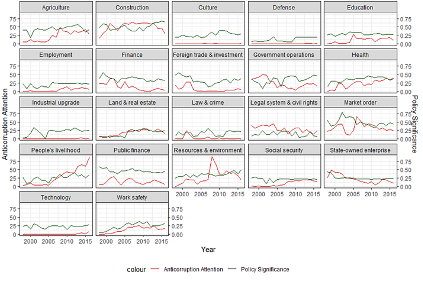
We test the correlation between anticorruption attention and policy significance, respectively measured by analyzing voluminous government documents. As shown in Figure 2, except in a few areas chronically ignored by the procurators between 1998 and 2016 (e.g., culture), anticorruption attention and policy significance have similar fluctuating patterns in most areas, with near-matching trend lines in areas such as land & real estate, state-owned enterprise, people’s livelihood, and work safety. Greater policy significance is usually accompanied by augmented anticorruption attention, whereas a steady decrease in policy significance often leads to reduced anticorruption attention.

Figure 2. Anticorruption Attention and Policy Significance by Area

Note: For each policy area, the horizontal axis is year; the vertical axis on the left and the red line represent anticorruption attention, while the vertical axis on the right and the green line represent policy significance.

We are among the first to explore authoritarian anticorruption enforcement from the perspective of attention allocation to policy issues. Our study brings a new perspective to understanding anticorruption endeavors in authoritarian regimes by showing that in addition to being motivated by political calculations such as elite power competition, single-party authoritarian regimes can strategically deploy anticorruption efforts as a policy tool to facilitate grand policy portfolios. Our findings resonated with research in predemocratic Brazil and Mexico, Kazakhstan, and Vietnam, in which the state could use political appointments to instrumentalize regulatory bureaucracies with expertise to serve government policies.

You can read the original article in Policy Studies Journal at

Zhan, Jing Vivian, and Zhu, Jiangnan. 2023. Policy coordination and selective corruption control in China. Policy Studies Journal 51: 685–702. https://doi.org/10.1111/psj.12487

About the Authors

Jing Vivian Zhan is a Professor at the Department of Government and Public Administration at the Chinese University of Hong Kong.

Email: zhan@cukh.edu.hk, Facebook: @Vivian Zhan, X: @jvzhan1


Jiangnan Zhu is an Associate Professor at the Department of Politics and Public Administration at the University of Hong Kong.

Email: zhujn@hku.hk, Facebook: @Jiangnan Zhu, X: jian_nan_zhu