The dynamics of constituency representation on immigration policy in the U.S. house

Immigration policy used to be a bipartisan issue, but now it is one of the most divisive in American politics. This study explores how lawmakers’ behavior changed as immigration became a party-defining issue–and what that means for the way Congress represents the foreign-born population. Using immigration bills in the House of Representatives from 1983 to 2014, email newsletters from 2010 to 2020, and data on district characteristics the authors ask: Do representatives still respond to immigrant populations in their districts, or does representation depend on which party wins the seat?

Expectations

The authors set out to discover whether polarization on this issue changed the mechanism of representation. They expect that as the issue polarizes, immigrations positions will depend more on party than on the size of the foreign-born population in the district, and that the effect of the foreign born population will occur via the electoral mechanism – influencing which party holds the seat – rather than by lawmakers’ in the same party holding positions that align with district characteristics. They also expect that under polarization the constituency effect will shift to predicting how active lawmakers are on the issue, rather than their positions.

Methodology

To test their expectations, the authors use three sources to measure lawmakers’ positions on immigration: floor speeches, email newsletters, and an original data set of immigration-related bills. Then, using regression models, they estimate the relationship between district demographics and legislators’ positions.

Key Findings

The Partisan Divide Has Grown

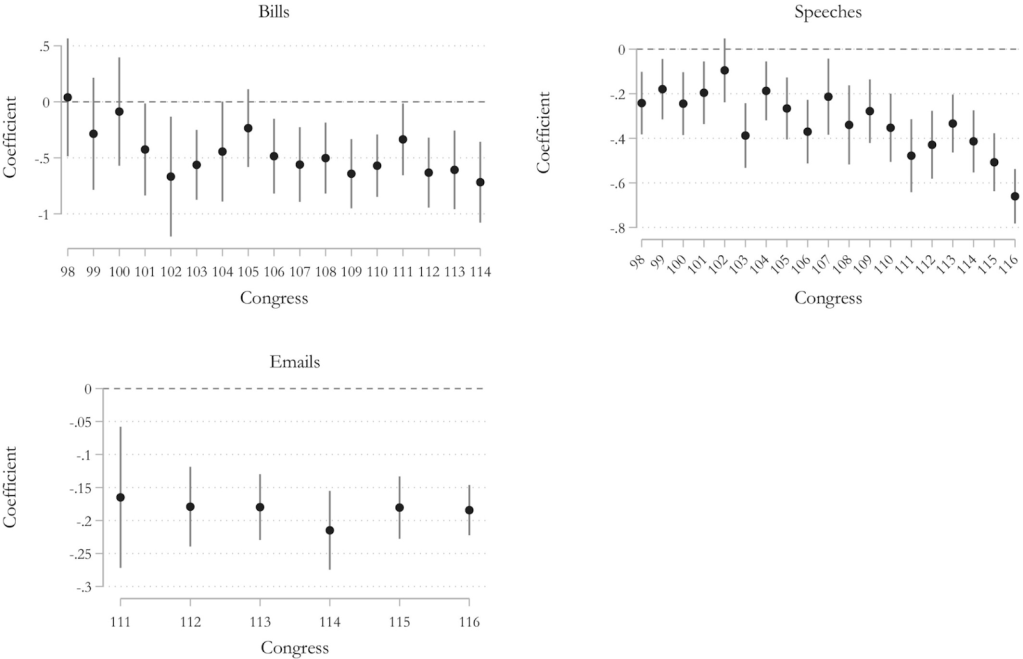
Figure 1 reveals the dramatic divergence of immigration positions over time between the two political parties. While Republicans move sharply toward anti-immigration positions, Democrats grew more supportive of immigration. This finding suggests that immigration has become a core partisan issue in U.S. politics, leaving little room for bipartisan collaboration.

Image Description

Figure 1. OLS coefficients of republican partisanship on pro-immigration positions. Figures report coefficients on Republican partisanship from OLS models estimate for each dependent variable in each Congress. Y-axes are on different scales.

The Mechanism of Representation Has Changed

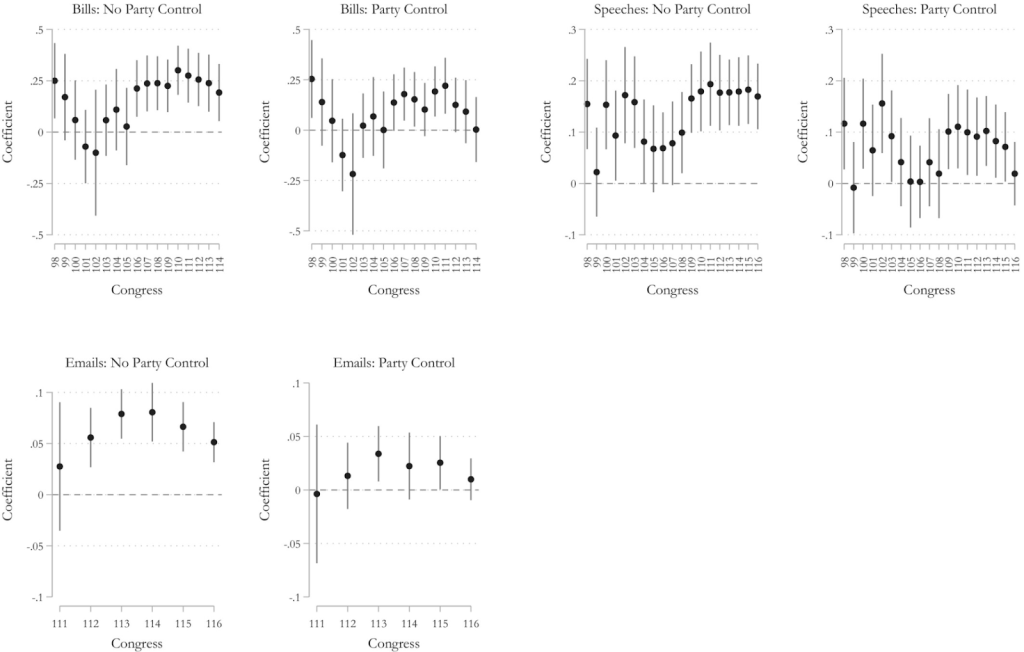
Figure 2 suggests that immigrant populations still matter–but indirectly. Instead of shaping individual lawmakers’ positions, foreign-born constituents hold more influence on which party wins the congressional seat itself, in part because they have become a more Democratic constituency. While Democrats representing districts with larger foreign-born populations. The correlation between the foreign-born population and legislators’ positions has actually become stronger, but it now passes through partisanship rather than dyadic responsiveness.

Image Description

Figure 2. OLS coefficient of foreign-born percentage (10-point increments) on immigration positions over time.

Asymmetrical Activism

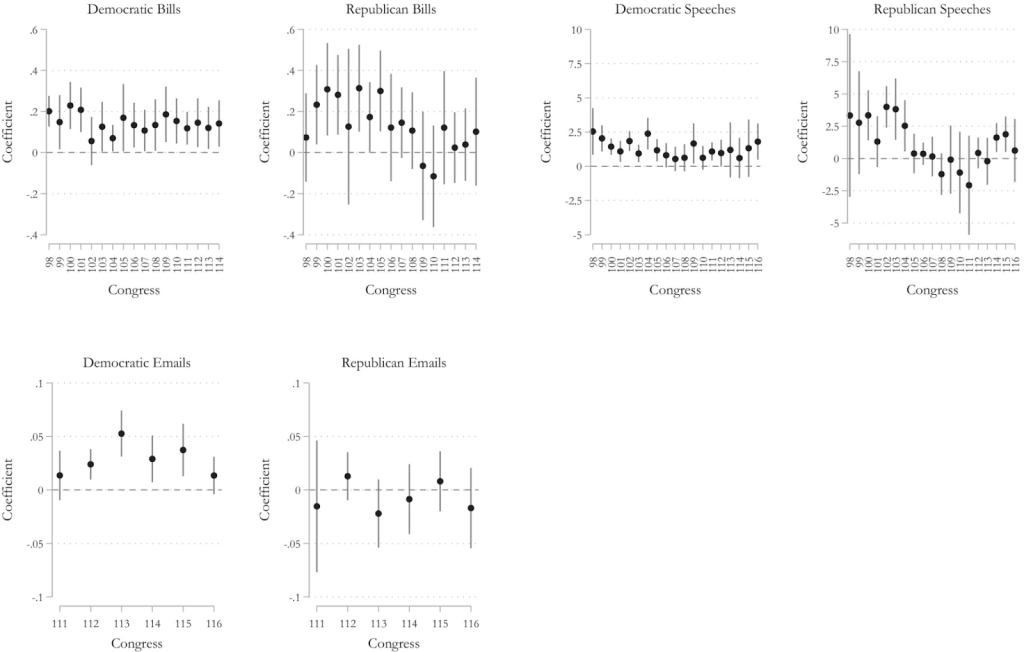
Figure 3 shows that Democrats with higher shares of immigrant constituents tend to be more active on immigration (e.g., sponsoring bills, giving speeches, and mentioning immigration in emails). On the other hand, Republicans show no such trend. Instead, the most conservative Republicans are the most active on immigration. For Democrats, the immigration agenda is set by representatives of immigrant communities, while for Republicans it is set by the conservative wing.

Image Description

Figure 3. Effect of percentage foreign born on the number of actions by party.

Why It Matters

Polarization has transformed how representation works. This article explores how party sorting reshapes legislative behavior and agenda-setting on immigration. For immigrant communities, influence now depends on influencing which party wins the election. The authors insist that future research should explore whether similar patterns occur on other party-defining issues, and how local advocacy strategies adapt in an era of deep national divides.

Read the original article in Policy Studies Journal:

Cayton, Adam and Lena Siemers. 2025. “The Dynamics of Constituency Representation on Immigration Policy in the U.S. House.” Policy Studies Journal 53(2): 480–498. https://doi.org/10.1111/psj.12579.

About the Article’s Authors

Adam Cayton is an associate professor in the Reubin O’D. Askew Department of Government at the University of West Florida. His research focuses on legislative representation. He received a Ph.D. from The University of Colorado – Boulder, and a B.A. from The University of North Carolina at Asheville.

Lena Siemers is a Ph.D. student in the Department of Global Studies at the University of Massachusetts, Lowell. Her research focuses on migrant and refugee studies. She received a M.A. from the University of West Florida and a B.A. from the University of South Alabama.

Information Is Cheap, But Filtering Is Costly: Congressional Investment In Reference Resources

Lawmakers swim in a constant flood of information—reports from think tanks, pitches from lobbyists, pleas from constituents, memos from agencies—you name it. It’s a tidal wave of policy talk, and it hits every single day. To keep from going under and still stay focused on what matters most to them, members of Congress have to become expert navigators, developing savvy strategies to cut through the noise and zero in on their priorities.

One key strategy is investing in information filtering through media sources. Instead of drowning in data, members often pay news outlets and media companies to help them filter, summarize, and contextualize the complex policy and political environment. These media expenditures are not insignificant; our research found that members of the U.S. House of Representatives spend tens of thousands of dollars annually on media subscriptions and reference materials.

But who spends the most? In our article, we explored how a member’s experience in Congress shapes their spending on information resources. Based on the data (see Figure 1), we assume a negative correlation between the institutional experience of members and their spending on information filtering through the media. Specifically, we hypothesized that freshman members of the House are more likely to rely on and invest more money in media resources. Lacking the deep institutional knowledge, established networks, and experienced staff of their senior colleagues, freshman members typically face a steeper learning curve in navigating the complex information environment.

Figure 1. Distribution of member spending on publications and reference material by seniority.

To test our hypothesis, we looked at the official record of expenditures (the Statement of Disbursements) for U.S. House members in 2019 and 2021. We identified members’ expenditures on publications and reference material which included subscriptions to national news outlets (like the New York Times), local papers, and pricey policy monitoring services (like Politico Pro or Bloomberg’s BGov) that track legislation and political developments in real-time (see breakdown of publications expenditures in Figure 2). We built regression models that examined the relationship between a member’s total expenditures on publications/reference material and whether or not they were in their first term, while controlling for other personal and institutional factors that may influence members’ spending patterns.

Figure 2. Publications expenditures by category and vendor.

Our analysis confirmed our hypothesis: being a freshman was the strongest predictor of higher spending on media resources. We found that first-term members of the House spent about 94% more on publications and reference material than their experienced colleagues in 2019, and 169% more in 2021. This translates to an average increase of $7,000 to $10,000 per year invested in information filtering (see Figure 3).

Image Description

Figure 3. Predicted money spent on publications and reference materials.

When we tracked members who were freshmen in 2019 into their second term in 2021, we observed that, once reelected and having gained more experience and institutional knowledge, their spending on media resources dropped significantly (by an average of $10,513), as they seem less reliant on external tools and resources to filter information.

Our work highlights how crucial (and costly) information processing is to lawmaking in Congress, especially for freshman members. In a world where information is cheap but filtering is expensive, new members appear willing to pay a premium to make sense of it all.

Read the original article in Policy Studies Journal:

Craig, Alison and Annelise Russell. 2025. “Information is Cheap, but Filtering is Costly: Congressional Investment in Reference Resources.” Policy Studies Journal 53(1): 159–170. https://doi.org/10.1111/psj.12561.

About the Article’s Authors

Alison Craig is an assistant professor in the Department of Government at the University of Texas at Austin. Her research focuses on improving our understanding of the day-to-day functioning of the United States Congress, with an emphasis on the relationships between members and the challenges of policymaking in the modern legislature. Alison earned her Ph.D. from The Ohio State University and has a B.S. in political science from the University of Oregon. Prior to graduate school, she spent eleven years working for members of Congress on Capitol Hill and in her home state of Oregon. In that time she filled various roles, from communications to casework, with most of her work as a legislative assistant handling domestic policy issues and as a field representative working with local governments and opinion leaders.

Annelise Russell is an Associate Professor of Public Policy at the University of Kentucky. She is also a faculty associate of the U.S. Policy Agendas Project and a member of the Comparative Agendas Project. Her research focuses on questions about how policymakers communicate their agendas and the role of the media, particularly social media, in the political process. Her work centers around congressional decision-making and communication, including an active research agenda in the intersection of social media and political institutions. She received a Ph.D. in Government from the University of Texas at Austin, and she also holds bachelor’s degrees in political science and journalism from the University of Oklahoma.

Rapid Response and Uncertain Agendas: Senators’ Response to Dobbs

by Corinne Connor & Annelise Russell

How do elected officials signal what matters to them when agenda-setting isn’t just about picking issues, but also deciding how to respond? In our recent paper, we dig into this question by looking at how U.S. senators reacted to the Supreme Court’s 2022 Dobbs v. Jackson Women’s Health Organization decision and the earlier draft opinion leak.

Twitter (or X, if you must) remains a go-to platform for today’s legislators—a direct line to advocates, the media, and political elites. Unlike traditional media, it lets lawmakers respond instantly and unfiltered, making it the perfect stage for showing where they stand. We explored how senators used Twitter during two moments: the shock of the draft opinion leak and the expected court ruling. By examining their “rhetorical agendas”— the issues they highlight and how they frame them online — we uncovered insights into how they communicate their priorities in real time

We tested the following hypotheses:

Time Hypothesis (a): More ideologically extreme senators will be more likely to react more quickly to theleaked court opinion on Twitter.

Time Hypothesis (b): Democratic senators will be more likely to react more quickly to the leaked court opinion on Twitter.

Frame Hypothesis (a): The most ideologically extreme senators will be more likely to frame the Dobbs leak and decision in terms of pro-life or pro-choice alternatives.

Frame Hypothesis (b): Senators with greater electoral security will be more likely to adopt pro-choice or pro-life responses to the leak and/or decision.

Image Description

Using 5,163 tweets from senators’ official Twitter accounts from the week surrounding both events, our analysis revealed clear distinctions in senators’ reactions. We found strong support for the Time Hypotheses regarding the leak. Ideologically extreme members were quicker to respond to the Dobbs leak compared to their more moderate peers. Democrats, as anticipated, were generally more prompt in addressing the leak, reflecting their platform’s commitment to reproductive rights. Interestingly, response timing for the court’s final decision did not follow the same pattern, suggesting that anticipation allowed for more calculated, uniform engagement across ideological lines.

Image Description

The results of our analysis, on the other hand, did not support our Frame Hypotheses. We found that partisanship and extremity of partisanship were significant predictors of whether a senator would adopt a “pro-life” or “pro-choice” position relative to the other issue frames. However, electoral vulnerability and ideological extremity did not seem to be significant predictors of issue framing—with the exception that ideological extremity predicted pro-life/pro-choice frames).

Image Description

Our study aims to understand how lawmakers’ attention and agenda-setting behavior as a response to highly salient events. During the Dobbs leak, uncertainty prompted quicker, more polarized responses. Conversely, the anticipated ruling enabled senators to prepare and standardize their communications, highlighting the difference between reactive and proactive agenda setting. Rapid-response platforms—like Twitter—compel lawmakers to not only choose whether to engage but how quickly and with what narrative. 

This study opens avenues for exploring digital responses to other unexpected events, such as acts of political violence or security crises, and how they compare to anticipated policy announcements. Additionally, further research could investigate whether similar patterns hold in the U.S. House or within other political systems that also use social media for agenda setting. Understanding these dynamics could deepen our grasp of modern policymaking and communication strategies in a digital landscape.

You can read the original article in Policy Studies Journal at

Connor, Corinne and Annelise Russell. 2024. “ Rapid Response and Uncertain Agendas: Senators’ Response to Dobbs.” Policy Studies Journal 52(4): 751–775. https://doi.org/10.1111/psj.12553.

About the Authors

Corinne Connor is a program analyst with The Heinz Endowments.


Annelise Russell is an associate professor at the University of Kentucky.


The Politics of Problems versus Solutions: Policymaking and Grandstanding in Congressional Hearings

by Jonathan Lewallen, Ju Yeon Park, & Sean M. Theriault

Many journalists, legislators, academics, and other commentators have lamented the recent state of U.S. policymaking and a seemingly increased emphasis on “message politics” and grandstanding at the expense of “serious” legislating.

Taking positions is an important part of political representation and grandstanding often gets traced to electoral motivations and incentives. Our new article, “The Politics of Problems versus Solutions: Policymaking and Grandstanding in Congressional Hearings,” finds another source: a focus on the problem space.

Many aspects of decision-making depend on whether we are focused on the problem space or the solution space. Simplifying problems involves using heuristics to narrow our attention on different potential focusing events and indicators. Navigating the solution space involves both consulting experts and making analogies to similar-enough alternatives adopted for other issues or in other governing jurisdictions.

We find evidence that the different focus on problems and solutions doesn’t just influence the kinds of information we pay attention to; it also influences how policymakers engage in deliberation and creates different political dynamics.

We compared Professor Park’s “Grandstanding Score,” which measures individual legislators’ intensity of sending political messages, across three types of U.S. congressional committee hearings: those focused only on the problem space, those focused on implementation of existing policies, and those focused on proposed alternatives.

Our analysis shows that hearings focused on the problem space have average grandstanding scores about 0.65 points higher than solution-focused hearings, and 1.41 points higher than implementation-focused hearings. 

We also find variation in grandstanding by policy topic using the Policy Agendas Project major topic codes. Specifically, hearings on issues like social welfare, law and crime, education, civil rights, macroeconomics, international affairs, and the environment tend to have significantly higher grandstanding scores. Hearings on technology and agriculture, on the other hand, tend to have significantly lower grandstanding scores.

Our research adds valuable insights to the ongoing discussion of legislative dysfunction in the United States, highlighting how the focus on problem politics at the expense of solution-driven deliberation has affected congressional behavior over time.

While our results are potentially good news for policymakers focused on implementing existing policy, they also present a few challenges to advocates looking to reduce messaging politics in Congress and encourage substantive policymaking. Grandstanding derives at least in part from both a focus on policy problems and the specific problems receiving attention; to some extent, grandstanding is baked into both the policy agenda and Congress’s responsibilities as a representative institution. Rather than trying to reduce grandstanding behavior, then, perhaps we need recommendations for encouraging the kinds of activities that counterbalance grandstanding.

You can read the original article in Policy Studies Journal at

Lewallen, Jonathan, Ju Yeon Park and Sean M. Theriault 2024. “ The Politics of Problems Versus Solutions: Policymaking and Grandstanding in Congressional Hearings.” Policy Studies Journal 52 (3): 515–531. https://doi.org/10.1111/psj.12526.

About the Authors

Jonathan Lewallen is an associate professor of political science at the University of Tampa. His research focuses on agenda setting and the policy process and how issues and institutions evolve together over time. Dr. Lewallen’s book Committees and the Decline of Lawmaking in Congress was published in 2020 by the University of Michigan Press.

Ju Yeon (Julia) Park is an Assistant Professor at the Department of Political Science, The Ohio State University and a faculty affiliate of the Center for Effective Lawmaking. Her research focuses on the public speeches and legislative behavior of members of U.S. Congress, and their impact on legislative processes and elections.

Sean M. Theriault is a University Distinguished Teaching Professor in the Government Department at the University of Texas at Austin.