The Executive Lawmaking Agenda: Political Parties, Prime Ministers, and Policy Change in Australia

by Andrew Gibbons & Rhonda Evans

Governments can pursue their public policy objectives through various means. What do they seek to accomplish through the lawmaking process? The executive’s role in the legislative process varies widely across political systems. In Westminster systems, like Australia’s, institutional rules allow executives to dominate the legislative agenda, though governments do face constraints, such as the need to balance competing interests, contend with bureaucratic processes, and attend to unforeseen events. 

Drawing from the Comparative Agendas Project (CAP) and analyzing a data set of government bills in Australia, our research offers a new perspective on agenda-setting in Westminster systems, shedding light on the distinct agenda space we call the executive lawmaking agenda.

We addressed four research questions:

RQ1: What policy areas comprise the executive lawmaking agenda?

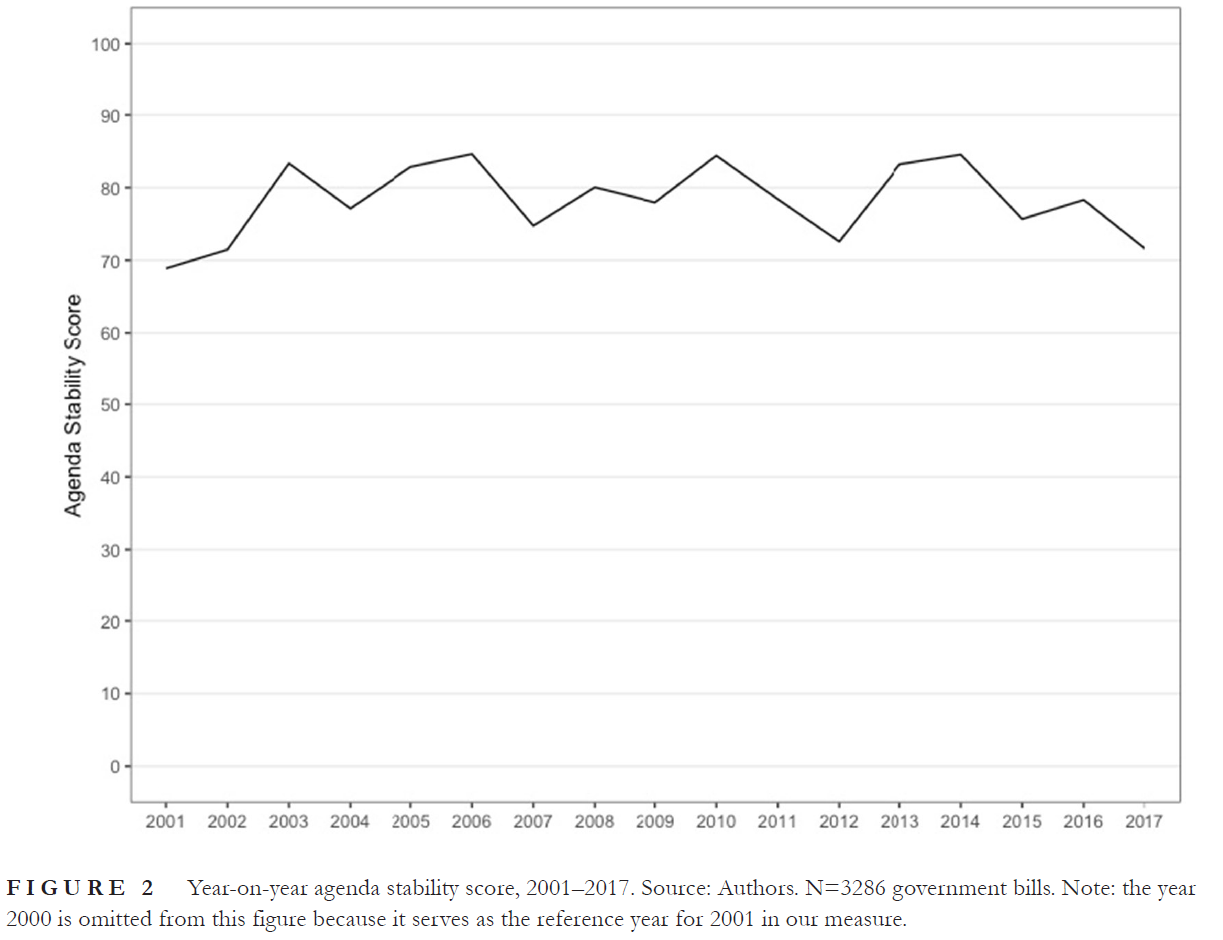
RQ2: How stable is the executive lawmaking agenda?

RQ3: Do the major political parties pursue different lawmaking agendas when in government? 

RQ4: Does a change in prime minister affect which issues receive executive lawmaking attention? 

Our study utilized an original dataset of 3,982 bills introduced into the Australian Federal Parliament between 2000 and 2017, focusing on government bills introduced by ministers. We coded each bill based on its policy content using the Australian Policy Agendas Codebook (APAP), measuring policy attention by counting the number of bills devoted to specific policy areas. We assessed agenda stability by using Sigelman and Buell’s measure of issue convergence, which calculates the degree of overlap in legislative attention distribution between different years. 

The results, illustrated in Figure 1, show that government operations and macroeconomics were the two largest policy areas on the executive lawmaking agenda, accounting for nearly 10% and over 8% of the agenda, respectively. Health, banking, and labor policy rounded out the top five policy areas, collectively making up over 40% of the entire executive lawmaking agenda. On the other hand, issues related to civil rights, minority concerns, civil liberties, housing, and community development, and cultural matters received limited attention. We also found a high degree of stability in the executive lawmaking agenda over time, with around 78% of the agenda overlapping from one year to the next.

Our analysis suggests that this stability persists even after power is shifted between political parties, as indicated in Figure 2. We also find that a change in prime minister is statistically related to a change in policy attention, but more work needs to be done to understand why. These findings seem to align with existing CAP research.

Further research needs to be done on executive policy agendas. Though we primarily looked at legislation, it is not the only kind of policy. Many executives have the ability to enact laws outside of the typical legislative process. Future research should focus on executive power in different stages of the policy process, non-legislative executive policy agendas, and examining alternative agenda spaces to deepen our understanding of executive lawmaking power.

You can read the original article in Policy Studies Journal at

Gibbons, A., and Evans, R.. 2023. “The executive lawmaking agenda: Political parties, prime ministers, and policy change in Australia”. Policy Studies Journal, 51, 307–325. https://doi.org/10.1111/psj.12503

About the Authors

Dr. Andrew Gibbons holds a PhD in political science from the University of Melbourne. His published research focuses on political communication and public policy, including policy responses to mis/disinformation, policy agendas, and the communication of policy ideas. 

Dr Rhonda Evans is an Associate Professor of Instruction in the Department of Government and Director of the Edward A. Clark Center for Australian and New Zealand Studies at the University of Texas at Austin. She holds a J.D. and a Ph.D. in Government and studies agenda-setting politics, focusing on the Australian Human Rights Commission and Federal Parliament of Australia, as well as judicial politics in Australia and New Zealand. She is co-author of Legislating Equality: The Politics of Antidiscrimination Policy In Europe with Oxford University Press. 
Find her on LinkedIn: https://www.linkedin.com/in/rhonda-evans-305aa4105/

Buzzworthy Updates from the PSJ Editorial Team

Greetings! As the year draws to a close, the Policy Studies Journal (PSJ) is excited to announce the upcoming release of its final issue of the year, PSJ 51(4). This November issue will feature ten exceptional articles that explore a wide range of themes within policy theory and substantive policy domains. We are confident that these articles will be a valuable resource for anyone interested in policy process research.

In addition to the exceptional contributions in this PSJ issue, we would like to take this opportunity to announce some significant developments and updates in PSJ’s operations. Firstly, we are thrilled to welcome Dr. Saba Siddiki from Syracuse University as our new Associate Editor. Dr. Siddiki is an accomplished scholar with expertise in policy theory and institutional analysis. We are confident that she will bring a wealth of experience to our editorial team and contribute to maintaining PSJ’s reputation as a leading publication outlet in the field.

We are also proud to have Drs. Heasun Choi from the University of Arkansas, Briana Huett from Drexel University, and Davor Mondom from Syracuse University join us as Managing Editors. Their diverse experiences and expertise will play a crucial role in shaping the course of the journal and ensuring that we keep up with emerging trends in policy research.

Aligned with our commitment to nurturing a vibrant community of policy scholars, practitioners, and citizens, we are excited to announce the launch of the PSJ Blog. Led by Dr. Melissa Merry, our Associate Editor, the PSJ Blog provides a platform for authors to extend the reach and impact of their research and encourages dialogue between policy researchers and practitioners. 

To facilitate meaningful conversations within the policy community, we are now accepting short article manuscripts (3,000-5,000 words) that meet the same rigorous standards for theoretical depth and methodological sophistication as full PSJ articles. This initiative is led by Dr. Gwen Arnold, our Associate Editor and PSJ Short Article Editor. We invite policy scholars to submit their innovative research on policy issues in concise and impactful ways.

Finally, we are pleased to announce that we will be publishing a PSJ special issue on homelessness in the coming year. Homelessness presents one of the most pressing social problems of our time and requires innovative and resolute policy solutions. We are eagerly looking forward to receiving impactful policy research that contributes to the policymaking process in this area.

We are proud of the exceptional contributions that have made PSJ a leading publication outlet in the field. We would like to express our gratitude to our contributors, reviewers, and readers for their support and involvement in making our journal a success. We look forward to continuing to promote high-quality policy research and providing a platform for valuable discussions on policy issues. Thank you!

Political Institutions, Punctuated Equilibrium Theory, and Policy Disasters

by E.J. Fagan

The classic authoritarian promise is to impose order on a disorderly society.  Benito promised to make the trains run on time. Donald Trump promised that he alone could save the country. The Chinese Communist Party promises record economic growth. All authoritarians ask that, in return, societies give up their political freedoms. If they can just push through all the noise and enact their vision for public policy without friction, they will make your life better. It is a tempting bargain for many people.

However, these promises are false. The political institutions of liberal democracies–such as free speech, rule of law, a vibrant political society, and an egalitarian democratic system–also make it better off. Liberal democracies are not only freer societies, but also have higher economic growth and human development indices.

In “Political institutions, punctuated equilibrium theory and policy disasters,” I add to that literature, using punctuated equilibrium theory (PET) to examine why some countries experience more of the most extreme policy failures than others. Briefly, PET posits that governments show a pattern of policy change where very little happens for a long period of time followed by short periods of explosive change. Governments that ignore problems for longer tend to have more pronounced policy punctuations to make up for lost time, while governments that address problems sooner tend to enact smaller changes. Authoritarian countries tend to have an even more punctuated pattern of change: they ignore problems for longer, then pass very large changes when they finally get around to doing something about it.

I study two very different types of policy disasters in this article. First, I use data on financial crises, such as sovereign debt defaults, hyperinflation, and major bank failures. Second, I use data on high-casualty natural and technological disasters. Each dataset contains observations beginning in the 1960s.

Figure 1 shows the relative frequency of both types of disaster in governing systems, compared to liberal democracies. Notably, authoritarian countries experience nearly twice as many financial crises. Closed autocracies, such as China or North Korea, experience more natural and technological disasters, but the result is not statistically significant. Electoral autocracy, which hold non-competitive single-party elections, are even worse.

Electoral democracies, which hold competitive elections but lack the free speech, press, civil society, and rule of law of liberal democracies, perform just as poorly, or even worse, as authoritarian systems. This result suggests that democracy needs these liberal institutions to function. Without them, countries like Turkey and Nigeria struggle to detect and solve problems before they become disasters.

Figure 1: Regime Types and the Frequency of Policy Disasters

Figure 2 examines the relationship between policy disasters and political institutions. The results suggest that countries with political institutions that are more inclusive and allow for free society have fewer policy disasters. Further, countries with more streamlined institutions, such as unitary systems and parliamentary systems, are better at solving problems before they become disasters.

Figure 2: Policy Disasters and Political Institutions

In conclusion, authoritarians make far more mistakes than their liberal democratic counterparts.  Nobel Prize-winning economist Amartya Sen once observed that every famine in world history occurred under an authoritarian government. These results suggest that authoritarian mistakes are broader than just famines; detecting problems before they become severe is authoritarianism’s biggest weakness.

At the same time, these results are a warning for backsliding democracies. Some leaders may want to maintain some semblance of a democracy, but eliminate the annoying problems created by a free press, independent judiciary or empowered civil society. But, democracy can’t function without these institutions. Without them, leaders in weak democracies are flying blind.

You can read the original article in Policy Studies Journal at

Fagan, E. J.(2023). Political institutions, punctuated equilibrium theory, and policy disasters. Policy Studies Journal, 51: 243–263. https://doi.org/10.1111/psj.12460

About the Author

E.J. Fagan is an Assistant Professor of Political Science at the University of Illinois Chicago. He studies agenda setting, think tanks, political parties and policymaking in the U.S. Congress.


The Editor

by Creed Tumlison

Once upon office hours dreary, while I pondered, weak and weary,
Over stacks of papers written with AI and nothing more –
While battling with my own frustration, looking for proper citation,
Suddenly, a notification, passing through my email’s door –
“Probably a student,” I presumed, “wanting extra credit more –
Check the syllabus, I implore!”

Oh how distinctly I remember, such an email in December
warmed my poor heart’s dying ember and picked me up off of the floor.
Quickly to my email turning, for this news I had been yearning,
Thinking the journal had been spurning – spurning my revisions more.
An email from the Journal Editor –  article accepted, I implore!
But said the Editor, “R&R, and nothing more.”

While I should have been elated, I sat there staring, almost sedated,
Since once again over reviewer comments I must pour.
Reading over suggested revisions, I must make some tough decisions,
And reply with no derisions, to reviewer comments galore.
How should I address these comments and not be a bore?
This is my task, and nothing more.

Then upon my resubmission, I waited through the intermission,
Dreaming of the new addition – adding to my CV more.
When an email notification, filled me with utmost elation,
For it was labeled from the desk of the Journal Editor.
“I’ll go tell my colleagues of acceptance, my journal article number four!”
But, requests the Editor, “Review one more.”


Happy Halloween from the PSJ Editorial Team!

Introducing Short Articles

We are excited to announce a change at PSJ that we hope will give policy scholars a unique option for developing and refining theory and strengthening our field’s methodological rigor. PSJ is now accepting short articles of 3,000-5,000 words, roughly half the length of our typical manuscripts. Short articles will meet the same high standards for theoretical depth and methodological sophistication as full PSJ articles. The difference is that short articles offer a narrower contribution, concisely communicating new ideas or approaches in policy research.

There are two options for short articles: A research note presents empirical data and analysis, ideally a novel methodology or novel application of a method, or an attempt to replicate previous empirical findings. A perspectives piece presents novel theory or arguments and potentially proposes a related research agenda.

Short articles should be situated in policy science research. They do not need to be strictly rooted in policy process theory, but should explicitly engage a readership interested in policy process theory. Both types of articles must (briefly) make a case for why the data analysis or theoretical arguments they pursue are needed or important; typically this will involve citing policy scholarship.

Like full PSJ articles, the word limit for short articles excludes references. We strongly encourage scholars to cite high-quality scholarship from a diverse range of authors. For further information on our recommendations regarding just and equitable citation practices, please see here. If a short article is accepted, authors commit to writing a PSJ blog post about it.

We are immensely thankful to Dr. Gwen Arnold (PSJ Associate Editor) for taking the lead in this endeavor as the PSJ Short Article Editor. Please reach out to the editorial team (policystudiesjournal@gmail.com) should you have any further questions. We look forward to collaborating with you on this exciting new venture!

Policy Dimension: A New Concept to Distinguish Substance from Process in the Narrative Policy Framework

by Johanna Kuenzler & Bettina Stauffer

The Narrative Policy Framework (NPF) is a handy tool for policy scholars, shedding light on the strategic uses of narratives in policy debates. However, a critical distinction often remains overlooked in existing literature: the separation of narrative elements focusing on substance from those centered on process. In our study, we emphasize the significance of this differentiation.

When we talk about a policy’s “substance,” we refer to its design — the core problem it addresses and the instruments applied to solve the problem. On the other hand, “process” pertains to the dynamics of influence and power surrounding the policy. To illustrate this distinction, consider the following example:

Narrative 1: We need to stop fossil fuel companies from jeopardizing our children’s future by preventing them from extracting climate-damaging energy sources.

Narrative 2: We need to stop fossil fuel companies from jeopardizing our children’s future by curbing their excessive lobbying against the introduction of a Green New Deal.

Both narratives cast fossil fuel companies as villains, thus signaling to readers that their behavior is problematic. However, Narrative 1 delves into the substance of the issue, focusing on the environmental consequences of the companies’ business. In contrast, Narrative 2 centers on the policy process, highlighting the lobbying practices of these companies that impede progress in climate policy.

To situate this distinction within the NPF, we introduce the concept of “policy dimension.” This dimension classifies narrative content as either substance-focused or process-focused. To assess its utility, we applied this concept to the case of the Child and Adult Protection Policy (CAPP) in Zurich, Switzerland.

Our methodology involved compiling a comprehensive dataset of parliamentary debates and newspaper articles. We then scrutinized these sources to ascertain the analytical value of the policy dimension within narrative content. Our findings revealed the prevalence of both substance and process narratives in CAPP debates. Additionally, we observed that the context in which a narrative is presented influences its policy dimension. Parliamentary debates, for instance, exhibited higher rates of process-oriented narrative elements compared to newspapers.

In summary, the “policy dimension” concept provides researchers with a more nuanced and precise tool for analyzing how narratives function in the policy process, and we look forward to seeing future applications.

We thank Eli Polley for supporting us in the drafting of this blog post.

You can read the original article in Policy Studies Journal at

Kuenzler, Johanna and Stauffer, Bettina. 2023. “ Policy dimension: A new concept to distinguish substance from process in the Narrative Policy Framework.” Policy Studies Journal, 51, 11–32. https://doi.org/10.1111/psj.12482.

About the Authors

Johanna Kuenzler is a research associate for public policy at the German University for Administrative Sciences Speyer. Her main areas of expertise are the Narrative Policy Framework (NPF) and organizational reputation. Empirically, she focuses on social and environmental policies as well as on animal welfare.
Learn more at: www.johanna-kuenzler.com
Follow her on X: @jo_kuenzler

Bettina Stauffer is a research associate for public policy at the Center for Public Management of the University of Bern. Her research focuses on policy making and public policy implementation, particularly in the areas of social and health policy as well as child and adult protection.

The Advocacy Coalition Index: A New Approach for Identifying Advocacy Coalitions

by Keiichi Satoh, Antti Gronow & Tuomas Ylä-Anttila

Often the first step to finding a solution is knowing what the problem is.

In April 2018, Antti Gronow, Tuomas Ylä-Anttila and Keiichi Satoh were attending the Joint Sessions of the European Consortium for Political Research (ECPR) in Nicosia, Cyprus. The session in question was organized by Chris Weible, Karin Ingold and Daniel Nohrstedt and it made Gronow and Ylä-Anttila think of how problematic it is to study advocacy coalitions in a comparative context. Coalitions among political actors are central to politics and policy, which is a fact long recognized within the Advocacy Coalition Framework (ACF).

In Cyprus, Gronow and Ylä-Anttila realized that previous research lacks a consistent way of identifying and measuring advocacy coalitions. During a break in the sessions, Gronow and Ylä-Anttila shared their concerns regarding the lack of a consistent method for identifying advocacy coalitions with Keiichi Satoh. Three months later, inspired by a figure explaining the fuzzy sets used in the qualitative comparative analysis, Satoh showed an initial sketch of a way to identify coalitions to Gronow and Ylä-Anttila. After intensive discussions, this sketch evolved into the Advocacy Coalition Index (ACI).

How does the ACI work?

The ACI is a combined measure of policy beliefs and coordination of action, based on techniques of social network analysis. It is a standardized method for identifying and analyzing advocacy coalitions that can be applied to comparative research and also to other research contexts involving attribute and relational data.

To use the index, researchers must first obtain information about policy actors’ beliefs and coordination relationships between these actors. Such data can be collected through a survey, public statements, or any reliable method of data collection. Next, the method focuses on identifying homophilous ties (in which like-minded actors coordinate with one another), cross-coalition ties (coordination between actors holding diverging beliefs), and missing ties (ties that do not exist between like-minded actors). The ACI can be expressed as a formula in the following way:

ACI= 1 – (Cross-coalition ties + Missing ties)

Political subsystems with typical, adversarial advocacy coalitions are likely to be closer to the value of one as a result of the calculation. In addition, to characterize different kinds of advocacy coalitions within subsystems, scholars can analyze variation in the homophilous ties score and in the ratio of cross-coalition ties and homophilous ties (the CCH ratio), as illustrated in the figure below. For example, in the case of adversarial coalitions (i.e. typical advocacy coalitions), there are many homophilous ties between like-minded actors (i.e., few “missing ties”), and almost no ties between actors with dissimilar beliefs.

The ACI can be applied in many different contexts in a consistent way. A standard way of measuring advocacy coalitions thus allows scholars to compare their results with studies conducted in other countries or other policy subsystems.

Our work also has implications outside academia. Policymakers and analysts now have a tool to reliably detect coalitions involved in policy processes, which helps in designing policy proposals that are politically feasible. Policy can be designed, implemented, and evaluated with a clearer understanding of the kinds of coalitions that are involved, as long as appropriate data exists. 

We are confident that our systematic, data-driven approach will be a useful contribution to the field of public policy research. We also hope that the ACI will be used as a tool in the policy process.

You can read the original article in Policy Studies Journal at

Satoh, K., Gronow, A. and Ylä-Anttila, T. 2023. “The Advocacy Coalition Index: A new approach for identifying advocacy coalitions.” Policy Studies Journal 51: 187–207. https://doi.org/10.1111/psj.12450

About the Authors

Keiichi Satoh is an Assistant Professor at the Faculty of Social Sciences, Hitotsubashi University, Japan. His research interests include climate and energy policy, social movements, and political processes using network theory and methods. His research has appeared in peer-reviewed journals such as Social Movement Studies, Urban Studies, and Journal of Comparative Policy Analysis.

Antti Gronow is a Senior Researcher at the Faculty of Social Sciences, University of Helsinki. His research interests include climate policy, advocacy coalitions, social network analysis, and political polarization. His research has been published in peer-reviewed journals such as Global Environmental Change, Governance, Policy Studies Journal, Public Administration, and JPART. Follow him on X: @AnttiGronow

Tuomas Ylä-Anttila is an Associate Professor of Political Science at the University of Helsinki. He currently leads four research projects on policy networks, communication networks and climate change politics, and chairs the 14-country comparative research effort Comparing Climate Change Policy Networks (see compon.org). His work has appeared in journals such as Global Environmental Change, Public Administration, Policy Studies Journal, Governance, and British Journal of Sociology.

Call for Applications for Guest Editor(s) of a Policy Studies Journal Special Issue on Homelessness

Policy Studies Journal, the premier outlet for scholarship developing and refining public policy theory, is seeking scholars to guest edit or co-edit a special issue on homelessness policy. Homelessness is a critical, complex societal challenge that requires creative and determined policy action. We hope to publish a collection of papers which meaningfully advance public policy theory by addressing questions such as (though not limited to): What factors shape the adoption of particular policies addressing homelessness? How do homelessness policies affect their target populations? What factors shape the stringency or laxity of these policies? How do unhoused people experience homelessness policies, and with what consequences? Can we predict the types of policy designs that will  be used in this policy domain, and why? We expect the special issue ultimately to contain at least 10 rigorous papers. Special issues typically take 18-24 months from the acceptance of a guest editor application through final publication.

An application for guest editorship should include:

  1. Name and affiliations of the proposed guest editor(s) (maximum of three) and an explanation of the homelessness policy expertise and editorial experience (as applicable) that equip the proposed guest editor(s) to manage this special issue (1-2 paragraphs per proposed guest editor).
  2. A description of the proposed guest editors’ vision for the special issue, not exceeding one page. This statement should discuss why the special issue will interest PSJ readers and highlight its expected novel contributions to public policy theory.
  3. Details on 15 or more high-quality and theoretically meaningful papers around homelessness policy that the proposed editors expect to be submitted for peer review. For each paper, these details should include an abstract and names and affiliations of its authors.
    • Although we understand that sometimes unforeseen events arise, the guest editor(s) should do their best to ensure that these authors are firmly committed to submitting their proposed papers to the special issue. 
    • The proposed papers should: Propose theoretical frameworks or concepts; empirically test theoretical frameworks or concepts using quantitative or qualitative methods; or provide a comprehensive review of relevant policy literature, identifying key themes and synthesizing key findings. 
    • During the process of developing the special issue, guest editors can solicit additional abstracts/papers not included in the original proposal. 
  4. A proposed timeline for accomplishing the guest editorship tasks described here. 

The guest editor(s) should commit to:

  1. Soliciting papers around homelessness policy that are high quality and make a meaningful theoretical contribution to public policy scholarship.
  2. Reviewing and providing feedback on each manuscript before it is submitted for review at PSJ, and/or coordinating a pre-submission review process wherein authors offer comments on each others’ work.
  3. Writing an introductory piece that frames and highlights the interconnections among papers ultimately included in the special issue and proposes an agenda for future policy scholarship on homelessness.

The PSJ editorial team will:

  1. Work closely with the guest editor(s) to ensure a smooth editorial process.
  2. Ensure the editorial process follows PSJ submission protocols, including double-blind review and resubmission within six months of a “revise and resubmit” decisions.
  3. Make final decisions about accepting or rejecting manuscripts. The PSJ team may confer with guest editor(s) about these decisions or may make them independently.
  4. Reserve the right to reject special issue paper submissions that do not meet journal standards and to cancel the special issue, if an insufficient number of high-quality submissions is received within a reasonable timeframe.
    • If the special issue is canceled, papers submitted pursuant to the special issue call, and which received an acceptance upon peer review, will be slated for inclusion in a regular PSJ issue. 

Applications for guest editorship should be submitted as a Word document to policystudiesjournal@gmail.com by January 29, 2024. Questions about the special issue or its editorship should be directed to the same address. The PSJ editorial team expects to make a decision concerning applications in late January or early February 2024.

Linking Issues for Long-Term Governance Success

by Dana A. Dolan

Governments frequently grapple with a perpetual cycle of reacting to immediate crises, leaving little room for proactive, long-term policy development. The concept of long-term governance, characterized by policies promising future benefits but incurring short-term costs, often faces challenges in securing priority amid more pressing issues. 

Nonetheless, the importance of long-term governance cannot be understated, given its historical successes and its relevance in addressing contemporary global challenges. For instance, the establishment of America’s National Park System was a clear investment in preserving nature for future generations. Today, nations worldwide confront a mounting array of long-term challenges, including climate change, biodiversity loss, immigration reform, and extreme economic inequality.

Lessons from Australian Climate Adaptation Policy

In a 2021 Policy Studies Journal article, I examined the process leading to Australia’s 2007 Water Act, one of the world’s earliest national climate adaptation policies, for insights into achieving long-term governance goals. The case presented several theoretical puzzles: why did Australian Prime Minister John Howard, a known climate science skeptic, champion this policy? Why did the conservative Howard Government support a policy that aimed to redirect water resources from lucrative agriculture to environmental conservation, contrary to its usual priorities? Why did the proposal garner public and political support during a severe decade-long drought, when all water users fiercely protected their allocations?

I applied Kingdon’s Multiple Streams Framework, analyzing the evolution of problem, policy, and political streams, and the process of coupling these streams to favor policy change over the status quo. After analyzing each of the three streams in depth, this study delved deeper into the coupling process. Its unique insight highlighted the interplay among “partial couplings” (illustrated in Figure 1 below) that connected pairs of streams for multiple policy issues. 

Figure 1. Alternative Approaches to Coupling All Three Streams.

In the Australian case, climate change rose on the policy agenda and became law under the 2007 Water Act, despite not all three streams being ready for coupling. This departure from basic expectations was explained by the policy entrepreneurial strategy known as issue linking. This strategy rhetorically connected the three streams of problems, policies, and politics through partial couplings involving three related issues: climate change (a valid problem with public demand but no viable policy solution), water management (a salient problem with a feasible solution but lacking political will), and adaptive governance (an accepted solution with political backing but no salient problem).

This configuration of multiple partial couplings allowed proponents of policy change to construct a convincing argument for legislative action. For a recent explanation of the MSF theory behind the coupling process, refer to Dolan and Blum’s work (2023/in press)

Issue Linking through Multiple Partial Couplings  

Issue linking emerges as a pivotal strategy for overcoming the challenges of long-term policymaking, where problems are recognized, viable policy solutions exist, but political will is lacking. However, not every combination of issues proves effective. Linked issues only succeed when the combination connects all pairs of streams through multiple partial couplings. In essence, issue linking serves as a guiding principle for policymakers navigating the complexities of long-term governance, where decisions today can shape a better and more sustainable tomorrow.

You can read the original article in Policy Studies Journal at

Dolan, Dana A. 2021. “Multiple Partial Couplings in the Multiple Streams Framework: The Case of Extreme Weather and Climate Change Adaptation.” Policy Studies Journal 49(1): 164–89. https://onlinelibrary.wiley.com/doi/abs/10.1111/psj.12341#

Other References

Dolan, Dana A., and Sonja Blum. 2023/in press. “The Beating Heart of the MSF: Coupling as a Process.” In The Modern Guide to the Multiple Streams Framework, eds. Nikolaos Zahariadis, Nicole Herweg, Reimut Zohlnhöfer, and Evangelia Petridou. Edward Elgar.

About the Author

Dana A. Dolan is a policy fellow and adjunct faculty member at George Mason University’s Schar School of Policy and Government. She is also a professorial lecturer in international affairs at The George Washington University’s Elliott School of International Affairs. Her research focuses on long-term governance issues, the politics of policymaking, and refining Kingdon’s Multiple Streams theory of the policy process. Her theory-driven work has been featured in top journals like Policy Studies Journal and Ambio: A Journal of the Human Environment.

Tips From the Editors

In the last few weeks, we have explained a few key pieces of advice that our editorial team thought would be helpful for prospective authors. This week, we will highlight a couple more suggestions from our team.

Tip #3: Don’t Bury the Lede

Tell the reader why your work is important! Associate Editor Gwen Arnold pointed out, “Authors, myself included, often write initial drafts similar to how they might tell a story, building a narrative arc and reaching a climax and then a resolution that delivers a moral or message.” She goes on to explain that this approach can cause authors to explain the most important aspects of their work later in the paper. Instead, make it clear to readers why your work is innovative and novel. State the key takeaways of your paper in the abstract, the introduction, the discussion, and then again in the conclusion. Don’t make reviewers, editors, and readers dig around for the lede; make it obvious so that you can grab their attention and keep them reading.

Tip #4: Intellectual Identity

Every journal, researcher, and individual work has what Editor-in-Chief Geoboo Song calls an “intellectual identity.” This includes the questions investigated, the methods used, and the topics and theories of focus. We recommend putting in the effort to make sure your work’s intellectual identity aligns with the journal’s. Read through a journal’s recent publications, social media posts, and website to gain a grasp on its identity. After that, take a look at the editorial team. Try to look through their research to discover their individual identities — after all, they are the ones who make most of the manuscript decisions. Finally, go back over your paper. Does it seem to fit with the collective intellectual identity? Would this journal’s readers be interested in your work? 

Academic publication is a competitive process, especially at journals like PSJ that receive a large volume of submissions. Hopefully, these tips from our editorial team will be of use to you when you are submitting your next paper.