The Triangle of Bureaucratic Policy Analysis and the Professional Types of High-Level Civil Servants: Empirical Evidence from Southern Europe

by Giliberto Capano, Alice Cavalieri, & Andrea Pritoni

Public policy and public administration research has focused on conceptualizing bureaucrats as pivotal actors in the policymaking process. This has allowed scholars to investigate the capacities and skills of bureaucrats as policymakers and how advice and knowledge inform their behavior. Nevertheless, the literature has proceeded in a fragmented way and without a sophisticated analytical framework that would allow for comparative research. Our recent study aims to address this by proposing a new framework for understanding how high-level civil servants—those at the top of national public administrations—engage in policymaking through the lens of policy analysis.

This study asks a central question: How can we better conceptualize the professional role of senior civil servants in the policy process? To answer this, we developed the “triangle of bureaucratic policy analysis,” which connects three core dimensions of bureaucratic work:

  • Policy Work: What bureaucrats do on a daily basis (e.g., advising, managing, steering).
  • Policy Analytical Capacity: What analytical skills and techniques they use (e.g., economic, legal, statistical).
  • Sources of Information: Where they get their information (e.g., laws, government reports, statistical data).

Figure 1. Triangle of bureaucratic policy analysis.

We applied this framework to a unique dataset: a large survey of 1,014 senior civil servants in the central governments of Greece, Italy, Portugal, and Spain. These countries share a “Napoleonic” administrative tradition and do not typically employ specialized policy analysts, making them ideal cases for examining how policy analysis functions without formal structures.

We used factor analysis to identify patterns in how civil servants combine work, skills, and information. Then, we used principal component analysis (PCA) to cluster these patterns into three main professional “types” of high-level bureaucrats:

  1. Political Generalist: A flexible coordinator and boundary-spanner. These bureaucrats steer ministry activities, interact with politicians and stakeholders, and rely on a broad mix of information sources. They possess “eclectic” analytical capacities—skills gained through both training and professional experience—and play a central role in aligning government priorities across sectors.
  2. Legal Advisor: True to Southern Europe’s legalistic traditions, these civil servants focus on advising political leaders using legal and regulatory tools. Their policy work revolves around assessing legal feasibility, and they rely heavily on juridical sources of information. Their analytical expertise is narrowly focused on legal techniques.
  3. Manager: A newer type, these officials emphasize implementation and results. They are more empirically oriented, favoring evidence-based data and economic analysis. Their policy work includes program management and performance monitoring, reflecting the influence of New Public Management reforms.

Each of these types reflects a different way that bureaucrats contribute to policymaking—one political and strategic, one legalistic, and one managerial.

Image Description

Figure 2. (a) Empirical types of high-level civil servants in Southern Europe: Type 1 (political generalist). (b) Empirical types of high-level civil servants in Southern Europe: Type 2 (legal advisor). (c) Empirical types of high-level civil servants in Southern Europe: Type 3 (manager).

This study contributes to a growing recognition that senior civil servants are more than passive implementers—they are policy actors with distinct analytical profiles. Our “triangle” approach offers a new way to classify and understand how bureaucracies influence policymaking, moving beyond simplistic divides like “generalist vs. specialist” or “bureaucrat vs. politician.” Moreover, these insights are relevant for reform efforts, helping policymakers assess whether administrative roles and skills are well-matched—and whether bureaucrats are being utilized effectively across different policy challenges.

You can read the original article in Policy Studies Journal at

Capano, Giliberto, Alice Cavalieri and Andrea Pritoni. 2025. “The Triangle of Bureaucratic Policy Analysis and the Professional Types of High-level Civil Servants: Empirical Evidence From Southern Europe.” Policy Studies Journal 53(1): 69–90. https://doi.org/10.1111/psj.12577.

About the Authors

Giliberto Capano is a professor of Public Policy at the University of Bologna, Italy. He specializes in public administration, public policy analysis, and comparative higher education. His research focuses on governance dynamics and performance in higher education and education, policy design and policy change, policy instruments’ impact, the social role of political science, the policy impact of COVID-19, and leadership as an embedded function of policy making. His recent books are A modern Guide to Public Policy (coedited with M. Howlett, Edward Elgar, 2020); Convergence and Diversity in the Governance of Higher Education (coedited with D. Jarvis, Cambridge University Press, 2020); Trajectories of Governance How States Shaped Policy Sectors in the Neoliberal Age (coauthored with A. Zito, J. Rayner, and F. Toth, Palgrave, 2022); The Fate of Political Scientists in Europe (with Luca Verzichellli, Palgrave, 2023). 

Alice Cavalieri is a post-doctoral researcher at the University of Trieste (Italy), where she works on a project about the response of parliaments and governments to different crises. Her main research interests are public budgeting and women’s representation. Her first book, Italian Budgeting Policy (Palgrave Macmillan; 2023), has been awarded the “Pietro Grilli di Cortona” Biannual Prize for the best book published by a member of the Italian Political Science Association. She is a member of the Italian team of the Comparative Agendas Project and former country lead for Italy of the OxCGRT led by the Blavatnik School of Government (University of Oxford).

Andrea Pritoni is an associate professor of Political Science in the Department of Arts at the University of Bologna, where he teaches Electoral Campaigns in Italy and Institutional Relations and Advocacy. His main research interests relate to Italian politics, lobbying and interest group politics, as well as comparative public policy. He has recently published articles on South European Society & Politics (2024), International Review of Administrative Sciences (2024) and European Political Science (2024).

Why Did a Progressive Tax Reform Succeed in Mexico Under a Pro-Business Party?

by Oswaldo Mena Aguilar

In 2013, Mexico passed a sweeping tax reform that, surprisingly, included measures to increase taxes on the wealthiest individuals and corporations—despite being led by a party often aligned with elite economic interests. A decade earlier, under similar institutional conditions and with widespread support from the business sector, a far more modest reform effort had collapsed. What explains this contrast?

My article tackles this puzzle by comparing two major reform efforts: President Vicente Fox’s failed 2001 attempt and President Enrique Peña Nieto’s successful 2013 overhaul. Despite similar levels of party fragmentation and legislative constraints, the outcomes were drastically different—not only in terms of success, but also in ideological orientation.

To make sense of these differences, I assess two major policy process theories: the Advocacy Coalition Framework (ACF) and Kingdon’s Multiple Streams Framework (MSF). The ACF suggests that lasting policy change results from coalitions of actors united by deep normative commitments. Yet in Mexico, such ideological coherence was absent in 2013. Instead, I argue that policy entrepreneurs took advantage of fleeting political windows—exemplifying the kind of opportunistic “coupling of streams” Kingdon describes.

In 2001, Fox’s proposal to extend the Value Added Tax (VAT) to basic goods failed because the PRI—then the main opposition party—refused to pay the political cost, despite sharing the PAN’s economic preferences. And yet, the Income Tax portion of that bill passed unanimously, after PRD legislators accepted corporate-friendly provisions in exchange for key progressive concessions. This trade-off exemplified a strategic, if ideologically messy, compromise enabled by a temporary alignment of interests.

Fast forward to 2013, when PRI, back in power, launched a tax reform that defied expectations: it dropped controversial VAT expansions and instead raised income and capital taxes on top earners. The reform succeeded not due to ideological conviction, but because it was part of a broader legislative package negotiated under the “Pacto por México.” PRI’s flexibility—along with the PRD’s willingness to strike a deal—made it possible to capitalize on a narrow legislative opportunity.

This case shows that policy change—even in rigid institutional environments—does not always reflect stable coalitions or shared beliefs. Sometimes, it’s about seizing the moment.

You can read the original article in Policy Studies Journal at

Mena Aguilar, Oswaldo A. 2024. “ Advocacy Coalitions or Pragmatic Coupling of Streams? Explaining Policy Change in Mexico: The Tax Reforms of Vicente Fox and Enrique Peña (2001 and 2013).” Policy Studies Journal 00 (0): 1–27. https://doi.org/10.1111/psj.12537.

About the Author

Oswaldo A. Mena is a Ph.D. Candidate in Political Science at the Graduate Center of the City University of New York. His research focuses on comparative politics, political economy, and the political determinants of inequality, poverty, and redistributive politics and policies in Latin America. He is a Data Research Fellow at the Center for Latin American, Caribbean, and Latino Studies and was a 2024 Junior Scholar of the Stone Center on Socio-Economic Inequality. He previously worked in Mexico’s public sector for nearly a decade.

Bluesky: @omenaguilar.bsky.social
X: @omenaguilar
Google Scholar: Here
Orcid: Here

Immigration, Government Type, and Social Welfare Spending

by Hang Qi

Immigration and the welfare state are often cast as adversaries in political debates. When immigration increases, concerns about overburdened social services frequently rise to the surface—especially during times of fiscal constraint. But is the relationship really that simple?

In my recent article, I argue that this question cannot be adequately answered without considering the role of the institutional framework and arrangements—specifically, the type of government in power.

Drawing on panel data from 28 advanced democracies between 1980 and 2019, I examine how immigration inflows interact with government types—single-party majority, coalition, and minority governments—to influence welfare spending. My findings show that the relationship between immigration and social expenditure is not uniform. While immigration alone does not have a consistent effect on welfare spending, its impact is significantly shaped by the type of government.

Coalition and minority governments – where power is more dispersed – are more likely to respond to immigration with increased welfare spending. This contrasts with single-party majority governments, which tend to be more cautious or even restrictive. The reasons are both institutional and political. In more fragmented governments, there are numerous veto players, and accountability is shared. This can shield pro-welfare and pro-immigration parties from electoral risks and dilute the policy influence of anti-immigrant sentiment.

By contrast, single-party majority governments, especially under growing public concern about immigration, may face stronger incentives to hold down spending. Parties in such governments are more directly accountable for all policy outcomes and may be wary of appearing “soft” on immigration in the eyes of median voters.

Real-world cases underscore these dynamics. In France, left parties in coalition governments have actively defended immigrants’ access to healthcare, despite political resistance. Meanwhile, in Denmark and the U.S., left-leaning single-party governments have in some instances moderated or even reversed their immigration-friendly positions in response to electoral pressure.

These findings illustrate a broader lesson: institutions matter. Political institutions determine how the government responds to social pressures and also condition whether immigration leads to policy expansion or retrenchment. Understanding these institutional filters is crucial for designing sustainable and inclusive social welfare policies in an era of increasing migration and political polarization.

You can read the original article in Policy Studies Journal at

Qi, Hang. 2025. “ Immigration, Government Type, and Social Welfare Spending.” Policy Studies Journal 00(0): 1–16. https://doi.org/10.1111/psj.70015.

About the Author

Hang Qi is an Assistant Professor of Political Science in the Department of Government and Public Administration at the University of Macau. His research focuses on the policy and politics of redistribution, immigration policy, fiscal policy, and political economy. His work has been published or is forthcoming in Policy Studies Journal, Public Opinion Quarterly, American Politics Research, and other journals.

X (Twitter): @Sailing_HQ1123
Facebook: Hang Qi
Linkedin: Hang Qi

Can Reducing Learning Costs Improve Public Support for Means-Tested Benefit Programs?

by Gregory Porumbescu, Stephanie Walsh, & Andrea Hetling 

This study examines how lowering learning costs in means-tested benefit programs, such as the Supplemental Nutrition Assistance Program (SNAP), influences public support and perceptions of beneficiary deservingness. Drawing on educational psychology research (cognitive load theory) and policy feedback theory, we investigate how the structure and clarity of information about SNAP’s eligibility and application process influence learning costs, public support, and attitudes. Through a pre-registered dose-response survey experiment, our findings show that improving the clarity of SNAP information reduces learning barriers, increasing support and positive perceptions of beneficiaries. This study is guided by two testable hypotheses:  

  1. Reducing learning costs improves comprehension drawing on educational psychology cognitive load theory. 
  2. Improved comprehension increases public support based on policy feedback theory. 

To test these hypotheses, we performed a dose-response survey experiment involving 1,677 New Jersey residents. Participants were assigned randomly to one of four groups: a control group that was given no information, and three treatment groups that were given increasingly clearer and more structured information on SNAP. The treatments were: 

Flyer: A low-structuring treatment with minimal structuring of content.
Screener: A tool that breaks the content into bite-sized, manageable chunks, mimicking state-level eligibility screens.
Video: A how-to tutorial walking participants through the eligibility process. 

After being exposed to the treatment, each participant answered a series of questions related to SNAP, with the number of questions they answered correctly comprising the dependent variable, their SNAP comprehension score. To analyze the data, we employed a one-way analysis of variance (ANOVA) to evaluate whether differences exist across the control and three treatment groups. We utilized planned contrasts to determine if the means differed significantly across each treatment group. To analyze the relationship between comprehension and program support measures, we used ordinary least squares regressions. The mediation framework improves upon traditional methods by leveraging the potential outcomes framework. By modeling intermediate pathways explicitly, this method offers improved estimates of indirect effects compared to the associations produced by standard mediation techniques.

Image Description

Figure 2. Distribution of SNAP comprehension score by treatment group. 

As shown in figure 2, providing structured, digestible information significantly enhances study participants’ knowledge. The video treatment group, which received the clearest presentation, had the highest comprehension levels, followed by the screener group. The flyer treatment group, with the least structured data, had the lowest comprehension. In addition, differences by participant racial identity emerged, as Black non-Hispanic participants show a stronger inverse relationship between SNAP understanding and perceived deservingness compared to other groups. These findings underscore the importance of comprehension in shaping attitudes toward SNAP policies. 

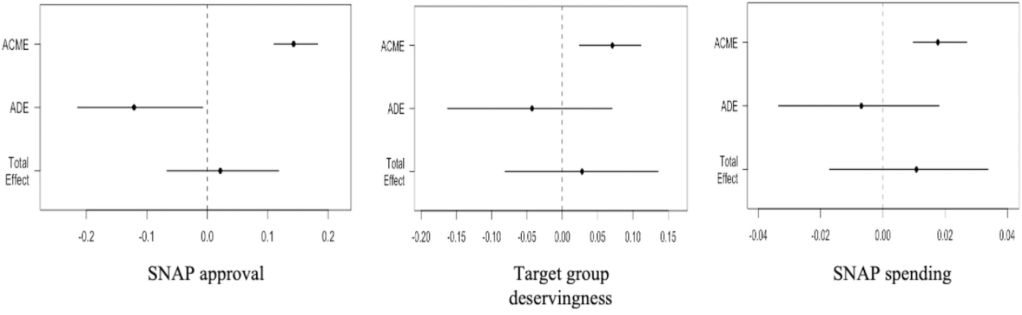
Findings also revealed significant indirect effects on SNAP approval, perceived deservingness, and support for increased funding. Higher comprehension connects reduced learning costs to greater support. This indicates that simplifying information delivery about complex benefit programs can enhance public approval and engagement. These results align with policy feedback theory, highlighting the importance of accessible information in shaping support for means-tested policies such as SNAP. 

Image Description

Figure 3. Indirect effects of content structure on different aspects of SNAP support. 

Empirically, the findings show that reducing learning costs not only improves knowledge but also increases support for programs like SNAP, improves positive perceptions of program beneficiaries, and draws support for program funding. These effects could carry over to other complex safety net programs like Temporary Assistance Needy Families (TANF) and Medicaid, with policy communication implications extending beyond the reduction of learning cost. 

You can read the original article in Policy Studies Journal at

Porumbescu, Gregory, Stephanie Walsh and Andrea Hetling. 2025. “ Can Reducing Learning Costs Improve Public Support For Means-tested Benefit Programs?.” Policy Studies Journal 53(1): 135–157. https://doi.org/10.1111/psj.12578.

About the Authors

Gregory Porumbescu (PhD, Seoul National University) is an associate professor in the Department of Public Administration and Policy at the University of Georgia‘s School of Public and International Affairs (SPIA). His research centers on understanding the implications of technology for government transparency and accountability. Dr. Porumbescu‘s work has been published in journals such as the Journal of Public Administration Research and Theory, Public Administration Review, Governance, and Social Science & Medicine. Prior to joining SPIA, Dr. Porumbescu served as an associate professor at Rutgers University–Newark. There, he was a co-founding principal investigator for the New Jersey State Policy Lab, an initiative dedicated to enhancing evidence based policy making in state governments. During his time at Rutgers, he was also appointed to serve on the AI, Equity, and Literacy Working Group, contributing to Governor Phil Murphy‘s New Jersey AI task force. Dr. Porumbescu‘s research has been supported by organizations such as the National Science Foundation, Korean Research Foundation, and the New Jersey Office of the Secretary of Higher Education.

Stephanie Walsh is Assistant Director of the Heldrich Center. She earned her doctorate in planning and public policy at Rutgers University. She also holds a Master‘s degree in public policy. Stephanie also serves as the Director of the New Jersey Statewide Data System, overseeing the governance, research agenda, and publications that use the linked longitudinal data. Her research interests focus on how data can inform public programs and policies to better support service delivery and improve individual outcomes.

Andrea Hetling is a Professor at the Edward J. Bloustein School of Planning and Public Policy at Rutgers University. Dr. Hetling‘s research interests focus on how public programs and policies can support economic well-being and financial stability among vulnerable populations, including families living in poverty and survivors of intimate partner violence. In 2019, Andrea was selected as one of only five Family Self-Sufficiency and Stability Research Network (FSSRN) Scholars and awarded a five-year grant by the US Department of Health & Human Services, Administration for Children and Families. Before getting her Ph.D., Andrea worked as a program administrator at a domestic violence agency, focusing on advocacy and development issues. As a strong believer in the public impact of applied policy research, Andrea regularly connects her research projects with her teaching and mentoring and to her service to the greater community.

Advocacy Groups, Policy Subsidies, and Policy Change: The Case of Teacher Evaluations

by Leslie K. Finger

In many policy areas, powerful interest groups—such as labor unions or industry associations—shape and protect the status quo. When these vested interests have significant financial and political clout, how do policymakers manage to enact major reforms against their preferences? My paper examines this question through the lens of teacher evaluation policy in the U.S., revealing that advocacy groups play a crucial role in facilitating policy change by providing what I call policy subsidies: information, resources, and capacity that enable reform-minded policymakers to push past entrenched opposition.

My primary research question is: How are powerful interest groups with a stake in the status quo overcome? In the case of teacher evaluations, many states moved to incorporate student growth measures—often derived from standardized testing—as a sizable portion of their teacher evaluation systems despite fierce resistance from teachers’ unions. I investigate why some states were more successful than others in adopting and sustaining these reforms, focusing on the role of advocacy groups in supporting policy change.

Teachers’ unions have long been among the most influential state-level interest groups, using their financial resources and political leverage to shape education policy. Given their strength, it would be expected that states would avoid implementing teacher evaluations that include student achievement as a key factor. Yet, from 2009 to 2015, a growing number of states adopted such provisions. Why?

I argue that advocacy groups—such as education reform organizations—provided information (i.e., policy ideas, analysis, data) and capacity (i.e., time-consuming actions). I call these assets policy subsidies. By reducing the costs associated with enacting and implementing controversial reforms, policy subsidies can make it easier for policymakers to challenge vested interests and push through significant policy changes.

Image Description

To test this theory, I conducted a 50-state quantitative analysis of teacher evaluation policymaking between 2010 and 2011 and case studies of Minnesota and Wisconsin, two states that took different policy paths. The study tested two primary hypotheses:

Hypothesis 1: States where advocacy groups provide policy subsidies are more likely to implement policy change opposed by vested interests than those without such groups.

Hypothesis 2: States where those in power are open to change are more likely to implement significant policy change opposed by vested interests than those without such politicians in power.

Image Description

My quantitative analysis showed that states where advocacy groups were active were significantly more likely to pass teacher evaluation reforms (see Figure 1). The effect of advocacy groups was strongest in states where Republicans controlled the legislature. In these states, advocacy groups helped craft policies that successfully incorporated student achievement as a “significant” factor in teacher evaluations (see Table 5). My case studies of Minnesota and Wisconsin illustrate this dynamic in action. In Minnesota, advocacy groups worked closely with Republican lawmakers to provide both technical policy assistance and political support, leading to the adoption of evaluation reforms. In contrast, Wisconsin—despite similar political conditions where Republicans were in control—lacked strong advocacy group engagement, and teacher evaluation reform was delegated to the bureaucracy, where, in the absence of advocacy group involvement, the student achievement provision was compromised during implementation..

Image Description

This study demonstrates that interest group influence is not absolute; advocacy groups can play a decisive role in shifting policy outcomes by lowering the costs of reform, even where vested interests are strong. Additionally, having policymakers favorable to a particular policy is not enough to overcome vested interests— policymakers need interest group allies to help them craft and implement those policies that might otherwise be stopped in their tracks by powerful interest groups. The concept of policy subsidies extends beyond education, offering insights into how policy entrepreneurs in other domains—such as climate change, healthcare, or labor policy—can challenge entrenched interests.

You can read the original article in Policy Studies Journal at

Finger, Leslie K. 2024. “ Advocacy Groups, Policy Subsidies, and Policy Change: The Case of Teacher Evaluations.” Policy Studies Journal 52 (4): 777–808. https://doi.org/10.1111/psj.12538.

About the Author

Leslie K. Finger is an Assistant Professor of Political Science at the University of North Texas. Her research focuses on interest groups, policymaking, and state and local politics with a focus on education policy. Her work has appeared in various journals, including Perspectives on Politics, Governance, Policy Studies Journal, Interest Groups & Advocacy, American Politics Research, and State Politics & Policy.

Learning in Polycentric Governance: Insights from the California Delta Science Enterprise

by Tara Pozzi, Mark Lubell, Tanya Heikkila, Andrea K. Gerlak, & Pamela Rittelmeyer

Science enterprises play an increasingly important role in shaping the policy process. While existing literature explores the nexus of science and decision-making, research is limited by a lack of empirical institutional analysis—specifically how science is shaped by and a feature of governance institutions. To address this gap, we integrate the ecology of games framework (EGF) and collective learning framework (CLF) to examine how polycentric systems of science actors and forums influence policy-relevant learning. This exploration is guided by three types of hypotheses to account for diverse actors:

  1.  Individual-level hypotheses consider how organizational affiliation, professional involvement, forum participation, and expertise on diverse issues of individual actors participating in a science enterprise may shape perceived learning.
  2. Forum-level hypotheses consider how variance in forum social dynamics, institutional structure, and functional domain characteristics may shape perceived learning.
  3. The learning stage hypothesis suggests that the perceived level of learning will be lower at later stages of the adaptive management cycle.

In 2021, we conducted a survey of science actors involved in managing and governing the California Delta. The survey participants were individuals who produce, interpret, or use science for Delta policymaking, including academics, government agency officials, and nonprofit and community representatives. Respondents were identified through a purposive sampling, using the Delta Science Program to disseminate the survey electronically to numerous listservs. The survey measured core perceptions of the regional science forums, such as extent of professional involvement and participation, expertise of diverse issues, leadership effectiveness, representative engagement, coordination, resources, and forum purpose.

To analyze the data, we estimated four generalized linear multi-level models using Bayesian methods. The models analyze the effect of individual- and forum-level variables on perceived learning across different science forums, with a separate model for a composite scale and each stage of the adaptive management cycle.

As illustrated in Figure 5, the social and institutional attributes of science forums are the most important drivers of learning, relative to the human and financial capital attributes of the forums or the level of individual actor engagement. For example, the variables of leadership, trust, and coordination consistently have the largest positive influence on all learning stages of adaptive management, whereas the resources variable is consistently less positive. This finding suggests that administrative and financial resource limitations are less important for learning than social drivers.

Image Description

Figure 5. Bayesian plot for learning models associated with “plan,” “do,” and “evaluate and respond” stages of adaptive management, and combined stages.

Through integrating two policy process frameworks, we have created a new theoretical basis for analyzing policy-related learning within polycentric governance systems. Our Bayesian approach allowed us to visualize the changing importance of social dynamics versus administrative resources across developmental stages of scientific forums. As polycentric systems grow over time, resources pose less limitations on their effectiveness. Our forum-level results also reaffirm findings in a comparative case study that social capital plays an important role in policy-related learning. The findings shed light on how science shapes and is shaped by the policy process, providing valuable insights into how policy-relevant learning occurs in polycentric governance systems.

You can read the original article in Policy Studies Journal at

Lubell, Mark, Tara Pozzi, Tanya Heikkila, Andrea K. Gerlak and Pamela Rittelmeyer. 2025. “ Learning in Polycentric Governance: Insights From the California Delta Science Enterprise.” Policy Studies Journal 53(1): 7–28. https://doi.org/10.1111/psj.12581.

About the Authors


Tara Pozzi is a PhD candidate in the Graduate Group in Ecology at the University of California, Davis. Her research focuses on how governance networks influence climate adaptation policy and planning.


Mark Lubell is a Professor in the Department of Environmental Science and Policy at University of California Davis. His research focuses on human behavior and the role of governance institutions in solving collective action problems and facilitating cooperation.


Tanya Heikkila is a Professor in the School of Public Affairs at University of Colorado Denver. Her work investigates how conflict and collaboration arise in policy processes, and what types of institutions support collaboration, learning, and conflict resolution.


Andrea K. Gerlak is a Professor in the School of Geography and Development and Director of the Udall Center for Studies in Public Policy at the University of Arizona. Her work addresses institutions, learning,  and governance of environmental challenges.


Pamela Rittelmeyer is a Senior Regulatory Analyst of energy efficiency programs at the California Public Utilities Commission.  Her work centers around better understanding various perspectives of environmental problems and supporting policy development.

Interlocal learning mechanisms and policy diffusion: The case of new energy vehicles in Chinese Cities

by Weixing Liu, Liang Ma, Xuan Wang, & Hongtao Yi

While policy diffusion based on learning mechanisms has received extensive scholarly interest, this literature has at least two limitations. First, policy learning is usually identified through indirect evidence, such as geographical proximity or successful policy innovations adopted in other jurisdictions. Second, measures of policy learning are used without considering how they interact with other factors. 

To address these limitations, our study measures policy learning through field learning conducted by local government officials, using the case of Chinese local financial subsidy policy for new energy vehicles (NEVs). Site visits from local government officials offer a direct mechanism of policy learning by enabling policymakers to exchange strategies and information with peers about the “know-how” of policy implementation. 

H1: When city i initiates policy learning from city j, policy innovation is more likely to diffuse from city j to city i.

We also examine the moderating effect of top-down mandates on . While governments learn from each other, they are also embedded in a multi-level regime, in which higher level authorities mandate or incentivize subordinate governments to adopt policies they favor. If the top-down signals are strong, peer-to-peer learning may be weakened.

H2: The adoption of the focal policy by the superior government will attenuate the impact of policy learning on policy diffusion across jurisdictions.

Image Description

Figure 1. The theoretical framework and hypothesis

To test these hypotheses, we collected data on the adoption of NEV policies in 282 cities between 2014 and 2018. The key independent variable captures interlocal learning between cities. To identify site visits, we searched for the keywords of “visits and learning” and “learning and exchange” on official websites and official papers in the cities. To examine the role of top-down mandates, we included a variable indicating whether NEV policies had been adopted by the superior government. Finally, we controlled for other horizontal diffusion mechanisms.

Using a directed EHA method based on a logit model, we find that the direct information exchange between local governments can significantly promote the diffusion of the NEVs’ local financial subsidy policies between cities. However, the purpose for the site visit has different implications on the diffusion of the policy. Empirical results indicate that compared with policy learning within public services, urbanization, government management, and cooperative projects, learning in the field of economic development, which is more related to the NEVs financial subsidy policy, can significantly promote the diffusion of policy innovation.

Consistent with H2, the results also show that policy behavior signals from a superior government can replace or decrease the impact of interlocal policy learning on policy diffusion. Lastly, the research shows that the level of authority of the government official who conducts the site visit plays a role in the adoption of the policy. That is to say, the more authority that the visiting government official has, the higher the chance of adoption of that policy in the other city. 

In summary, the findings indicate that policy learning plays a crucial role in policy diffusion, and governments can leverage site visits and other learning approaches to facilitate policy adoption. While conventional information channels help policymakers to learn about emerging policy innovations, face-to-face interactions may be more influential in policy diffusion. Particularly for leading government officials with scarce attention to specific policies, their dedicated site visits could boost policy learning and then policy diffusion and spread.

You can read the original article in Policy Studies Journal at

Liu, Weixing, Liang Ma, Xuan Wang and Hongtao Yi. 2025. “ Interlocal Learning Mechanisms and Policy Diffusion: The Case of New Energy Vehicles Finance in Chinese Cities.” Policy Studies Journal 53(1): 49–68. https://doi.org/10.1111/psj.12576.

About the Authors

Weixing Liu is an assistant professor at the School of Government, University of International Business and Economics. His research focuses on policy process, environmental policy, and networks.

Liang Ma is a professor at the School of Government at Peking University. His research interests include digital governance and performance management.

Xuan Wang is an assistant professor at the National School of Development at Peking University. His research interests include tax policy, China’s economy, and policy innovations.

Hongtao Yi is a professor at Askew School of Public Administration and Policy at Florida State University. His research interest focuses on network governance and environmental policy.

Not a Public Good, but a Public Responsibility: Rethinking AMR Governance

by Isaac Weldon

Governance failures often stem from a fundamental error: misdiagnosing what needs to be governed. As Nobel Prize laureate Elinor Ostrom argued, different types of goods—whether private, public, or common-pool—create distinct collective action problems, each demanding tailored solutions. When policymakers misidentify a resource or conflate its nature with how it should be governed, they risk applying the wrong tools and crafting ineffective policies. These misdiagnoses plague many of today’s biggest challenges, from climate change to biodiversity loss and global health.

Effective governance begins with defining what resources are being managed, how they are being depleted, and what institutional arrangements are necessary to sustain them. In a recent Policy Studies Journal article, my co-authors and I applied this logic to antimicrobial resistance (AMR), one of the world’s most pressing health challenges.

AMR—the third leading cause of global mortality—occurs when microbes evolve resistance to antimicrobial drugs like antibiotics, rendering treatments ineffective. Every use of antimicrobials increases this risk, and millions still lack access to these lifesaving medicines. AMR governance requires balancing conservation with equitable access and innovation, yet current policies struggle because they misdiagnose the problem itself.

Central to AMR are two distinct types of goods:

  • Antimicrobials (the physical pills) are private goods: They are excludable (they require prescriptions and money to access) and rivalrous (one person’s use prevents another from using the same dose). Historically, the default governance model for antimicrobials has been market-driven, relying on intellectual property protections and pricing mechanisms to incentivize production and ration use.
  • Antimicrobial effectiveness (the ability of these drugs to work over time) is a common-pool resource: It is non-excludable (difficult to prevent people from benefiting from it) and rivalrous (overuse diminishes effectiveness for all). Markets fail to govern this resource because firms and individuals benefit from selling and consuming more antimicrobials, not from ensuring long-term effectiveness.

But the nature of a resource does not dictate how it should be governed. Just because antimicrobials are private goods does not mean they should be left to market forces alone. Many excludable and rivalrous private goods—such as electricity and water—are publicly regulated because they are essential and generate widespread externalities. However, the fact that antimicrobial effectiveness is critical for public health does not mean it should be framed as a public good. Unlike true public goods, antimicrobial effectiveness is rivalrous—a distinction that shapes its governance. The pill (a private good) and its effectiveness (a common-pool resource) are distinct but interconnected, and their governance must reflect this.

In short: antimicrobials are private goods, antimicrobial effectiveness is a common-pool resource, and their governance must be a public responsibility.

AMR is not an isolated case. Climate change, biodiversity loss, and global health challenges all suffer when the wrong governance model is applied to the wrong kind of resource. Misidentifying the nature of a resource, or conflating its nature with its optimal governance regime, leads to mismatches that render solutions ineffective.

Better governance starts with better problem definitions. If we fail to define what is being governed, we will continue applying the wrong solutions—at great cost to human health and the planet.

You can read the original article in Policy Studies Journal at

Weldon, Isaac, Kathleen Liddell, Susan Rogers Van Katwyk, Steven J. Hoffman, Timo Minssen, Kevin Outterson, Stephanie Palmer, A. M. Viens and Jorge Viñuales. 2024. “ Analyzing Antimicrobial Resistance As a Series of Collective Action Problems.” Policy Studies Journal 52(4): 833–856. https://doi.org/10.1111/psj.12552.

About the Author

Isaac Weldon is an Assistant Professor of Law with the Centre for Advanced Studies in Bioscience Innovation Law (CeBIL) at the University of Copenhagen and an Investigator with the Global Strategy Lab at York University, Toronto. His research investigates antimicrobial resistance, emerging pandemic threats, and sustaining our planetary health. Recent works have also been featured in Perspectives on Politics and Globalization and Health.

The Power of Political Will in Driving Policy Innovation

by Shiran Victoria Shen

In a world facing climate crises, pandemics, and geopolitical shifts, governments must embrace bold policy innovation.  Scholars have long examined the drivers of policy change—ranging from economic conditions to policy diffusion and entrepreneurial leadership. Yet, one critical but underexplored factor is political will.

In my recent Policy Studies Journal article, I argue that political will is a key driver of drastic policy innovation—policy changes so bold that they redefine governmental priorities and novel policy instruments that any jurisdiction has rarely tested in the country. Using China’s low-carbon city experimentation as a case study, I show that strong political will among local leaders significantly increased the likelihood of drastically innovative climate policy measures being adopted and implemented.

What Is Political Will?

Political will is the commitment of key decision-makers (i.e., elected politicians in democracies or political leaders in autocracies) to enact and implement policies, even at political or financial risk. It consists of three key components:

  1. Authority – The power to enact and enforce policies
  2. Capacity – The fiscal, human, and administrative resources to implement them effectively
  3. Legitimacy – Stakeholder acceptance, which is crucial for garnering support and reducing resistance

Political will is distinct from political power.  While power provides the means, political will determines whether leaders use that power to drive bold policy change.

How Political Will Shapes Drastic Policy Innovation

China’s low-carbon city pilot provides a suitable setting to study political will. Unlike many centrally led pilots, this initiative required cities to voluntarily apply and commit their own resources. My research examines the second batch of pilot cities, which were selected based on leadership engagement, demonstrability, and locally driven decarbonization strategies.

Political will is gauged by the Leader of the Low-Carbon City Construction Leading Group (LCCLG). I found that cities where the prefectural party secretary—the highest-ranking local official—steered the LCCLG were significantly more likely to introduce and implement drastically innovative climate policies. These leaders not only set ambitious goals but also effectively mobilized resources and overcame bureaucratic resistance. In contrast, cities where their low-carbon city pilots were led by lower-ranking officials demonstrated a weaker commitment, resulting in fewer innovative policies proposed or implemented.

Why Institutionalizing Political Will Matters

A critical insight from my study is that when political will is institutionalized, policy innovation persists despite leadership turnover. In China, this was achieved through LCCLGs, which maintained policy continuity even when key officials changed.

This challenges the conventional wisdom that leadership changes disrupt policy innovation.  Instead, embedding political will within the leadership structure sustains transformative policy efforts over time.

Lessons for Policymakers Worldwide

Although my case study focuses on China, the implications extend beyond authoritarian regimes. In democracies, political will is shaped by electoral incentives, coalition-building, and public advocacy, requiring a different approach to measurement. In authoritarian states, political will aligns closely with leader rank and authority, whereas in democracies, multiple veto points necessitate a broader set of variables.

Yet the core principle remains: bold policy innovation depends on committed leadership willing to take risks and overcome resistance.

For policymakers and scholars, political will should be explicitly considered as a critical driver of policy innovation. Whether tackling climate change, public health, or economic shock, fostering and institutionalizing political will enables governments to implement transformative policies that endure.

You can read the original article in Policy Studies Journal at

Shen, Shiran Victoria. 2025. “ Political Will As a Source of Policy Innovation.” Policy Studies Journal 53(1): 185–200. https://doi.org/10.1111/psj.12571.

About the Author

Shiran Victoria Shen is a senior research scholar and the lead for the China Energy Program at the Stanford Doerr School of Sustainability.  Her research examines how incentives and institutions shape climate and environmental actions.  More broadly, she is interested in key issues in public policy and governance.

Call for Papers: PSJ Special Issue on Policy Diffusion 

The Policy Studies Journal (PSJ) invites submissions for a special Issue focusing on policy diffusion. Since Walker’s groundbreaking work 65 years ago, policy diffusion research has both burgeoned and stagnated at times (Mooney 2021). It continues to be a key policy process theory that has experienced significant advancements in the last decade in data (Boehmke et al. 2020), methods (e.g., Linder et al. 2020), theory (e.g., Colvin and Jansa 2024), and broadening from the American federal context (e.g., Cao 2010, Zhang and Zhu 2019).

This special issue invites papers that engage on any of the four fronts listed above: data, methods, theory, and context. Importantly, the aim is not to publish studies of a single policy using conventional methods (e.g., Event History Analysis) that confirm existing theory. We are looking for work that continues to push the boundaries of policy diffusion research. Papers should aim to explain diffusion broadly and should only focus on a single policy if it is a unique case that illustrates the boundaries of existing theory. These could include papers that:

  • Provide methodological and/or theoretical advancements on our specification and understanding of the key mechanisms of diffusion.
  • Explore diffusion dynamics in contexts beyond the American federal system and Europe. These could be new within-country contexts or underexplored regions like Africa.
  • Propose new methods for conducting diffusion research.
  • Link the macro-level patterns most commonly observed in diffusion studies (e.g., number and timing of adoptions) with the micro-level behavioral foundations that are assumed to be generating those patterns.
  • Builds bridges between policy diffusion and other major policy process theories.
  • Make greater use of the State Policy Innovation and Diffusion (SPID) database (https://dataverse.harvard.edu/dataverse/spid).

We also invite shorter pieces (3,000 – 5,000 words), including those that wrestle with the translational and practical implications of policy diffusion research for policymaking and governance. These will be published together in Policy Theory & Practice (a rolling special issue associated with PSJ) and will be bound with the PSJ special issue through our editorial introduction. This allows us to leverage all opportunities offered by PSJ to advance our thinking about policy diffusion.

For details on PSJ article types and their requirements, see https://onlinelibrary.wiley.com/page/journal/15410072/homepage/forauthors.html.

**The deadline for submitting a manuscript for the Special Issue is December 1, 2025**

Potential contributors to the Special Issue may participate in a “Peer Paper Exchange” in the spring of 2025, through which authors can obtain informal feedback from peers who also plan to submit a paper to the Special Issue and opt to participate in the Exchange. For the exchange, papers will be paired together so the authors can exchange and provide each other with feedback. It is not a formal workshop. Participation in the exchange is intended to support the development of papers but has no bearing on the peer review process that will be undertaken by PSJ once papers are submitted to the journal. That review process is formal and entirely independent of the Peer Paper Exchange.

To participate in the Peer Paper Exchange, please submit a one-page abstract that explains your research question, the contribution of your research to policy diffusion, and the data and methodological approaches you plan to use to answer your research question, along with the paper title and author information. This is due by April 1st. Notifications of acceptance to participate in the Peer Paper Exchange will be made by May 15th.

Authors participating in the Exchange must share their draft papers with fellow participants by September 1st. Comments from the Exchange review will be returned to the authors by October 1st.

To apply for the Peer Paper Exchange, please visit: https://uark.qualtrics.com/jfe/form/SV_5vwfxRpAF5NKeVM

Special Issue Schedule Summary:

  • April 1, 2025: One-page proposal for peer exchange
  • May 15, 2025: Decisions sent for inclusion in peer exchange
  • September 1, 2025: Paper shared with peer exchange
  • October 1, 2025: Comments returned from peer exchange
  • December 1, 2025: Deadline for submitting to PSJ

If you have any questions, please contact Dr. Dan Mallinson at policystudiesjournal@gmail.com