The Power of Policy Narratives in Electoral Autocracies: Lessons from a Pension Movement

by Elifcan Celebi & Volkan Yilmaz

Social movements rely on narratives to frame their struggles and mobilise support. How they craft these narratives is especially intriguing in electoral autocracies, where political competition exists to a degree but democratic freedoms are curtailed. Our article (Celebi & Yilmaz, 2025) builds on the Narrative Policy Framework (NPF) by analyzing the policy process within an electoral autocratic context, specifically how the Turkish pension movement generated support through policy narratives on social media. 

The Turkish pension movement (“those stuck in the pension age barrier,” or emeklilikte yaşa takılanlar (EYT) in Turkish) emerged in the mid-2010s in response to a 1999 reform that reinstated a pension age requirement, prompting some citizens who began working before the change to campaign against the rule being retroactively applied to them. Despite initial government resistance, the campaign ultimately led to the requirement’s removal in 2023 for those who had their first jobs before the 1999 reform.

One of our hypotheses was that when the government resisted removing the pension age for this group, the movement would broaden its constituency through strategic narrative framing. Figure 1 below shows that the movement tended to use narrative strategies emphasizing diffused benefits and costs. By adopting this approach, the movement extended victimhood onto a wider constituency than it actually represents. We argue that this strategy served to not only broaden the movement’s base but also to expand the scope of the conflict itself. Furthermore, it reiterates the movement’s strategic engagement with electoral competition.

Image Description

Figure 1. Number of narrative strategies used involving specific characters.

Second, the temporal analysis of narrative strategy shown in Figure 2 below shows that the movement alternated between using concentrated costs and diffused benefits strategies. When the likelihood of a positive government response was low, the movement adopted a concentrated costs strategy directed at the government. Conversely, when a positive government response seemed more likely, the movement shifted to a diffused benefits strategy to advance its goals.
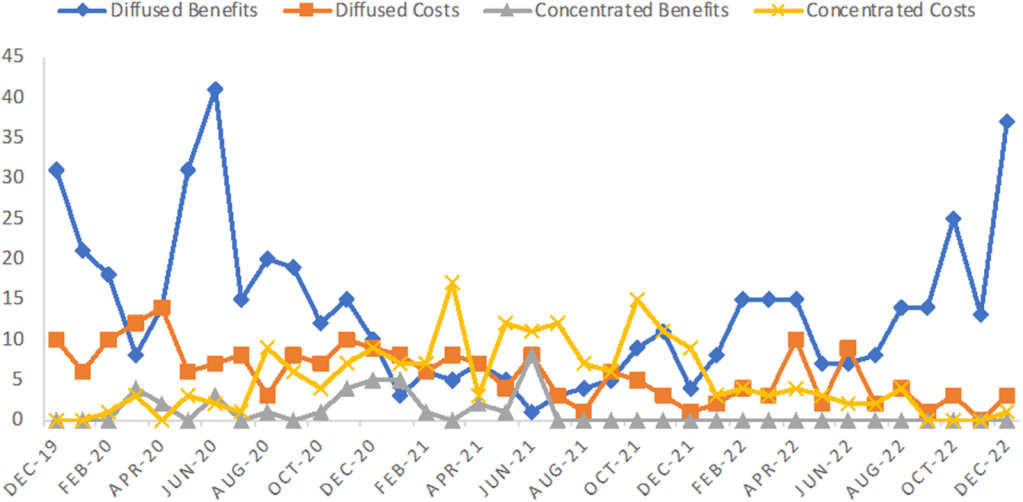
Image Description

Figure 2. Trends in narrative strategies.

Our article explores the ways in which non-government actors can create and leverage impactful policy narratives in electoral autocratic contexts. When narratives highlight injustice, resonate with shared values of the population at large, and leave room for political manoeuvre, they can reshape policy debates even in regimes where the odds are stacked against citizens and social movements.

This paper builds on earlier NPF research, which remains limited in contexts beyond liberal democracies; research on social movements within these contexts is even more scarce. However, alternative policy narratives still hold power in electoral autocracies. We maintain the importance of applying the NPF to electoral autocratic contexts, highlighting three new research areas: (1) testing similar narrative strategies in other electoral autocracies and policy domains, (2) examining narratives in closed autocracies without elections, and (3) comparing the narrative content and strategies of single-issue movements with multi-issue organizations.

Read the original article in Policy Studies Journal:

Celebi, Elifcan and Volkan Yilmaz. 2025. “Narrative Power in Electoral Autocracies: The Policy Narrative Behind the Success of a Pension Movement.” Policy Studies Journal 53(2): 328–348. https://doi.org/10.1111/psj.70014.

About the Authors

Elifcan Celebi is an Assistant Professor at University College Dublin’s School of Politics and International Relations. She holds a PhD degree in Political Science from the Max Planck Institute for the Study of Societies and the University of Cologne. Her research primarily focuses on comparative politics and public policy in electoral autocracies with a particular emphasis on care, labour and digitalisation.

Volkan Yilmaz is a Lecturer in Social Policy at Ulster University, Belfast, within the School of Applied Social and Policy Sciences. He holds a PhD in Politics from the University of Leeds. He is one of the Editors-in-Chief for the Journal of Social Policy. He serves as the Coordinator of the Sociology of Social Policy and Social Welfare Research Network (RN26) of the European Sociological Association. His areas of expertise include the politics of social policy and welfare and public policy analysis with a special emphasis on health and social protection.

Seeking the High Ground: Exploring Advocacy Groups’ Use of Policy Narratives in the Legalization of Same-Sex Marriage in Taiwan

by Yu-Heng Jung & Zong-Xian Huang

Many democratic nations have faced the challenge of political polarization, which affects both public opinion and policy decision-making. One of the most contentious modern issues is the recognition of rights for lesbian, gay, bisexual, transgender, queer, and more (LGBTQ+) individuals. In Taiwan, the legalization of same-sex marriage became especially controversial due to its relatively conservative culture. Before Taiwan became the first Asian country to legalize same-sex marriage, both supporters and opponents of LGBTQ+ rights used various strategies in the policy process. These strategies included vibrant street protests, lobbying legislators, filing petitions for constitutional interpretation, and participating in a national referendum on same-sex marriage. Throughout this process, advocacy groups had to effectively use policy narratives and framing techniques to build public support.

The Narrative Policy Framework (NPF) suggests that policy actors often use narrative elements and strategies to influence policy decision-making processes. That is, as individuals utilize images, symbols, concepts, and language for communication, their understanding of the world is shaped by the complex interaction of these narrative components. Consequently, narratives are crucial not only for processing information and expressing viewpoints but also for influencing how people interpret and make sense of the world. Although a substantial amount of research has focused on narrative strategies, the NPF framework has yet to thoroughly examine how narrative use may evolve as policy conflicts develop. Additionally, while traditional NPF research has relied on the winning-losing dichotomy to predict narrative strategy usage, recent scholars argue that a coalition’s policy position may serve as a better indicator.

By analyzing the Facebook pages of competing advocacy groups involved in Taiwan’s same-sex marriage debate from October 2016 to May 2019, this study illustrates how these groups adjust their narrative strategies over time and identifies the factors driving these changes. Our findings reveal that, during the same-sex marriage discussions in Taiwan, anti-LGBTQ+ groups consistently employed a “devil shift” strategy in their narratives, while pro-LGBTQ+ groups gradually adopted a less extreme form of this strategy. In view of this, the study suggests that policy positions may provide better predictability for the devil–angel shift than the traditional winning-losing dichotomy.

Furthermore, when examining advocacy groups with varying scopes of conflict strategies regarding the status quo or preferred proposals, a consistent pattern emerges in the narrative strategies of anti-LGBTQ groups. They tend to employ a conflict expansion strategy in narratives related to the legalization of same-sex marriage, while using a conflict containment strategy in narratives aimed at maintaining marriage rights exclusively for heterosexual couples. In contrast, pro-LGBTQ groups strategically adjusted their scope of conflict strategy over time, based on the nature of policy issues, political events, and their target audiences. This suggests that conflict expansion and containment strategies depend on the evolving policy landscape and the social construction of target populations.

The study also highlights that constitutional arrangements and institutional mechanisms enable advocacy groups to engage in venue shopping. This underscores the connection between narrative strategies and a country’s institutional framework, emphasizing the contextual nature of these strategies. Additionally, the findings demonstrate that policy narrative learning occurs as potential policy outcomes converge, illustrating how advocacy groups modify and refine their narratives in response to evolving conditions.

In light of the increasing social awareness of diversity, equity, and inclusion issues in recent years, this research enhances our understanding of how narrative strategies are employed to address contentious social issues. It not only presents a dynamic picture of the narrative strategies adopted by different advocacy groups but also depicts a sophisticated scenario in which the narrative is intertwined with social and political factors. Overall, this study provides a novel perspective on deconstructing narrative strategies and makes significant contributions to both theoretical and practical advancements in the NPF literature.

You can read the original article in Policy Studies Journal at

Jung, Yu-Heng and Zong-Xian Huang. 2024. “ Seeking the High Ground: Exploring Advocacy Groups’ Use of Policy Narratives in the Legalization of Same-sex Marriage in Taiwan.” Policy Studies Journal 52 (3): 671–696. https://doi.org/10.1111/psj.12542.

About the Authors

Yu-Heng Jung is a Ph.D. student at the Daniel J. Evans School of Public Policy and Governance at the University of Washington. He is interested in the profound impact of rapidly evolving technology and decision-making tools on administration, governance, and society. His current research focuses on bureaucratic professionalism and responsiveness, the digital transformation of government, as well as the role of narrative strategies and social media in political communication.

Zong-Xian Huang is a Ph.D. student in the Department of Public Administration and Policy at the University at Albany, State University of New York (SUNY). His research interests include digital governance, digital inequalities, information technology management and algorithmic bias.

What’s the Grand Story? A Macro-Narrative Analytical Model and the Case of Swiss Child and Adult Protection Policy

by Bettina Stauffer

Narrative Policy Framework (NPF) research has mostly focused on micro- and meso-level narratives — in other words, narratives that operate at the individual and group levels. Macrolevel NPF research is scarce, and the existing literature suffers from inconsistent definitions and research methods. My paper sets out to address this disparity in NPF literature by providing a definition of macrolevel narratives, proposing a model for replicable empirical research, and connecting the macro level to lower-level narratives.

In an effort to create a versatile, standard definition of macrolevel narratives, I draw on the policy paradigm concept. A policy paradigm, as Peter Hall saw it, is a system of standards and ideas shared among policy actors that outline a policy problem, policy goals, and instruments that can be used to attain these goals. I argue that macrolevel narratives are constrained within a policy paradigm and tell stories about the paradigm. These narratives can also tell stories about the institutional and cultural contexts as these are related to the paradigm. Thus, it is useful to divide macrolevel narratives into three categories: paradigm macrolevel narratives, institutional macrolevel narratives, and cultural macrolevel narratives.

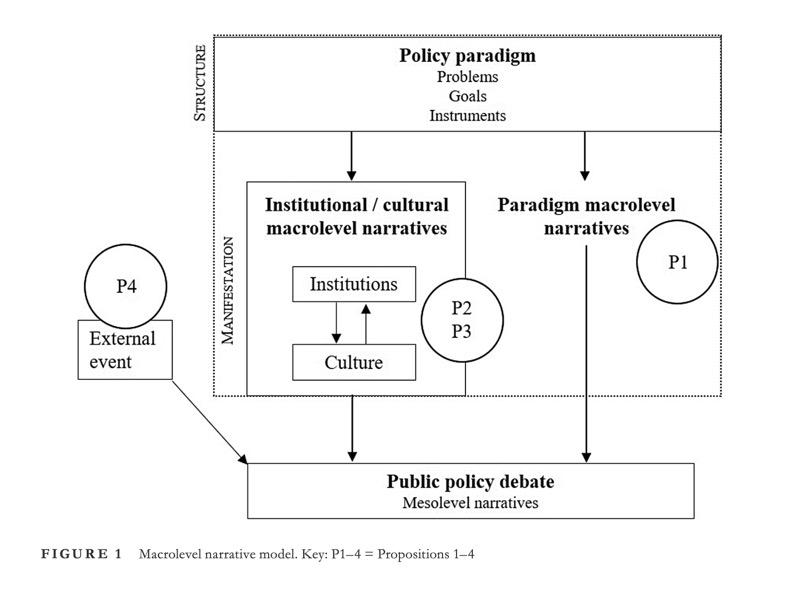
Conceptualizing macrolevel narratives like this gives researchers a clearer definition that can be adapted to various policy contexts and will help standardize future macrolevel research. I also use this definition to develop a standard model for macrolevel NPF analysis. This model (illustrated in Figure 1) empirically captures how macrolevel narratives affect public policy debate at the macro and meso level.

I derive several propositions from this model:

P1: If a policy paradigm is supported (e.g., by political actors, the civil society, the public), positive macrolevel and subsequent mesolevel narratives dominate. If a paradigm is opposed, negative macrolevel and mesolevel narratives dominate.

P2: If a policy paradigm and existing institutions coincide, positive macrolevel and subsequent mesolevel narratives dominate. If a paradigm and institutions do not coincide, that is, if institutional changes have to be made to adjust to a paradigm, negative macrolevel and mesolevel narratives dominate.

P3: If a policy paradigm and existing cultural norms are compatible, positive macrolevel and subsequent mesolevel narratives dominate. If a paradigm and culture are incompatible, that is, if a paradigm leads to incongruence with cultural values or between institutions and culture, negative macrolevel and mesolevel narratives dominate.

P4: Several external factors, including focusing events, can change a public policy debate, that is, mesolevel narratives after an external event may start opposing the macrolevel narratives about a policy paradigm and/or its corresponding institutions and culture.

I applied these developments to child and adult protection policy in Switzerland. I found quantitative and qualitative evidence that macrolevel narratives do, in fact, tell the story of how a policy paradigm affects institutional and cultural settings. I demonstrated that macrolevel narratives affect mesolevel narratives. This will prove useful in future analysis that hopes to determine where mesolevel narratives come from. My analysis also demonstrated how this model can be used as a tool for future standardized empirical research on macrolevel narratives.

I thank Eli Polley for supporting me in the drafting of this blog post.

You can read the original article in Policy Studies Journal at

Stauffer, Bettina. 2023. “ What’s the grand story? A macro-narrative analytical model and the case of Swiss child and adult protection policy.” Policy Studies Journal 51: 33–52. https://doi.org/10.1111/psj.12465.

About the Author

Bettina Stauffer is a research associate for public policy at the Center for Public Management of the University of Bern. Her research focuses on policy making and public policy implementation, particularly in the areas of social and health policy as well as child and adult protection.

The Role of Policy Narrators During Crisis: A Micro-Level Analysis of the Sourcing, Synthesizing, and Sharing of Policy Narratives in Rural Texas

by Mark C. Hand, Megan Morris, & Varun Rai

Policy researchers have done extensive research to understand the use of narratives in the policy process. We see that policymakers use narratives to set policy agendas, to emphasize issues, to suggest solutions, and much more. But how do policymakers respond to crisis?

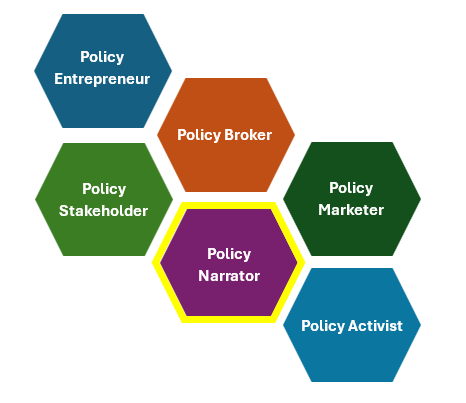
Across numerous theories of the modern policy process, scholars have highlighted the importance of policy actors, or individuals that drive policy change. Scholars have variably defined these actors as policy entrepreneurs, policy stakeholders, policy brokers, and policy activists, with the distinctions across roles often blurry. Seeking a term that can span theories, some scholars have suggested the concept of the policy entrepreneur. While we share the goal of bridging theory, we argue that the fuzziness of this term limits our ability to detangle the diverse functions that policy actors serve.

We suggest a different method: What if we conceptualized a range of policy actors, each who serve distinct roles within each framework?

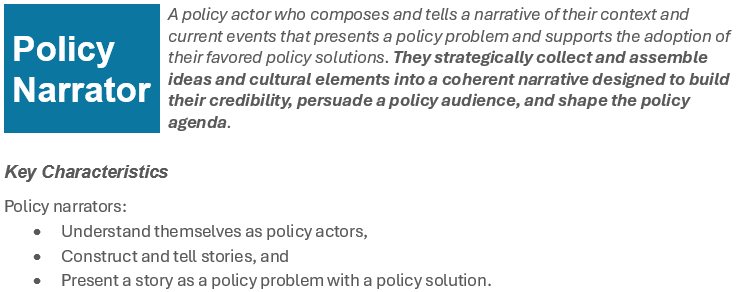
In our study, we propose a policy actor who can sit at the center of the Narrative Policy Framework (NPF) specifically: the policy narrator. This actor, we argue, plays the unique role of composing narratives that weave political, social, and economic contexts and current events to present a distinct policy problem and call for a particular policy solution. 

To further conceptualize this actor’s role in the policy creation process, we use comparative case studies of seven oil-producing counties in one region of rural Texas that experienced two distinct crises in 2020: falling oil prices and mass rig closures following the spread of COVID-19.

Building on previous NPF work – as well as from narratology, entrepreneurship scholarship, and diffusion theory – we test four sets of propositions about how policy narrators source, synthesize, and share their policy narratives during times of crises. 

While we make multiple findings on narrative strategies (including surrounding the effectiveness of the devil-angel shift, narrative congruence, and the use of characters), we believe that our most important contribution is defining and situating a specific policy actor within the NPF. 

Our results support the idea that policy narrators create narratives with distinct, identifiable characteristics that can conceptually separate them from other policy actors. We argue that if we continue this honing of the characteristics, function, and strategies of actors across other policy process theories, we can start to build a common language that connects our understandings of how the policy process operates. 

You can read the original article in Policy Studies Journal at

Hand, M. C., Morris, M., and Rai, V.. 2023. “The role of policy narrators during crisis: A micro-level analysis of the sourcing, synthesizing, and sharing of policy narratives in rural Texas.” Policy Studies Journal, 51, 843–868. https://doi.org/10.1111/psj.12501

About the Authors

Mark C. Hand is an Assistant Professor in the Political Science department at the University of Texas at Arlington, where he researches employee ownership and workplace democracy, campaigns and elections, and theories of the policymaking process. 


Megan Morris is a Policy Manager at the Abdul Latif Jameel Poverty Action Lab (J-PAL) at MIT. Megan manages the Gender sector and works on issues related to gender equity and women’s and girl’s agency. 


Dr. Varun Rai is the Walt and Elspeth Rostow Professor in the LBJ School of Public Affairs at the University of Texas at Austin, with a joint appointment in Mechanical Engineering. His interdisciplinary research, delving with issues at the interface of energy systems, complex systems, decision science, and public policy, develops policy solutions for a sustainable and resilient energy system. In 2016 he was awarded the David N. Kershaw Award and Prize. He received his Ph.D. and MS in Mechanical Engineering from Stanford University and a bachelor’s degree in Mechanical Engineering from the Indian Institute of Technology (IIT) Kharagpur.

Analyzing the Association of Policy Narratives with Problem Tractability in the Implementation of EU Decisions: Evidence from the Phytosanitary Policy Area

by Marco Schito 

Stories can help us make sense of this world by building compelling narratives in which the motives of and interactions between heroes, victims, and villains weave a plot, resulting in the resolution of the problem. However, a growing number of policy issues are becoming “intractable” in the sense that there is no easy way to address and solve the problem.

In this study, I employ the Narrative Policy Framework (NPF) to understand how the stories recounted during a mysterious epidemic decimating the population of olive trees in South-Eastern Italy were associated with the tractability of this policy problem. I analyze 79 editorials, opinion pieces, and guest columns published between 2014 and 2020 from five local and national news outlets across the political spectrum.

The study focuses on the debate surrounding the implementation of EU decisions aimed at tackling this epidemic. EU implementing decisions are normally a very drab and straightforward affair that should leave little space for competing narratives to take root. Nevertheless, several competing narratives did emerge about the causes of the problem, the best practices of implementation, and even the policy solution. Theories of policy implementation offer a theoretical hook to the NPF to address the association between narratives and tractability by suggesting that problems may become more tractable if a theory about the causes of the problem the implementing policy is addressing is developed.

In the study, I first test whether narratives that attribute different roles to characters and emphasize disagreements about the causes and solutions of the problem are suggestive of a higher degree of problem intractability. Secondly, I test whether the accumulation of scientific knowledge to generate a valid causal theory linking problems, means and solutions is associated with changes in the usage of narrative strategies.

The strongest differences in the use of characters were found for heroes, especially between the most ideologically opposed news outlets. Moreover, the analyzed documents differed in the way they weaved their plots, presented differing solutions, and made appeals to science to solve the problem. All but one news outlets also displayed a stronger use of blame-apportionment strategies (the so-called “devil shift”) as opposed to highlighting problem-fixers. Hence, these narrative elements created a vicious cycle of polarisation based on disagreements about the facts and theories and on the way forward, contributing to making this policy problem all the less tractable. 

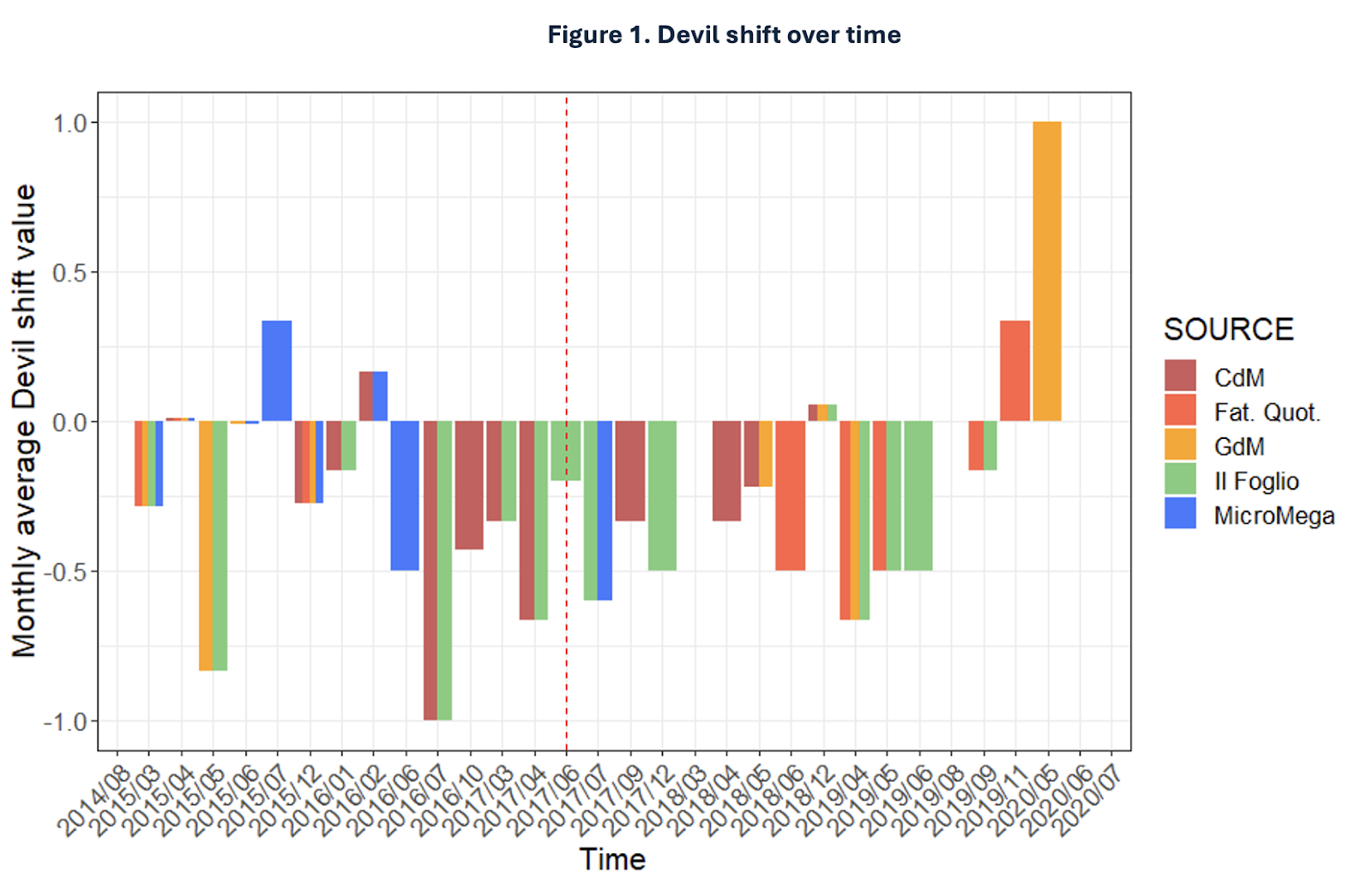
To assess whether the tractability of the problem changed over time thanks to the presence of established theories about the causes of the epidemic, I took a temporal approach to the devil shift. While scientists did manage to establish the causes of the epidemic in May 2017, Figure 1 shows that the news outlets continued to employ blame-apportionment strategies throughout the entire period of analysis. 

From a substantive standpoint, the results of this study cast doubt on the ability of policy actors to engage in fruitful debates in an increasingly polarised world. Theoretically, however, the article represents a first attempt to bring the NPF together with the literature on problem definition and implementation. The three partly share a common language, and insights from each can add to the others’ theoretical and empirical developments.

You can read the original article in Policy Studies Journal at

Schito, Marco. 2023. Analyzing the association of policy narratives with problem tractability in the implementation of EU decisions: Evidence from the phytosanitary policy area. Policy Studies Journal, 51, 869–886. https://doi.org/10.1111/psj.12500

About the Author

Marco Schito is a researcher at the Public Policy and Management Institute (PPMI) in Vilnius, Lithuania. His research interests involve socio-economic issues and state-business relations. He was most recently involved in studies about the effect of inflation on small and medium enterprises in the EU-27.
E-mail: marco.schito@ppmi.lt

Policy Dimension: A New Concept to Distinguish Substance from Process in the Narrative Policy Framework

by Johanna Kuenzler & Bettina Stauffer

The Narrative Policy Framework (NPF) is a handy tool for policy scholars, shedding light on the strategic uses of narratives in policy debates. However, a critical distinction often remains overlooked in existing literature: the separation of narrative elements focusing on substance from those centered on process. In our study, we emphasize the significance of this differentiation.

When we talk about a policy’s “substance,” we refer to its design — the core problem it addresses and the instruments applied to solve the problem. On the other hand, “process” pertains to the dynamics of influence and power surrounding the policy. To illustrate this distinction, consider the following example:

Narrative 1: We need to stop fossil fuel companies from jeopardizing our children’s future by preventing them from extracting climate-damaging energy sources.

Narrative 2: We need to stop fossil fuel companies from jeopardizing our children’s future by curbing their excessive lobbying against the introduction of a Green New Deal.

Both narratives cast fossil fuel companies as villains, thus signaling to readers that their behavior is problematic. However, Narrative 1 delves into the substance of the issue, focusing on the environmental consequences of the companies’ business. In contrast, Narrative 2 centers on the policy process, highlighting the lobbying practices of these companies that impede progress in climate policy.

To situate this distinction within the NPF, we introduce the concept of “policy dimension.” This dimension classifies narrative content as either substance-focused or process-focused. To assess its utility, we applied this concept to the case of the Child and Adult Protection Policy (CAPP) in Zurich, Switzerland.

Our methodology involved compiling a comprehensive dataset of parliamentary debates and newspaper articles. We then scrutinized these sources to ascertain the analytical value of the policy dimension within narrative content. Our findings revealed the prevalence of both substance and process narratives in CAPP debates. Additionally, we observed that the context in which a narrative is presented influences its policy dimension. Parliamentary debates, for instance, exhibited higher rates of process-oriented narrative elements compared to newspapers.

In summary, the “policy dimension” concept provides researchers with a more nuanced and precise tool for analyzing how narratives function in the policy process, and we look forward to seeing future applications.

We thank Eli Polley for supporting us in the drafting of this blog post.

You can read the original article in Policy Studies Journal at

Kuenzler, Johanna and Stauffer, Bettina. 2023. “ Policy dimension: A new concept to distinguish substance from process in the Narrative Policy Framework.” Policy Studies Journal, 51, 11–32. https://doi.org/10.1111/psj.12482.

About the Authors

Johanna Kuenzler is a research associate for public policy at the German University for Administrative Sciences Speyer. Her main areas of expertise are the Narrative Policy Framework (NPF) and organizational reputation. Empirically, she focuses on social and environmental policies as well as on animal welfare.
Learn more at: www.johanna-kuenzler.com
Follow her on X: @jo_kuenzler

Bettina Stauffer is a research associate for public policy at the Center for Public Management of the University of Bern. Her research focuses on policy making and public policy implementation, particularly in the areas of social and health policy as well as child and adult protection.