
by Marco Schito
Stories can help us make sense of this world by building compelling narratives in which the motives of and interactions between heroes, victims, and villains weave a plot, resulting in the resolution of the problem. However, a growing number of policy issues are becoming “intractable” in the sense that there is no easy way to address and solve the problem.
In this study, I employ the Narrative Policy Framework (NPF) to understand how the stories recounted during a mysterious epidemic decimating the population of olive trees in South-Eastern Italy were associated with the tractability of this policy problem. I analyze 79 editorials, opinion pieces, and guest columns published between 2014 and 2020 from five local and national news outlets across the political spectrum.
The study focuses on the debate surrounding the implementation of EU decisions aimed at tackling this epidemic. EU implementing decisions are normally a very drab and straightforward affair that should leave little space for competing narratives to take root. Nevertheless, several competing narratives did emerge about the causes of the problem, the best practices of implementation, and even the policy solution. Theories of policy implementation offer a theoretical hook to the NPF to address the association between narratives and tractability by suggesting that problems may become more tractable if a theory about the causes of the problem the implementing policy is addressing is developed.
In the study, I first test whether narratives that attribute different roles to characters and emphasize disagreements about the causes and solutions of the problem are suggestive of a higher degree of problem intractability. Secondly, I test whether the accumulation of scientific knowledge to generate a valid causal theory linking problems, means and solutions is associated with changes in the usage of narrative strategies.
The strongest differences in the use of characters were found for heroes, especially between the most ideologically opposed news outlets. Moreover, the analyzed documents differed in the way they weaved their plots, presented differing solutions, and made appeals to science to solve the problem. All but one news outlets also displayed a stronger use of blame-apportionment strategies (the so-called “devil shift”) as opposed to highlighting problem-fixers. Hence, these narrative elements created a vicious cycle of polarisation based on disagreements about the facts and theories and on the way forward, contributing to making this policy problem all the less tractable.
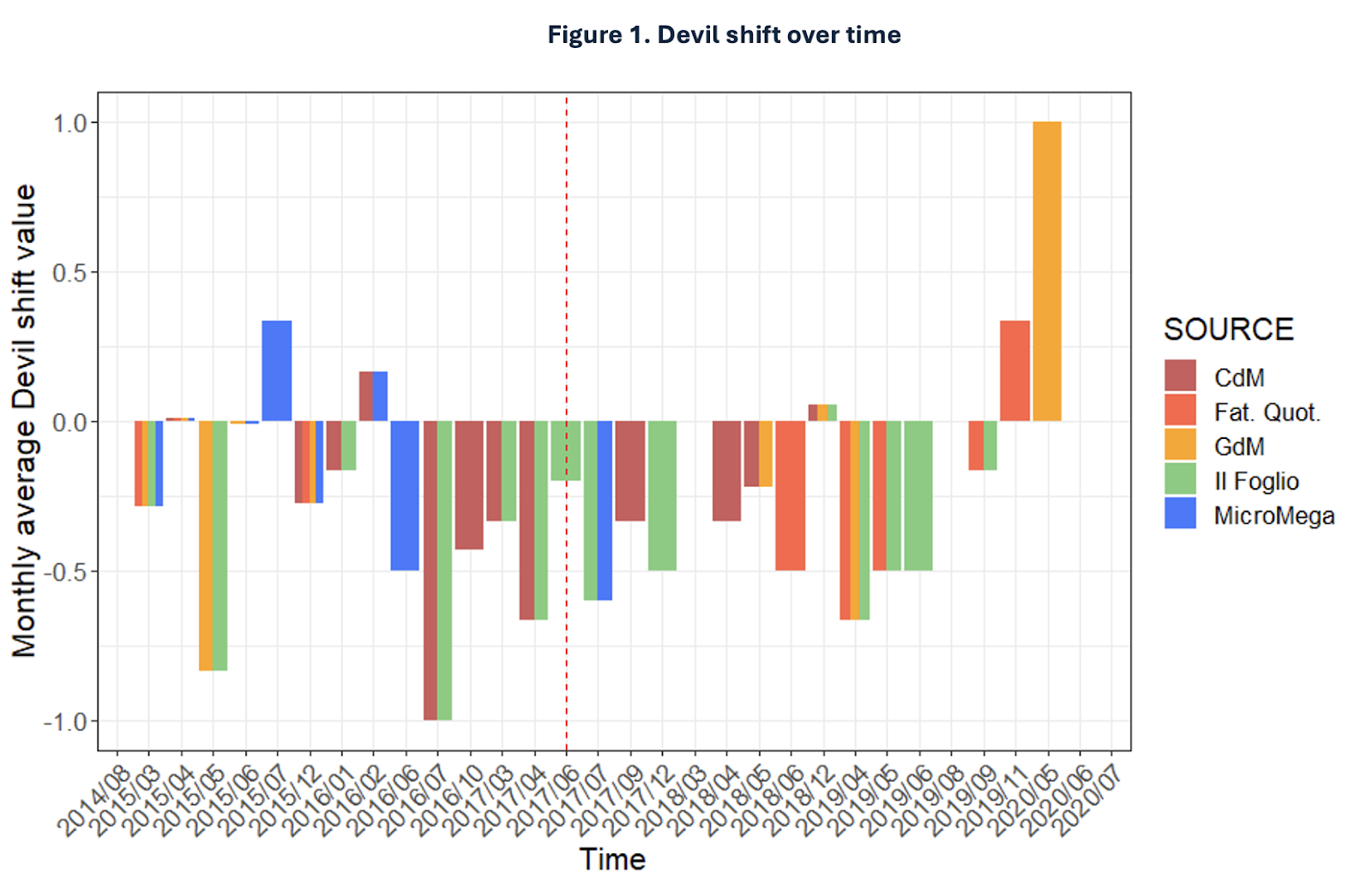
To assess whether the tractability of the problem changed over time thanks to the presence of established theories about the causes of the epidemic, I took a temporal approach to the devil shift. While scientists did manage to establish the causes of the epidemic in May 2017, Figure 1 shows that the news outlets continued to employ blame-apportionment strategies throughout the entire period of analysis.
From a substantive standpoint, the results of this study cast doubt on the ability of policy actors to engage in fruitful debates in an increasingly polarised world. Theoretically, however, the article represents a first attempt to bring the NPF together with the literature on problem definition and implementation. The three partly share a common language, and insights from each can add to the others’ theoretical and empirical developments.
You can read the original article in Policy Studies Journal at
Schito, Marco. 2023. Analyzing the association of policy narratives with problem tractability in the implementation of EU decisions: Evidence from the phytosanitary policy area. Policy Studies Journal, 51, 869–886. https://doi.org/10.1111/psj.12500
About the Author

Marco Schito is a researcher at the Public Policy and Management Institute (PPMI) in Vilnius, Lithuania. His research interests involve socio-economic issues and state-business relations. He was most recently involved in studies about the effect of inflation on small and medium enterprises in the EU-27.
E-mail: marco.schito@ppmi.lt
 Policy Studies Journal Blog