As announced in October 2023, the Policy Studies Journal (PSJ) editorial team has expanded the range of manuscripts we consider for publication through the addition of two short-article formats, the research note and the perspectives piece.
Below we answer some frequently asked questions about how these manuscripts are processed and evaluated.
Question 1: Do short article forms go through a less stringent review process from traditional research articles?
All short articles submitted to PSJ – both research notes and perspectives pieces alike – receive the same level of peer review as traditional research articles. Submitting your manuscript as a short article does not mean you will lose the opportunity to get valuable feedback from multiple reviewers, nor does doing so give it a higher chance of acceptance. To ensure manuscript quality across the board, every submission undergoes the same peer review process.
Question 2: If I submit my manuscript as one type, will it only be considered for publication in that form?
There’s no need to worry about designating your manuscript a certain way – PSJ editors are here to help. If our editors believe your submission might be better designated as a different manuscript type, we will reach out to you directly to discuss it. With this, there is no “right way” to designate your manuscript submission.
Question 3: If I am asked to consider designating my manuscript as a short article, is this a request to downgrade it?
If our editors do reach out and ask you to consider submitting your traditional research article as a short article, this does not mean we believe your manuscript to be less impactful for policy process theory. Accepted short articles meet the same high standards for both theoretical depth and methodological sophistication, just using a narrower scope.
With these new additions, our goal is to advance the theoretical literature surrounding the policy process with the understanding that novel methodological approaches, empirical replications, and theoretical arguments are central to that process. We look forward to taking this journey with you!
Despite widespread application of the canonical model, a key criticism of the Multiple Streams Framework (MSF) is the primary focus on agenda-setting and policy adoption, and relatively little consideration of what happens after policy is adopted. However, recent scholarship applies MSF to policy implementation and assesses agenda-setting, policy adoption, and implementation as components of an integrated process. Furthering this line of research, I use MSF to construct a theoretical model that connects policy-making and implementation.
Although policy adoption and implementation make up two distinct components of policy processes, recent scholarship largely argues that “policy systems and processes are nested, with policymaking and policy implementation existing in organized interdependent layers” (Fowler, 2019, p. 406). Based on this, I contend that there are separate outputs for policy adoption and implementation that are linked together and aggregate to policy process outputs.
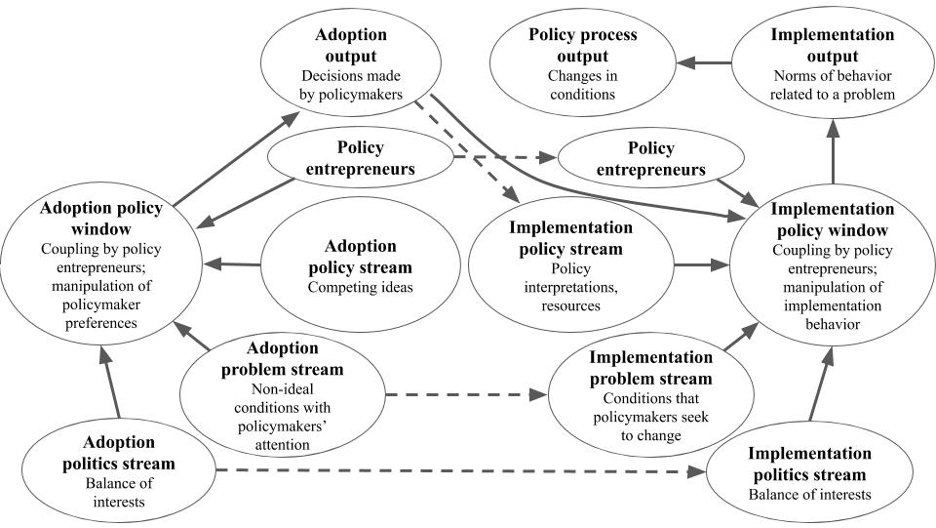
Figure 1. MSF Theoretical Model for Policymaking and Policy Implementation Processes
[Note: Solid lines represent a causal relationship between streams, policy windows, and outputs, while dashed lines represent the transition of streams from a policymaking orientation to an implementation orientation.]
Figure 1 illustrates an MSF policy process model that includes both policy adoption and implementation sub-processes. First, policy adoption outputs are new policies that result from decisions made during policy adoption, which address non-ideal social conditions. Second, once new policies are adopted, policy implementers respond. Individual-level behaviors, then, aggregate to the norms of policies in practice, which constitute implementation outputs. Third, implementation outputs lead to changes in behaviors related to social conditions that new policies aim to affect. In turn, this suggests three hypotheses:
Policy adoption hypothesis: Effects of politics on policy adoption outputs are conditional on current problems and policies.
Policy Implementation hypothesis: Effects of politics on policy implementation outputs are conditional on current problems and policies.
Interdependent Processes hypothesis: Effects of politics, policy, and problems streams on policy adoption outputs are not independent from their effects on policy implementation outputs.
I test this model by using data from U.S. state implementation of federal environmental policy. I treat states as independent cases in which policy, politics, and problem streams are coupled (or not) to understand under which conditions policy adoption (i.e., budgetary changes) or implementation (i.e., changes in pollution) outputs are likely to experience non-marginal changes. Results provide support for all three hypotheses and suggest an interconnected process. Most importantly, they indicate that an interaction between political, problem, and policy streams is necessary in both the policy-making and implementation phases in order to spur non-marginal changes in environmental policy outcomes. Specifically, where any variable measuring one of the streams is held at its mean value, only marginal changes results (i.e., status quo maintained), but where all three reach extreme values, non-marginal changes occur (i.e., policy change).
This extends MSF to capture the entire policy process and unifies scholarship examining two different phases of policy to understand how ideas become actions and lead to changes in social or environmental conditions. It also suggests that MSF can be an important tool for analyzing governance processes and providing practical advice that connects decision-making with implementation. For instance, we can glean that while policy windows can be utilized to increase program resources, those new resources may not affect policy outputs unless the right political and problem circumstances exist.
You can read the original article in Policy Studies Journal at
Fowler, Luke. (2022), Using the Multiple Streams Framework to Connect Policy Adoption to Implementation. Policy Stud J, 50: 615-639. https://doi.org/10.1111/psj.12381
About the Author
Dr. Luke Fowler is an Associate Professor of Public Policy and Administration and serves as the Faculty Director for SPS. His research interests include policy implementation, collaboration and collective action, energy and environmental policy, and state and local government. Dr. Fowler is the author of more than four dozen journal articles appearing in many of the field’s top journals, including Perspectives on Public Management & Governance, Governance, Public Administration, Policy Studies Journal, Review of Policy Research, Administration & Society, American Review of Public Administration, State & Local Government Review, and State Politics & Policy Quarterly. His latest book is Democratic Policy Implementation in an Ambiguous World. He is also the author of Environmental Federalism: Old Legacies and New Challenges. Dr. Fowler is the co-host of The Big Tent, a weekly public affairs radio show on Radio Boise. Dr. Fowler previously served as MPA program lead, and completed his Ph.D. at Mississippi State University in 2013.
The Policy Studies Journal (PSJ) is inviting submissions for an upcoming special issue dedicated to the concept of power in policy theory research. Although the importance of power is widely acknowledged, its investigation within the realm of policy theory has been limited, with notable exceptions (e.g., Spitzer 1987, Cook 2010, Henry 2011, Ingold 2011, Öberg et al. 2014, Favre et al. 2019, Angst and Huber 2023). This special issue aims to deepen the examination of how power shapes, is distributed, and operates in policy processes of diverse contexts.
Building on Schattschneider’s classic notion of power as the ability to shape the scope of political discourse and determine the participants and their influence in the policy process, we invite contributions that critique, apply, or advance this and other conceptualizations of power in policy theory research in an explicit and robust manner. We seek theoretical, empirical, and methodological contributions that address, but are not limited to:
Advancements in the theoretical understanding of power within policy processes, drawing from one or more policy theory traditions.
Innovative methodological approaches to examine power within policy theory research.
The influence of power on policy processes and policy outcomes.
Case studies highlighting the distinctive role of power in the policymaking process, focused on a specific policy domain.
Comparative studies of power dynamics across different policy settings or national contexts.
**The deadline for submitting a manuscript for the Special Issue is September 15, 2024.**
Potential contributors to the Special Issue may participate in a “Peer Paper Exchange” through which authors can obtain informal feedback from peers who also plan to submit a paper for the Special Issue and opt to participate in the Exchange. Each paper will be reviewed by 1-2 peers who will provide informal written feedback. Participation in the Exchange is intended to support the development of papers but has no bearing on the peer review process that will be undertaken by PSJ once papers are submitted to the Journal; that review process is formal and entirely independent of the “Peer Paper Exchange.”
To participate in the “Peer Paper Exchange,” please submit a one-page abstract that explains your research question, the contribution of your paper to policy scholarship, and the data and methodological approaches you plan to use to answer your research question, along with the paper title and author information. This is due by May 10th. Notifications of acceptance to participate in the “Peer Paper Exchange” will be made by June 1st. Authors participating in the Exchange must share their draft papers with fellow Exchange participants by August 1st. Comments from the Exchange peer review will be returned to authors by August 21st.
If you have any questions about the submission process or the “Peer Paper Exchange,” please contact Drs. Geoboo Song (PSJ Editor-in-Chief), Gwen Arnold (PSJ Associate Editor), or Aaron Smith-Walter (PSJ Associate Editor) at policystudiesjournal@gmail.com
We’ve recently explored over twenty years of PSJ citation data, and we’re thrilled to see its consistent growth over time! A huge thank you to all the remarkable contributors whose relentless dedication and effort have elevated PSJ to its leading status today!
Over time, there’s been a significant increase (both in terms of quantity and proportion) in the number of cited articles, suggesting a clear shift away from uncited ones. This underscores the evolving landscape of scholarly references within the policy community.
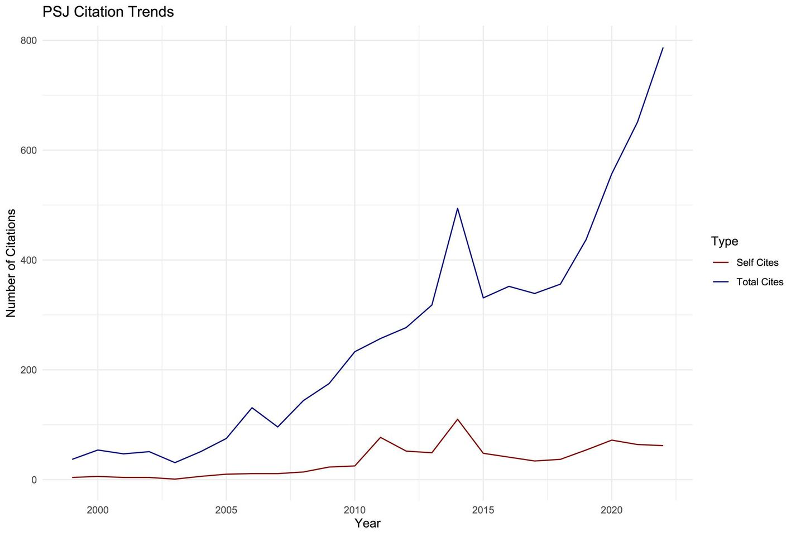
The following analysis offers another overview of the PSJ’s citation trends over time. The total citations for the journal have seen a steady increase over the years, with a particularly steep surge since 2019. This highlights the growing impact of the journal in the scholarly community. It is important to note that the self-citation rate has remained consistently low over the years, reflecting a commitment to maintaining the highest standards of scholarly integrity.
It is noteworthy that a high self-citation rate is often seen as a warning sign for journals, and if it exceeds a particular threshold, the journal risks being removed from the SSCI citation reports — an outcome that can have potentially grave consequences for the journal’s reputation and readership. This analysis underscores the impressive trajectory of PSJ in terms of both total citation counts and the maintenance of rigorous scholarly standards.
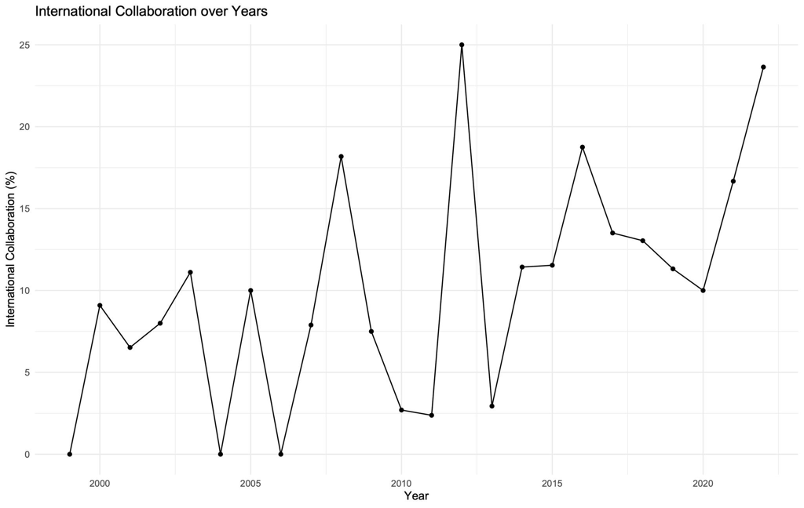
The following graph illustrates the trend of international collaboration through PSJ publications, measured by the proportion of PSJ articles authored by researchers from multiple countries each year over the past two decades. The collaboration fluctuates over time, but we are undoubtedly heading in the right direction. Of course, it is crucial to foster more international collaboration at PSJ.
Again, none of these achievements could have been realized without your invaluable support and assistance. For this, we deeply appreciate your dedication and effort!
Previous scholarship has investigated how policy entrepreneurs use narratives and expert information to influence policy agendas. In particular, narratives can be powerful tools for communicating policy problems and solutions, while expert information can help clarify complicated subject matters and increase confidence in policy proposals. This raises a question: can policy entrepreneurs effectively use narratives to influence policymakers even in complex, technical policy domains where we might think the technical details might be traditionally most important?
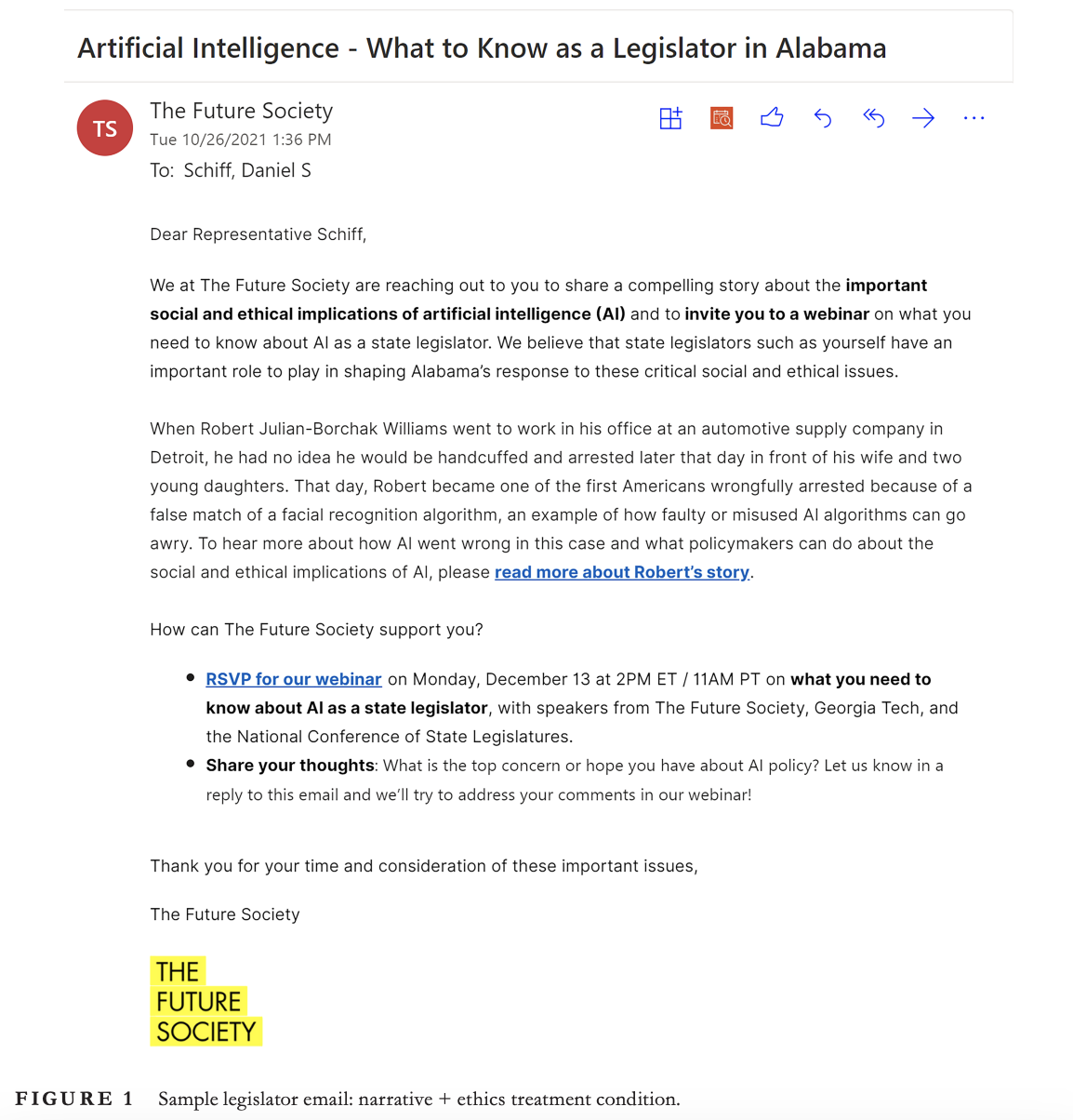
We explore this question in the context of artificial intelligence (AI) policy – an emerging policy domain that is highly technical and multi-faceted, with social, ethical, economic implications. Because the agenda for AI policy is still in the process of development, it presents a ripe case for understanding agenda setting and policy influence efforts. In partnership with a leading AI think tank, The Future Society (TFS), we conducted a field experiment on state legislators across the United States. Emails about AI policy were sent to 7,355 legislative offices. Legislators were randomly assigned to receive an email containing either a narrative strategy, an expertise strategy, or generic, neutral information. We also considered two ways of issue framing: ethical and economic/competition (see Figure 1).
Legislators were presented with either a fact sheet or story, and invited to register for and attend a webinar about AI for state legislators, which we hosted in December 2021. For example, legislators (or their staffers) might read an email message about an individual falsely arrested due to facial recognition, or between a geopolitical contest between the US and China.
We measured link clicks and webinar registration and attendance as proxies for policymaker engagement. Using these data on engagement with the emails, we tested the following hypotheses:
Policy Entrepreneur Effectiveness Hypothesis: The provision of narratives or expertise by policy entrepreneurs will increase policymaker attention to and engagement with the policy issue at hand.
Dominance of Narratives Hypothesis: The provision of narratives will induce greater policymaker engagement than the provision of expertise.
Dominance of Expertise Hypothesis: The provision of expertise will induce greater policymaker engagement than the provision of narratives.
Strategies by Issue Framing Hypothesis: Policymakers will respond with greater engagement to narratives when they are provided issue frames emphasizing the ethical and social dimensions of AI as compared to issue frames emphasizing the economic and technological competitiveness dimensions of AI.
Prior Experience Hypothesis: Compared to legislators in states with greater prior experience in AI policymaking, legislators in states with less experience with AI will respond with greater engagement to the expertise treatment.
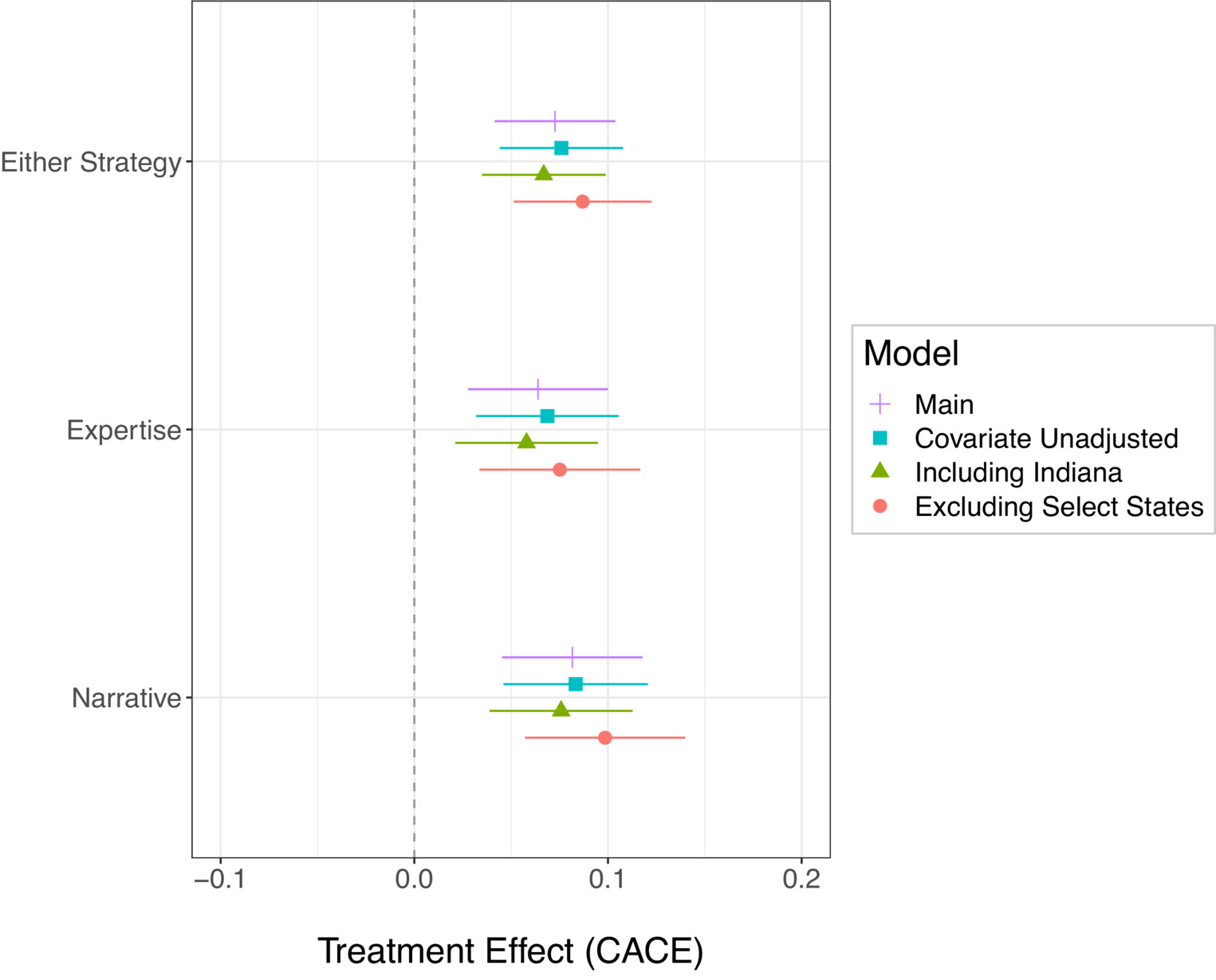
Consistent with the Policy Entrepreneur Effectiveness Hypothesis, we found that narrative strategies and expert information increased engagement with the emails (see Figure 3). Interestingly, comparing the narrative and expertise treatments, we found no statistically significant differences in their effects on engagement, suggesting that narratives are as effective as expert information even for this complex policy domain.
Figure 3. Both expert information and narratives engaged state legislators as compared to a more generic ‘control’ message, with increased engagement of 30 or more percentage points.
Contrary to our expectations, framing the issue to emphasize ethical or economic dimensions of AI also did not affect engagement, suggesting that the use of strategies like narratives can be effective even when AI policy is framed in very different ways. We had hypothesized that narratives might be especially effective when an ethics-focused policy frame of AI is promoted, but it appears narratives are just as effective when geopolitical and strategic dimensions of AI policy are emphasized.
Finally, legislators with no prior experience with AI policy were more likely to engage with the emails than legislators who had considered or passed AI policy in the past, and state legislatures with higher capacity (e.g., more staff, longer sessions) were far more likely to the email messages, an important note for those seeking to reach out to policymakers..
Our findings show that narratives can influence policymakers as much as expertise, even in complicated policy domains like AI. It is worth noting that our data was collected in 2021 before the introduction of large language models (LLMs), like OpenAI’s ChatGPT, which gained unprecedented public attention. This development has surely influenced the salience of AI policy. We suggest that future research should consider this development. Nevertheless, our work makes important contributions by extending the NPF to new contexts and investigating narratives using field experiments, a novel research approach in the field.
You can read the original article in Policy Studies Journal at
Schiff, Daniel S. and Kaylyn Jackson Schiff. 2023. “ Narratives and Expert Information in Agenda-setting: Experimental Evidence on State Legislator Engagement With Artificial Intelligence Policy.” Policy Studies Journal 51(4): 817–842. https://doi.org/10.1111/psj.12511.
About the Authors
Dr. Daniel Schiff is an Assistant Professor of Technology Policy at Purdue University’s Department of Political Science and the Co-Director of GRAIL, the Governance and Responsible AI Lab. He studies the formal and informal governance of AI through policy and industry, as well as AI’s social and ethical implications in domains like education, manufacturing, finance, and criminal justice.
Follow him on X/Twitter: @Dan_Schiff (@purduepolsci and @Purdue)
Kaylyn Jackson Schiff is an Assistant Professor in the Department of Political Science at Purdue University and Co-Director of the Governance and Responsible AI Lab (GRAIL). Her research addresses the impacts of emerging technologies on government and society. She studies how technological developments are changing citizen-government contact, and she explores public opinion on artificial intelligence in government.
Narrative Policy Framework (NPF) research has mostly focused on micro- and meso-level narratives — in other words, narratives that operate at the individual and group levels. Macrolevel NPF research is scarce, and the existing literature suffers from inconsistent definitions and research methods. My paper sets out to address this disparity in NPF literature by providing a definition of macrolevel narratives, proposing a model for replicable empirical research, and connecting the macro level to lower-level narratives.
In an effort to create a versatile, standard definition of macrolevel narratives, I draw on the policy paradigm concept. A policy paradigm, as Peter Hall saw it, is a system of standards and ideas shared among policy actors that outline a policy problem, policy goals, and instruments that can be used to attain these goals. I argue that macrolevel narratives are constrained within a policy paradigm and tell stories about the paradigm. These narratives can also tell stories about the institutional and cultural contexts as these are related to the paradigm. Thus, it is useful to divide macrolevel narratives into three categories: paradigm macrolevel narratives, institutional macrolevel narratives, and cultural macrolevel narratives.
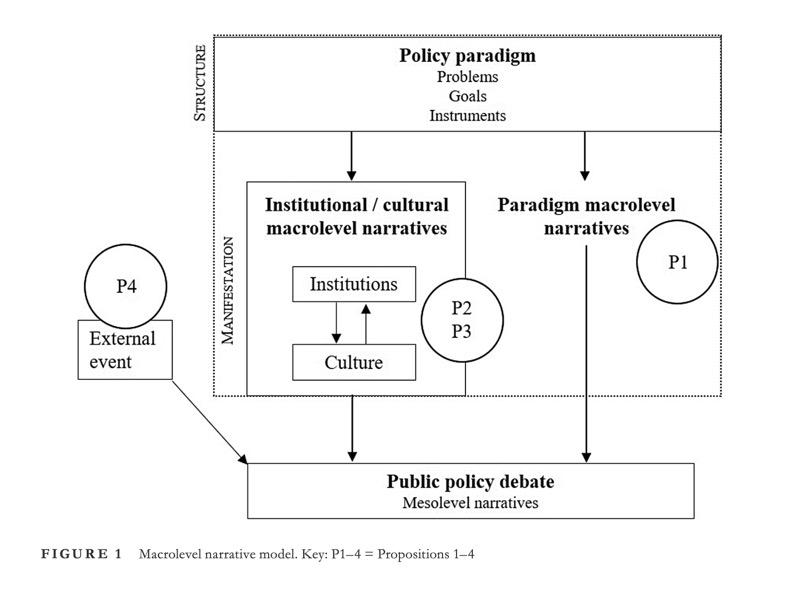
Conceptualizing macrolevel narratives like this gives researchers a clearer definition that can be adapted to various policy contexts and will help standardize future macrolevel research. I also use this definition to develop a standard model for macrolevel NPF analysis. This model (illustrated in Figure 1) empirically captures how macrolevel narratives affect public policy debate at the macro and meso level.
I derive several propositions from this model:
P1:If a policy paradigm is supported (e.g., by political actors, the civil society, the public), positive macrolevel and subsequent mesolevel narratives dominate. If a paradigm is opposed, negative macrolevel and mesolevel narratives dominate.
P2: If a policy paradigm and existing institutions coincide, positive macrolevel and subsequent mesolevel narratives dominate. If a paradigm and institutions do not coincide, that is, if institutional changes have to be made to adjust to a paradigm, negative macrolevel and mesolevel narratives dominate.
P3:If a policy paradigm and existing cultural norms are compatible, positive macrolevel and subsequent mesolevel narratives dominate. If a paradigm and culture are incompatible, that is, if a paradigm leads to incongruence with cultural values or between institutions and culture, negative macrolevel and mesolevel narratives dominate.
P4:Several external factors, including focusing events, can change a public policy debate, that is, mesolevel narratives after an external event may start opposing the macrolevel narratives about a policy paradigm and/or its corresponding institutions and culture.
I applied these developments to child and adult protection policy in Switzerland. I found quantitative and qualitative evidence that macrolevel narratives do, in fact, tell the story of how a policy paradigm affects institutional and cultural settings. I demonstrated that macrolevel narratives affect mesolevel narratives. This will prove useful in future analysis that hopes to determine where mesolevel narratives come from. My analysis also demonstrated how this model can be used as a tool for future standardized empirical research on macrolevel narratives.
I thank Eli Polley for supporting me in the drafting of this blog post.
You can read the original article in Policy Studies Journal at
Stauffer, Bettina. 2023. “ What’s the grand story? A macro-narrative analytical model and the case of Swiss child and adult protection policy.” Policy Studies Journal 51: 33–52. https://doi.org/10.1111/psj.12465.
About the Author
Bettina Stauffer is a research associate for public policy at the Center for Public Management of the University of Bern. Her research focuses on policy making and public policy implementation, particularly in the areas of social and health policy as well as child and adult protection.
by Simon Montfort, Manuel Fischer, James Hollway, & Nicolas W. Jager
In the analysis of intergovernmental cooperation within federal systems, conventional explanations have centered on problem characteristics, governance incentives, and actor interdependencies. Here, we seek to understand why institutions evolve in different directions even though they address similar problems. To address this puzzle, we investigate forms of cooperation. We seek to understand the process of institutionalization by which new agreements with specific forms of cooperation, captured through institutional design mechanisms, build upon existing ones. Our paper explores the nuanced dynamics of federal cooperation, examining how earlier institutional design choices condition subsequent cooperation.
Institutional design mechanisms are the agreed-upon rules shaping interactions during intergovernmental collaboration. This study focuses on three key mechanisms: provisions for monitoring, conflict resolution, and agreement commissions. We use these three mechanisms to investigate whether cooperation between subnational governance units, called substates, follows specific institutional design paths consisting of particular sequences of design mechanisms over time in their collaborative relationships. We expect, for instance, that conflict resolution mechanisms and monitoring provisions serve as an entry point to more strongly institutionalized forms of cooperation. The latter forms of cooperation include, for instance, agreement commissions, where substates concede more authority for shared decision-making, potentially rather slowing down other forms of cooperation.
We analyze substate cooperation in Switzerland’s federal water systems—an ideal-typical setting with robust substate competencies and a history of institutionalized cooperation. Swiss cantons, endowed with a range of voluntary cooperation options, manifest these in formal treaties known as “concordats” around water management issues. The study scrutinizes the uptake and design mechanisms in concordats spanning the last 40 years, offering insights into the dynamics of federal cooperation. We manually code formal treaties between cantons and use a semi-parametric Cox proportional hazards model to analyze the data.
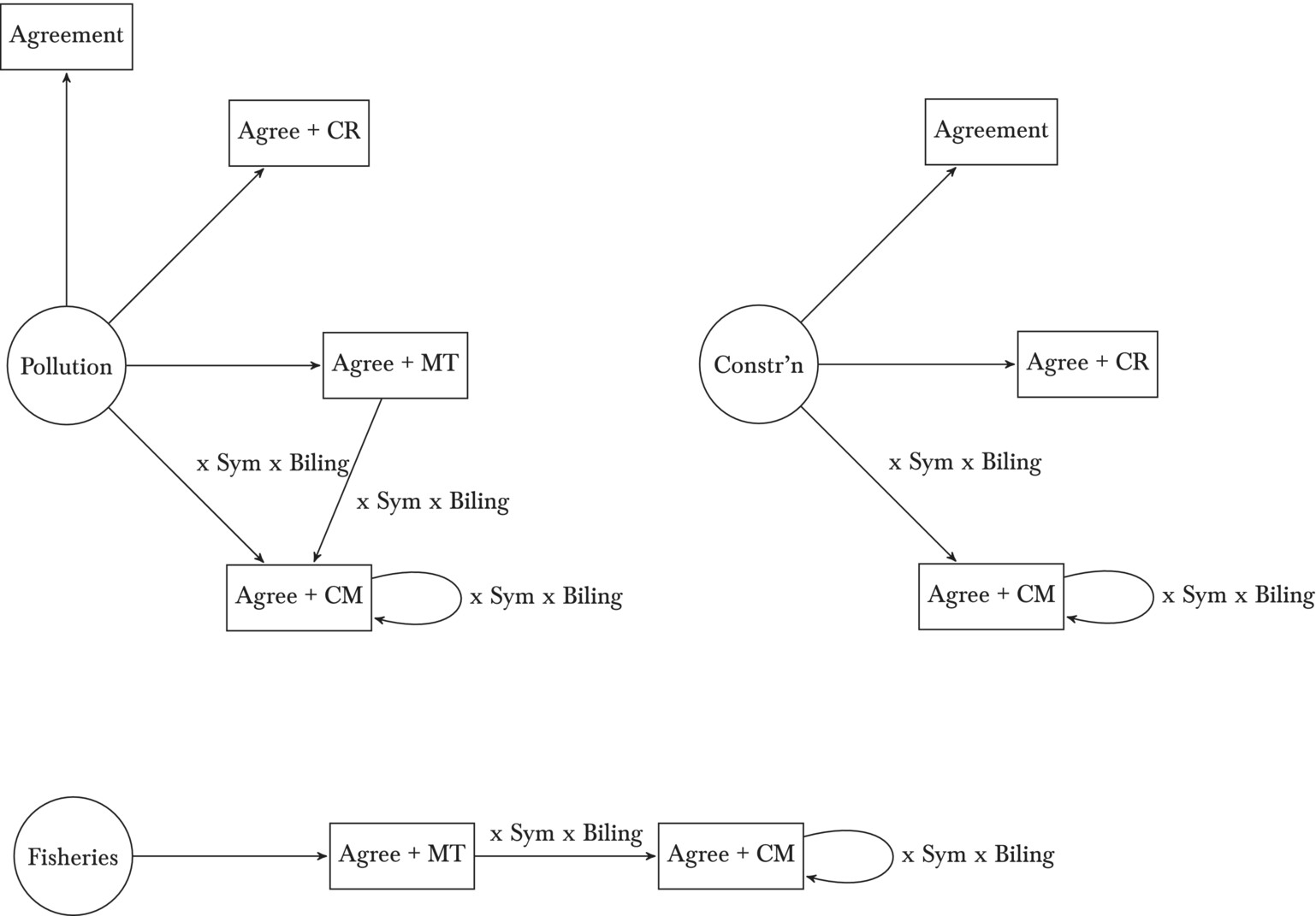
Figure 1. Issue-specific pathways.
Our findings show that institutional design mechanisms contribute to specific design paths, either facilitating or hindering the inclusion of similar mechanisms in the future. For instance, the establishment of a commission often leads to further use of agreement commissions in the future. However, once a commission is in place, adding independent monitoring or conflict resolution mechanisms becomes less likely. We also identified a few design paths in which substates utilized multiple mechanisms. Additionally, we see unique pathways on pollution and fishing cooperation. These design pathways are illustrated in Figure 1.
This research enriches the literature on intergovernmental cooperation in federal systems by examining cooperation as a long-term, evolving process. By focusing on institutional design mechanisms rather than a binary assessment of cooperation, the study provides insights into the nuanced patterns of federal cooperation for similar underlying problem characteristics. Additionally, the exploration contributes to the common pool resource governance literature by shedding light on the development and layering of institutional design mechanisms over time.
In conclusion, identifying existing institutional design mechanisms can advance our understanding of intergovernmental cooperation. The Swiss case study offers valuable insights into the dynamics of federal water systems, illustrating the long-term impact of earlier institutional choices on the paths taken in subsequent cooperative ventures. As federal systems continue to evolve, understanding these design mechanisms becomes paramount for fostering effective and adaptive intergovernmental cooperation.
You can read the original article in Policy Studies Journal at
Montfort, Simon, Manuel Fischer, James Hollway, and Nicolas W. Jager. 2023. Design paths of federal intergovernmental cooperation. Policy Studies Journal, 51, 773–792. https://doi.org/10.1111/psj.12498
About the Authors
Simon Montfort is a Doctoral Candidate at the Institute of Political Science at the University of Bern. His research, supported by a Swiss National Science Foundation Doc.CH grant, focuses on pathways to ambitious environmental policy. He works at the intersection between natural language processing, public opinion surveys and social network analysis.
Manuel Fischer is a research group leader in Policy Analysis and Environmental Governance (research group PEGO) at the Department of Environmental Social Sciences at Eawag and an adjunct professor (Titularprofessor) at the Institute of Political Science, University of Bern. His research analyzes governance arrangements, decision-making processes, and political networks, focussing on water and environmental issues.
James Hollway is Co-Director of the Global Governance Centre, Head of the Environment and Sustainability Specialisation, and Associate Professor of International Relations/Political Science at the Graduate Institute of International and Development Studies in Geneva. His research develops multilevel and dynamic network theories, methods, and data for studying institutionalised cooperation and conflict on trade, health, and environmental issues such as fisheries and freshwater. His book “Multimodal Political Networks” came out in 2021 with Cambridge University Press. He is currently working on a 4-year SNSF funded project “Power and Networks and the Rate of Change in Institutional Complexes”.
Nicolas W. Jager is Assistant Professor of Governance of Sustainability Transformations with the Public Administration and Policy Group at Wageningen University and Research (NL). He is further an Associate Junior Fellow at the Hanse Wissenschaftskolleg – Institute for Advanced Study Delmenhorst (DE). His research interests include issues of sustainability and climate policy, collaborative governance, and institutional change and stasis.











 Policy Studies Journal Blog