
by Luke Fowler
Despite widespread application of the canonical model, a key criticism of the Multiple Streams Framework (MSF) is the primary focus on agenda-setting and policy adoption, and relatively little consideration of what happens after policy is adopted. However, recent scholarship applies MSF to policy implementation and assesses agenda-setting, policy adoption, and implementation as components of an integrated process. Furthering this line of research, I use MSF to construct a theoretical model that connects policy-making and implementation.
Although policy adoption and implementation make up two distinct components of policy processes, recent scholarship largely argues that “policy systems and processes are nested, with policymaking and policy implementation existing in organized interdependent layers” (Fowler, 2019, p. 406). Based on this, I contend that there are separate outputs for policy adoption and implementation that are linked together and aggregate to policy process outputs.
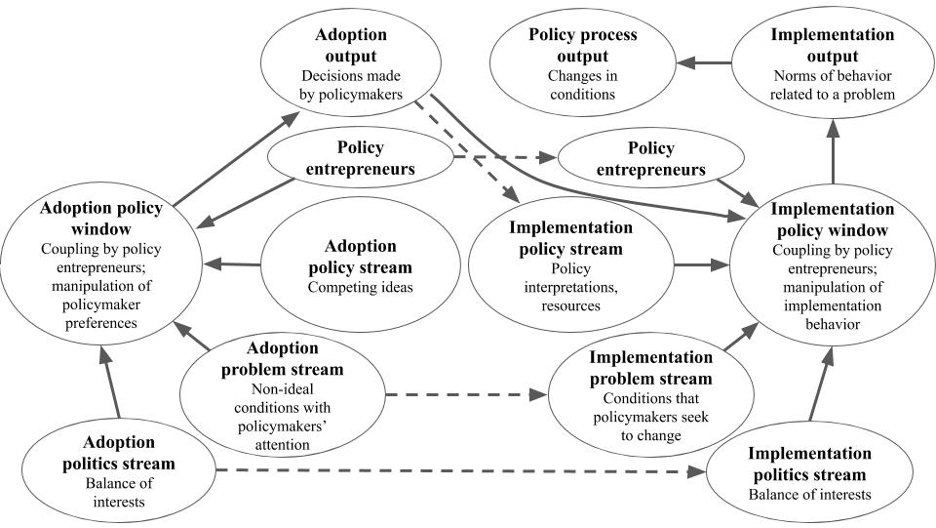
Figure 1. MSF Theoretical Model for Policymaking and Policy Implementation Processes
[Note: Solid lines represent a causal relationship between streams, policy windows, and outputs, while dashed lines represent the transition of streams from a policymaking orientation to an implementation orientation.]
Figure 1 illustrates an MSF policy process model that includes both policy adoption and implementation sub-processes. First, policy adoption outputs are new policies that result from decisions made during policy adoption, which address non-ideal social conditions. Second, once new policies are adopted, policy implementers respond. Individual-level behaviors, then, aggregate to the norms of policies in practice, which constitute implementation outputs. Third, implementation outputs lead to changes in behaviors related to social conditions that new policies aim to affect. In turn, this suggests three hypotheses:
- Policy adoption hypothesis: Effects of politics on policy adoption outputs are conditional on current problems and policies.
- Policy Implementation hypothesis: Effects of politics on policy implementation outputs are conditional on current problems and policies.
- Interdependent Processes hypothesis: Effects of politics, policy, and problems streams on policy adoption outputs are not independent from their effects on policy implementation outputs.
I test this model by using data from U.S. state implementation of federal environmental policy. I treat states as independent cases in which policy, politics, and problem streams are coupled (or not) to understand under which conditions policy adoption (i.e., budgetary changes) or implementation (i.e., changes in pollution) outputs are likely to experience non-marginal changes. Results provide support for all three hypotheses and suggest an interconnected process. Most importantly, they indicate that an interaction between political, problem, and policy streams is necessary in both the policy-making and implementation phases in order to spur non-marginal changes in environmental policy outcomes. Specifically, where any variable measuring one of the streams is held at its mean value, only marginal changes results (i.e., status quo maintained), but where all three reach extreme values, non-marginal changes occur (i.e., policy change).
This extends MSF to capture the entire policy process and unifies scholarship examining two different phases of policy to understand how ideas become actions and lead to changes in social or environmental conditions. It also suggests that MSF can be an important tool for analyzing governance processes and providing practical advice that connects decision-making with implementation. For instance, we can glean that while policy windows can be utilized to increase program resources, those new resources may not affect policy outputs unless the right political and problem circumstances exist.
You can read the original article in Policy Studies Journal at
Fowler, Luke. (2022), Using the Multiple Streams Framework to Connect Policy Adoption to Implementation. Policy Stud J, 50: 615-639. https://doi.org/10.1111/psj.12381
About the Author

Dr. Luke Fowler is an Associate Professor of Public Policy and Administration and serves as the Faculty Director for SPS. His research interests include policy implementation, collaboration and collective action, energy and environmental policy, and state and local government. Dr. Fowler is the author of more than four dozen journal articles appearing in many of the field’s top journals, including Perspectives on Public Management & Governance, Governance, Public Administration, Policy Studies Journal, Review of Policy Research, Administration & Society, American Review of Public Administration, State & Local Government Review, and State Politics & Policy Quarterly. His latest book is Democratic Policy Implementation in an Ambiguous World. He is also the author of Environmental Federalism: Old Legacies and New Challenges. Dr. Fowler is the co-host of The Big Tent, a weekly public affairs radio show on Radio Boise. Dr. Fowler previously served as MPA program lead, and completed his Ph.D. at Mississippi State University in 2013.
 Policy Studies Journal Blog