

Policy outcomes and concerns about social and racial equity have long been discussed in policy scholarship. A question that often arises is why disparities persist even though scholars and practitioners have increasingly paid attention to equity in policy design.
In this article, I argue that policy design is not only a standalone process. The way policy agendas are set plays a role in shaping policy design. Agenda-setting influences how problems are defined, which issues are elevated, and which solutions are treated as legitimate or workable. Because of that, how we understand and explain agenda-setting matters. If agenda-setting is treated as neutral, it can miss how race, power, and exclusion shape what gets attention in the first place.
To further unpack what may be missing in mainstream approaches, I suggest using a race-conscious framework such as Critical Race Theory (CRT). CRT helps examine how race and racism can be embedded in systems that often present themselves as objective or race-neutral. This is not a claim that mainstream policy process theories lack value. Instead, it is a reminder that many of these theories were not built to center race, even though race and power shape policy processes and outcomes.
MSF & CRT
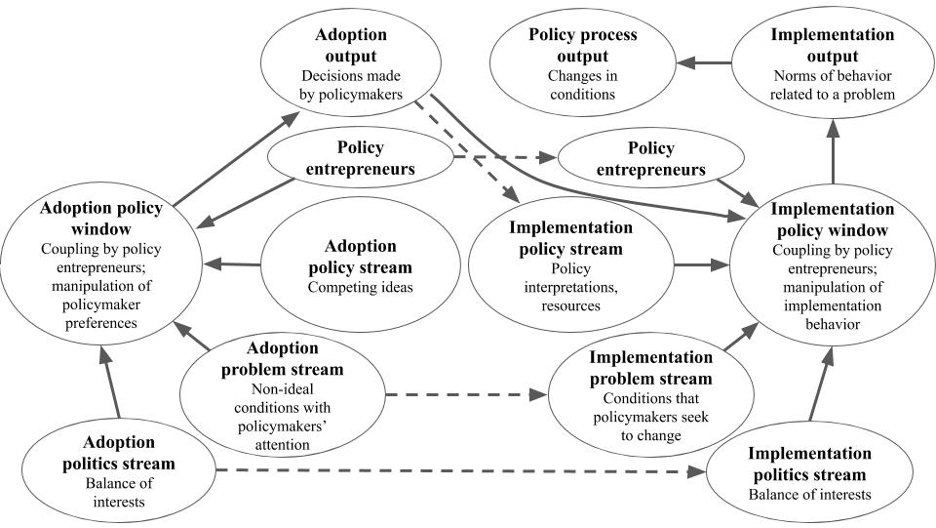
To illustrate how CRT can strengthen our understanding of agenda-setting, I use the Multiple Streams Framework (MSF), a widely used policy process theory. MSF is one example of a broader set of mainstream policy process theories that often rely on similar assumptions about neutrality and rationality. MSF includes several key elements: the problem stream, policy stream, policy entrepreneurs, and policy windows. It is commonly used to explain how agendas form and why some issues gain traction over others.
So, where does CRT come in? CRT includes key tenets such as interest convergence, voice of color, race as socially constructed, and racism as ordinary. These tenets help explain how race is constructed and how power operates through institutions and processes that are often described as “neutral”. When applying CRT to MSF, it becomes easier to see what race-neutral agenda-setting can overlook. For example, problem indicators can be discussed in ways that hide disparities, policy communities can reflect unequal representation, political institutions carry histories of exclusion, and policy windows can open without producing equity-centered change.
The point is not to dismiss MSF, but to show how a CRT lens can reframe MSF’s components and make racialized assumptions more visible in agenda-setting, which then shapes the foundations of policy design. In the article, I use CRT tenets to reinterpret each MSF component as part of agenda-setting, showing how race-neutral assumptions shape which problems and solutions become the foundation for policy design.
Why It Matters
The article’s contribution focuses on how we think about agenda-setting and policy design, especially the assumptions we bring to both. I argue that if we want to address inequitable policy outcomes, policy scholarship should take race consciousness more seriously and do it early. Centering race in agenda-setting theory can strengthen how we explain why certain problems and solutions become “designable”, and why some equity concerns remain sidelined.
Read the original article in Policy Studies Journal:
Wong, J. (2025). Centering Critical Race Theory in Policy Design: A Reframing of Multiple Streams Framework. Policy Studies Journal, 53(3), 795-805. https://doi.org/10.1111/psj.70059
About the Article’s Author(s)

Jonathan Wong (he/him) is a doctoral candidate in the School of Public Administration at the University of Nebraska Omaha. His research interests focus on public administration and public policy, with a particular emphasis on civic engagement, equity, and governance. His research explores how deliberative and participatory practices within public administration intersect with questions of racial equity, inclusion, and governance. Jonathan is also committed to integrating research and teaching to strengthen connections between public service, democratic engagement, and social justice.










 Policy Studies Journal Blog