

Why do policy actors sometimes cooperate with their political opponents while at other times coordinating almost exclusively with like-minded allies?
The Advocacy Coalition Framework (ACF) argues that policy actors coordinate with others who share similar policy beliefs. This tendency, known as belief homophily, has become of the frameworks’ most established findings and a central explanation for the formation of advocacy coalitions. Yet an important question remains: Does belief homophily operate similarly across different political systems?
As part of the internationalization of the ACF research agenda, the concept of coalition opportunity structures was introduced to account for institutional differences between countries. Coalition opportunity structures refer to the institutional contexts within which coalitions operate, particularly differences between consensus and majoritarian democracies. Despite its theoretical importance, the concept has rarely been tested empirically.
In our recent article, we examine whether coalition opportunity structures influence the extent to which belief homophily matters for advocacy coordination.
Hypotheses
The ACF generally expects actors with similar policy beliefs to coordinate with one another. We argue that political institutions influence how strongly this mechanism operates.
In consensus democracies, policy change typically requires agreement among a broad range of actors. Consequently, actors have incentives to coordinate across coalition boundaries and maintain relationships with organizations holding different policy beliefs. In contrast, policy actors can more often pursue their goals through cohesive alliances of like-minded actors in majoritarian democracies. As a result, belief homophily is likely to play a stronger role in shaping coordination.
Based on this argument, we developed two main expectations. First, belief homophily should be a stronger driver of coordination in majoritarian democracies than in consensus democracies. Second, actors in majoritarian democracies may also be more likely to coordinate with influential actors because political influence is particularly valuable in contexts where policy change depends on political competition instead of broad consensus.
Methodology
To test these expectations, we analyzed climate policy subsystems in nine countries representing varying degrees of consensus and majoritarian democracy. The study draws on survey-based network data capturing long-term coordination relationships among governmental organizations, businesses, NGOs, research organizations, political parties, and other key policy actors.
We combined these network data with measures of policy beliefs, actor influence, and institutional context based on Lijphart’s measure of consensus and majoritarian democracy. We then applied a multilevel structural equation model to examine both the direct and indirect effects of coalition opportunity structures on coordination behavior.
Key Findings
Our findings show that coalition opportunity structures shape advocacy coordination.
First, actors in consensus democracies are more likely to coordinate action despite belief dissimilarity. In other words, coordination is less restricted to like-minded actors, and cross-coalition coordination is therefore more common. Conversely, actors in majoritarian democracies are more likely to coordinate with partners who share their policy beliefs. These findings suggest that belief homophily remains important across political systems, but its influence is substantially stronger in majoritarian contexts.
Second, actors in consensus democracies tend to have a larger number of coordination partners. This broader pattern of coordination contributes to greater interaction across belief differences and helps explain why belief homophily is weaker in these contexts.
Finally, we find more tentative evidence that actors in majoritarian democracies are more likely to coordinate with influential actors. While this result should be interpreted cautiously, it suggests that strategic alignment with influential actors may represent an additional coordination logic alongside belief homophily. The results of the structural equation model are shown in Figure 6.
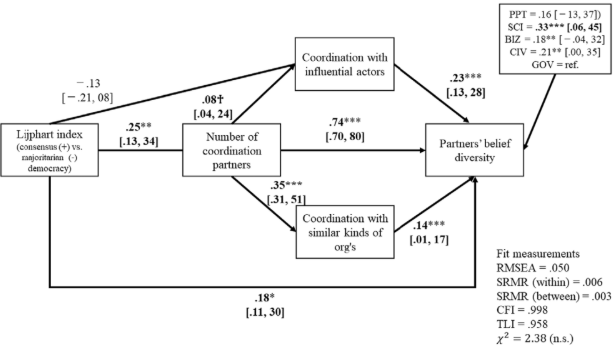
Figure 6. The Results of the Structural Equation Model.
Why It Matters
Our findings contribute to the ACF by providing one of the first systematic empirical examinations of coalition opportunity structures. The study demonstrates that the relationship between policy beliefs and coordination depends on institutional context.
More broadly, the results highlight the importance of comparative policy process research. Advocacy coalitions do not emerge and operate in a political vacuum. The institutional rules of the game shape how actors coordinate, whom they choose as partners, and the extent to which coordination crosses coalition boundaries.
By showing how coalition opportunity structures influence advocacy coordination, our study helps connect macro-level political institutions to meso-level coalition behavior and advances a comparative understanding of advocacy coalitions.
Read the original article in Policy Studies Journal:
Satoh, K., Gronow, A., Ylä-Antilla, T., Delicado, A., Schmidt, L., Swarnakar, P., Wagner, P.M., and Yun, S.J. 2026. “Coalition Opportunity Structures and Advocacy Coalition Coordination in Consensus and Majoritarian Democracies” Policy Studies Journal 54(1): e70067. https://doi.org/10.1111/psj.70067.
About the Article’s Author(s)

Antti Gronow is a senior researcher at the Faculty of Social Science, University of Helsinki, Finland. His research interests range from advocacy coalitions and social networks to political polarization and pragmatism. In addition to Policy Studies Journal, Gronow’s work has appeared in journals such as Governance, Public Administration, JPART and Global Environmental Change. He is one of the chairs of the steering committee of the 14-country comparative research effort “Comparing Climate Change Policy Networks” (see compon.org).

Keiichi Satoh is an Associate Professor at the Faculty of Social Science, Hitosubashi University, Tokyo, Japan. His research interests range from climate change politics and policy processes to social network theory and methods. Like the other two authors of this blog post, Satoh is an active member of the Comparing Climate Change Policy Networks Project. His latest paper is “Ecological Modernization Theory and Climate Action” in the Oxford Handbook of Climate Action (ed. Paul Almedia). He is also the author of the agent-based modeling package for R software, “rABM).

Tuomas Ylä-Anttila is professor of political science at the University of Helsinki. He has published widely on policy processes and advocacy coalitions, climate change politics, policy and communication networks, and social movements in journals such as Policy Studies Journal, JPART, Journal of Communication, Governance, and Global Environmental Change. He chairs the international Comparing Climate Change Policy Networks research initiative (compon.org).

