
When hospitals and schools had to ration life-saving care and educational support during the COVID-19 pandemic, who did the public think should go first? A growing body of research on the social construction of target populations shows that political power and perceptions of “deservingness” shape who benefits from policy. But we know less about whether the public’s view of the same group shifts across different policy contexts. This paper explores whether people without known disabilities are more likely than people with disabilities (PWD) to receive scarce medical and educational resources. To examine this question, the authors conducted a survey during the COVID-19 pandemic, when such resources were rationed.
Hypotheses
The authors offer one main and two alternative hypotheses:
H1: In resource-scarce, zero-sum policy contexts, PWD will be denied health and educational resources at higher rates than people without known disabilities.
Alt-H1a: Regardless of resource scarcity and zero-sum policy contexts, PWD will be prioritized for scarce compensatory educational resources at higher rates than people without known disabilities.
Alt-H1b: In resource-scarce, zero-sum policy contexts, PWD will be deprioritized for life-saving health resources at higher rates than people without known disabilities.
Methodology
During the COVID-19 pandemic, the authors fielded a national representative survey with 2,500 respondents who were recruited through YouGov panels. The researchers employed a conjoint design and used the same survey to conduct two experiments, the first of which addressed medical resources and the second addressed educational resources. In the medical experiment, the survey showed respondents four sets of two patient profiles and asked them to choose which patient should get a hospital’s last ventilator. In the educational experiment, the survey showed respondents three sets of two student profiles and asked them to choose which student should get the last slot for recovery services to combat pandemic learning loss. In both experiments, the researchers created profile attributes that involved disability type, control, gender/racial identity, and reciprocity and randomly varied these attributes. In addition to the two experiments, they asked respondents a series of questions about their feelings toward PWD.
Key Findings
Respondents Deprioritized PWD for Medical Resources
As shown in Figure 2, survey respondents deprioritized PWD for the allocation of scarce medical resources. That is, they were significantly more likely to say that a hospital’s last ventilator should be given to a patient without a known disability than to a patient with a known disability. This finding supports H1.
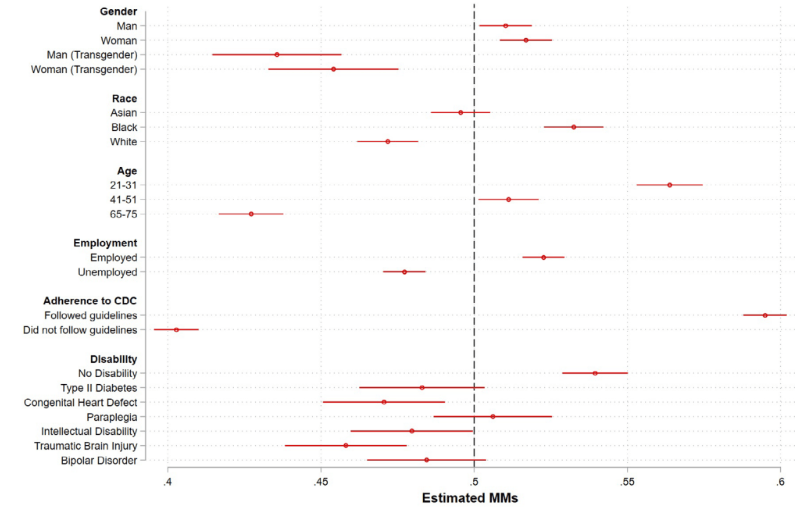
Figure 2. Estimated marginal means of patient characteristics on likelihood of choosing patient for last ventilator.
Respondents Prioritized PWD for Educational Resources
By contrast, as shown in Figure 4, survey respondents prioritized PWD for the allocation of scarce educational resources. That is, they were significantly more likely to say that the last slot for recovery services should be given a student with a known disability than to a student without a known disability. This finding supports the alternative hypothesis, Alt-H1A.
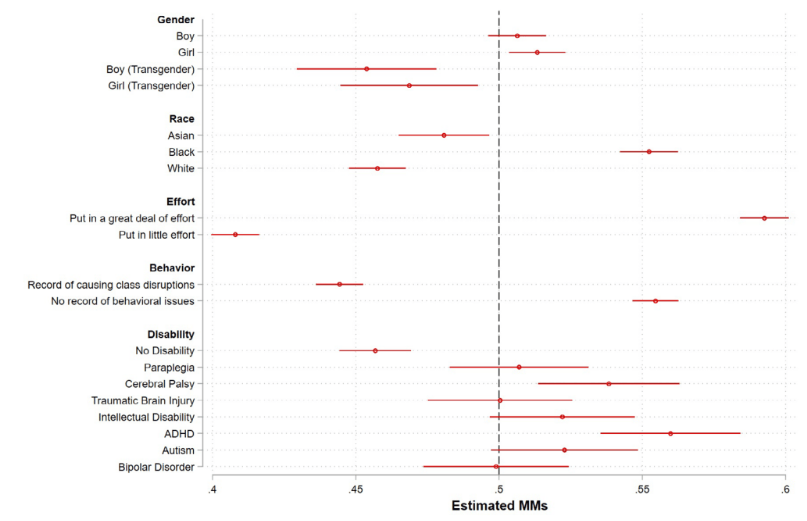
Figure 4. Estimated marginal means of student characteristics on likelihood of choosing student for compensatory education services.
Respondents’ Feelings Toward PWD Correlated With Their Allocation Preferences
Finally, respondents’ feelings about PWD correlated with their preferences about how to allocate scarce medical and educational resources. That is, as shown in Figure 5, respondents who expressed feelings of inspiration and admiration toward PWD were significantly less likely to favor allocations for those without known disabilities when allocating the last ventilator. Respondents showed the same preference when allocating the last slot for recovery services.
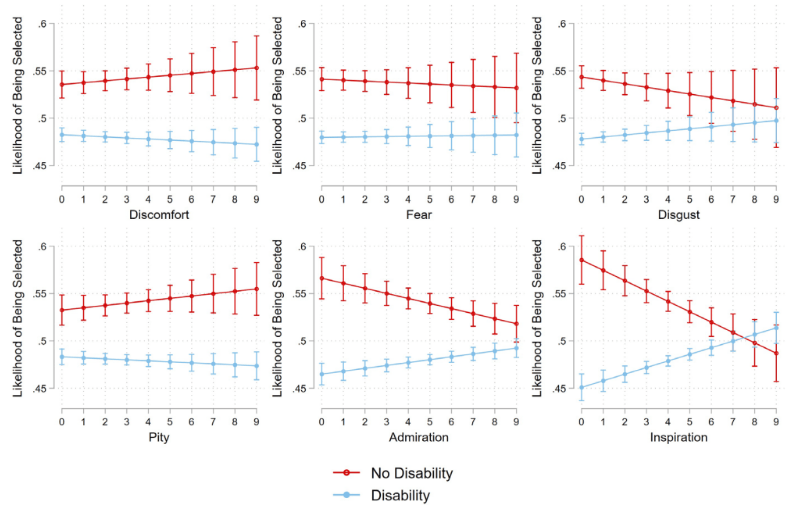
Figure 5. Interaction results for emotions, disability, and likelihood of being selected for last ventilator.
Why It Matters
This article shows that resource scarcity, policy domain, and emotions all shape who the public believes deserves scarce resources. It expands on past research by exploring how perceptions of a given group change based on the policy context. Going forward, the authors encourage researchers to repeat their experiments in other scarcity contexts (i.e., not the COVID-19 pandemic). In addition, they hope scholars will test the robustness of the results they found using a conjoint experiment via other methods and designs.
Read the original article in Policy Studies Journal:
Bell, Elizabeth, Monica C. Schneider, Dara Z. Strolovitch, and Ari Ne’eman. 2026. “Who Deserves Scarce Health and Education Resources? How Policy Context Shapes Target Group Deservingness.” Policy Studies Journal 54(2): e70088. https://doi.org/10.1111/psj.70088
About the Article’s Author(s)
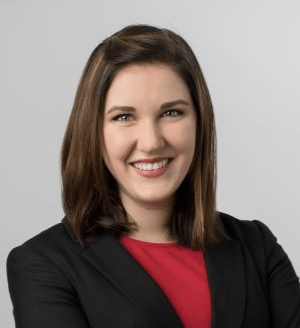
Elizabeth Bell is an Associate Professor at the LBJ School of Public Affairs at the University of Texas at Austin. Her research seeks to improve the governance of programs designed to uplift marginalized communities, improve citizens’ experiences of government, and restore trust in government.
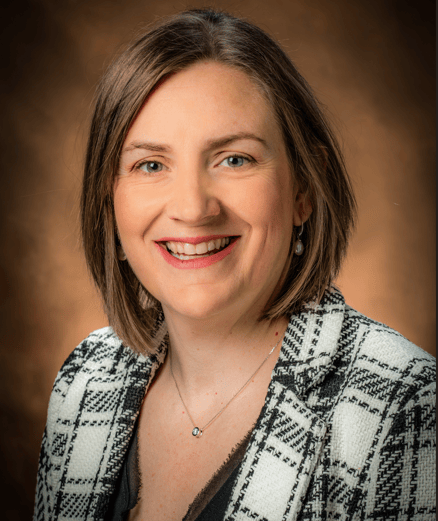
Monica C. Schneider is Professor of Political Science at Miami University in Oxford, Ohio. Her research examines gender and racial stereotypes in American politics, the gender gap in political ambition, and disability politics and policy.
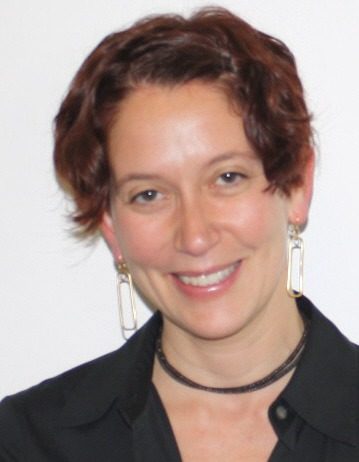
Dara Z. Strolovitch is Professor of Women’s, Gender, and Sexuality Studies, American Studies, and Political Science at Yale University, where she also co-directs the ISPS Center for the Study of Inequality. Her research focuses on the intersecting politics of race, class, gender, and sexuality in the U.S., focusing in particular on their manifestations in advocacy organizations, social movements, and public policy.

Ari Ne’eman is an Assistant Professor of Health Policy and Management at Harvard T.H. Chan School of Public Health. His research focuses on the role public policy can play in facilitating the inclusion of people with disabilities, including long-term services and supports and disability employment and benefits. He previously served as the executive director of the Autistic Self Advocacy Network and as a member of the National Council on Disability.

